Christ Church Cathedral
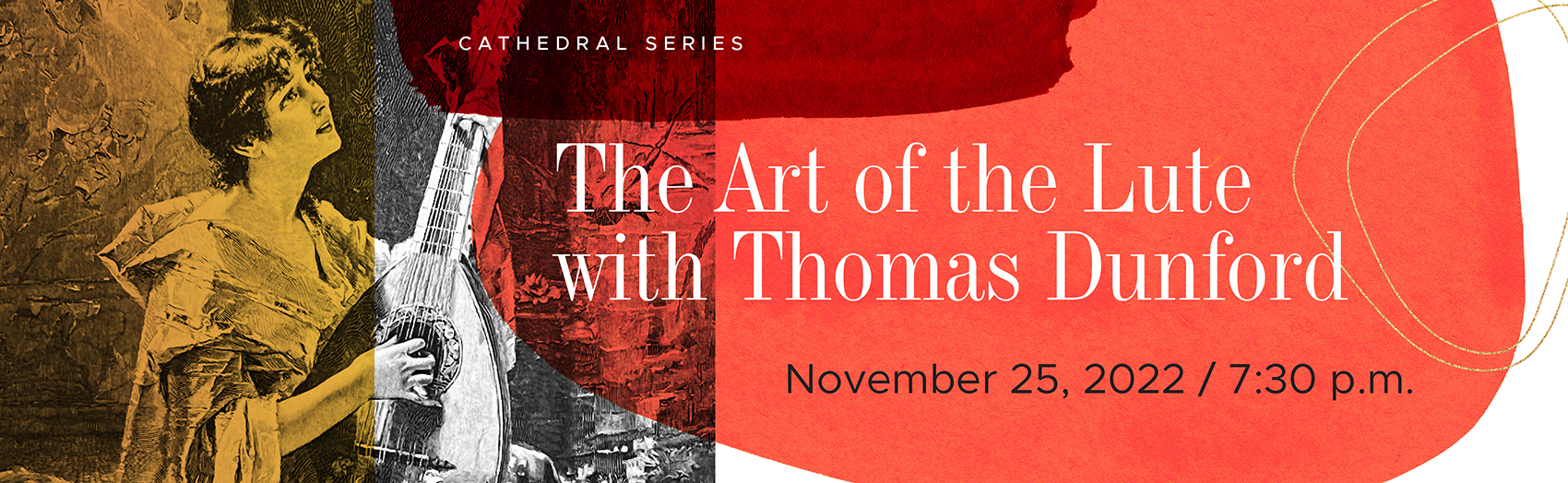
Artists: Thomas Dunford, lute
The lute arrived in Europe from Moorish Spain, spreading rapidly in the 15th century and becoming the most popular instrument among courtiers and commoners in the 16th century. Henry VIII played the lute, and made sure that his three children – the future monarchs Edward VI, “Bloody” Mary, and Elizabeth I – learned it, as well. The lute was also a popular feature in late Elizabethan and early Jacobean theatre, which was enjoying its own golden age in the works of William Shakespeare and Ben Jonson.
John Dowland, an indisputable master of the lute and lute song repertoire, is quite ‘Shakespearian’ in the range of emotion and expression found in his music, and in his ability to absorb and synthesize the cultural influences of his day.
Bach arranged his Fifth Cello Suite for the lute which gives us unsuspected harmonies and a better understanding of how and where Bach would add ornaments. Thomas Dunford, following in Bach’s footsteps, arranged Bach’s First Cello Suite for archlute, a lute with an extended neck and unstoppable bass strings like the theorbo.
Giovanni Girolamo Kapsperger was an Austrian-Italian virtuoso performer and highly original composer whose compositions for the lute and theorbo were fundamental in the development of these as solo instruments.
Pre-concert Talk at 7 p.m.: Suzie LeBlanc in conversation with Thomas Dunford.
This concert is generously supported by José Verstappen and Jonathan Drance.
PROGRAMME
John Dowland (1563 – 1626)
Praeludium
Fortune
A fancy (from the complete Dowland Lute Book by Diana Poulton)
Semper Dowland Semper dolens
Mrs. Winter’s jump
A dream
The king of Denmark’s galliard
Lachrimae
Frog galliard
Girolamo Kapsberger (1580 – 1651)
Toccata I
Toccata VI
Juan Ambrosio Dalza (fl. 1508)
Calata alla Spagnola
Johann Sebastian Bach (1685-1750)
Suite in G Major, BWV 1007
Prélude (1685-1750)
Allemande
Courante
Sarabande
Menuet I
Menuet II
Gigue
Chaconne (from Violin Partita No. 2 in d minor, BWV 1004)
PROGRAMME NOTES
The term “lute”, according to the Hornbostel- Sachs classification system (the equivalent of the library cataloguing Dewey Decimal system but for musical instruments), refers to a large group of stringed instruments from around the world, all characterized by a “string bearer” (the device that holds the strings taut for playing) united with a resonator, with strings running parallel to the surface of the resonator. The earliest surviving evidence for such instruments dates from between the 4th and the 2nd millennium BCE. More specifically, “lute” can refer to a family of European instruments that enjoyed sustained popularity from the medieval era until the end of the eighteenth century. The ancestors of these instruments, short-necked lutes with wooden bodies tapered towards their neck, probably developed in Gandhara, an ancient region including parts of present-day Pakistan and Afghanistan that was heavily influenced by Hellenistic culture. These instruments spread both to China and Japan and to the Arabian Peninsula and surroundings and from there to Europe via Spain. The Arabian ūd (meaning “wood”) was likely named for its remarkable bowl-shaped resonator made not from a gourd or turtle shell but from wooden ribs, each less than 2mm thick, bent over a mould, and glued edge to edge.
The ūd and early European lutes were played using a plectrum and were likely melody instruments, percussive rhythm instruments, or both. Sometime during the fifteenth century, European lutenists transitioned to playing with their fingertips, opening the possibility of performing several musical lines simultaneously and allowing them to play the full texture of popular polyphonic songs on their instrument. Around the same time, lutenists devised various styles of tablature, a kind of music notation that offered the player a map of where and when to place their fingers on the fingerboard, and lutes became tremendously popular with amateur and professional musicians alike. Virtuoso lutenists were among the most highly paid court musicians, and some composers like Giovanni Pierluigi da Palestrina seem to have preferred the lute as the instrument on which to try out their new compositions. At the time of his death in 1552, the luthier Laux Maler had 1100 finished lutes ready for sale and an additional 1300 soundboards ready for installation on instruments!
European lutes existed in a variety of sizes, with various tessituras and numbers of strings. Many were strung with courses or pairs of strings, forcing the player to stroke the strings (rather than pluck them in the way that a modern classical guitarist does), and giving the lute its characteristic, gently buzzy sound. Some lutes, though, like the impressively large, long-necked theorbo used in ensemble music of the seventeenth and eighteenth century were single-strung instead, allowing for better projection in large spaces. Over the course of the seventeenth and eighteenth centuries, players increasingly preferred larger and larger instruments with more strings and wider ranges.
Both lutherie and virtuoso lute playing were skills learned in apprenticeship and often guarded by the secrecy of trade guilds. English lutenist Thomas Mace explained the chief difficulties in learning the lute in his Musicke’s Monument (1676).
A Third and very Considerable Reason is, From the Closeness of Masters in the Art, who (all along) have been extreme Shie in revealing the Occult and Hidden Secrets of the Lute… so that it is no marvel, that it continues Dark and Hidden to All, excepting some Few, who make it their Chief Work to Practise, and Search into its Secrets. Which when they have done, and with Long Pains, and much Labour obtained, THEY DYE, AND ALL THEIR SKILL AND EXPERIENCE DYES WITH THEM. So that the next Generation is still to seek, and begin again a-New, for such Attainments. And it may be noted, That seldome in an Age appears above One or Two who are Excellent or Rare Artists in This kind.
The music on this program is by some of those Rare Artists, mentioned by Mace, whose art lay primarily in improvisation.
John Dowland, though a highly paid lutenist of the Danish and eventually of the English court, one of the most famous musicians in Europe, and a prolific composer and publisher of song, never fulfilled his promises to publish a lute tutor or music for solo lute. His lute solos survive in manuscripts and prints of uncertain accuracy. In cases where a piece survives in more than one source, the musical text is rarely identical, reflecting the extemporized nature of his art – the way that he must have played from his embodied knowledge of dance forms and his memory of songs. Girolamo Kapsberger, an Italian composer and performer on plucked stringed instruments, achieved such esteem in Rome that the influential Jesuit polymath Athanasius Kircher declared him Claudio Monteverdi’s musical successor. Kapsberger served Cardinal Francesco Barberini for thirty years, working alongside the greatest Roman musicians of the day including Girolamo Frescobaldi. Kapsberger drew attention to the theorbo’s possibilities as a solo instrument, improvising and publishing toccatas for that instrument very like those that Frescobaldi created for keyboard instruments – free compositions built from short sections, some recitative-like, others fugal, and others dramatic outbursts of virtuosic flourishes. About Juan Ambrosio Dalza we know little other than that he worked in Milan during the early decades of the sixteenth century and that his music was featured in one of the earliest prints of solo lute music. If this publication is an indication of his musical inclinations, he preferred to play dance music rather than the arrangements of vocal music popular at the time. His Calata alla Spagnola is a set of variations on a popular ground or musical theme.
Johann Sebastian Bach’s personal relationship with the lute is something of a mystery. His will includes mention of a lute; he almost certainly knew Silvius Leopold Weiss, the foremost lutenist of his day who was employed nearby in Dresden; and several of Bach’s students and close colleagues became eminent lutenists, including Johann Christian Weyrauch. Bach’s Partita in C Minor, BWV 997 survives in lute tablature in Weyrauch’s hand, and he also transcribed Bach’s fifth cello suite for the instrument. The transcription of Bach’s Cello Suite No. 1, BWV 1007 on this program follows Weyrauch’s example. Bach himself probably conceived of his works for lute on the lautenwerk, a plucked keyboard instrument strung with gut strings. Bach’s contemporary, Jakob Adlung, captured his generation’s participation in the centuries of admiration for the subtle charm of the lute, when he called its keyboard imitator “the most beautiful of all keyboard instruments after the organ…because it imitates the lute, not only in tone quality, but also in compass and delicacy.”
- notes by Christina Hutten
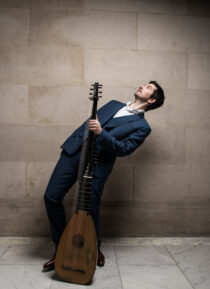
Thomas Dunford, lute
Born in Paris in 1988, Thomas Dunford discovered the lute at the age of nine, thanks to his first teacher Claire Antonini. He completed his studies in 2006 at the Conservatoire de Paris (CRR), when he obtained a unanimous 1st Prize with honors in the class of Charles-Edouard Fantin.
Thomas continued his studies at the Schola Cantorum in Basel with Hopkinson Smith, and participated in several master classes with artists the caliber of Rolf Lislevand and Julian Bream, and in workshops with Eugène Ferré, Paul O’Dette, Pascale Boquet, Benjamin Perrot and Eduardo Eguez. He was awarded his Bachelor’s degree in 2009.
From September 2003 through to January 2005, Thomas gave his first performances playing the role of the lutenist in Shakespeare’s Twelfth Night on stage at the Comédie française. Since then, Thomas has played recitals in New York’s Carnegie Hall and Frick Collection, London’s Wigmore Hall, the Washington Kennedy Center, the Vancouver Recital Society, Cal performances at Berkeley, the Banff center, the Palau de la Musica in Barcelona, the festivals of Saintes, Utrecht, Maguelone, Froville, TAP Poitiers, WDR Cologne, Radio France Montpellier, Saffron Hall. He made numerous solo or ensemble appearances in the most prestigious European festivals including Ambronay, Arc La Bataille, Bozar, La Chaise-Dieu, Nantes, Saintes, Utrecht and many others. He has also performed further afield in England, Scotland, Ireland, Spain, Germany, Austria, Norway, Belgium, Netherlands, Switzerland, Poland, Hungary, Romania, Estonia, Czech Republic, Bresil, Colombia, Chili, Mexico, United States, Israel, China, Japan and India.
Thomas Dunford’ first solo CD Lachrimae recorded for the French label Alpha in 2012, was unanimously acclaimed by critics and was awarded the Caecilia prize of 2013, BBC Magazine calling him the “Eric Clapton of the lute”. His second CD « Labirinto d’Amore » was awarded the « Choc » from Classica magazine.
Thomas is regularly in demand, playing a variety of early plucked string instruments with the ensembles Les Arts Florissants, Akadêmia, Amarillis, Les Ambassadeurs, Arcangelo, La Cappella Mediterranea, Capriccio Stravagante, Le Centre de Musique Baroque de Versailles, La Chapelle Rhénane, Clematis, Collegium Vocale Gent, Le Concert Spirituel, Le Concert d’Astrée, A 2 Violes Esgales, The English Concert, l’Ensemble Baroque de Limoges, La Fenice, Les Folies Francaises, the Irish Baroque Orchestra, Marsyas, Les Musiciens du Louvre, Les Musiciens du Paradis, Les Musiciens de Saint Julien, Les Ombres, Pierre Robert, Pygmalion, La Sainte Folie Fantastique, Scherzi Musicali, La Serenissima, Les Siècles, the Scottish Chamber Orchestra, La Symphonie du Marais…
Thomas is attracted to a wide variety of music including jazz, and collaborates in chamber music projects with conductors and soloists Paul Agnew, Leonardo Garcia Alarcon, Nicola Benedetti, Keyvan Chemirani, William Christie, Jonathan Cohen, Christophe Coin, Iestyn Davies, Lea Desandre, Isabelle Faust, Bobby McFerrin, Philippe Herreweghe, Monica Huggett, Alexis Kosenko, Francois Lazarévitch, Anne-Sophie von Otter, Trevor Pinnock, Patricia Petibon, Sandrine Piau, Anna Prohaska, Hugo Reyne, Anna Reinhold, Jean Rondeau, Skip Sempé, Jean Tubéry…