
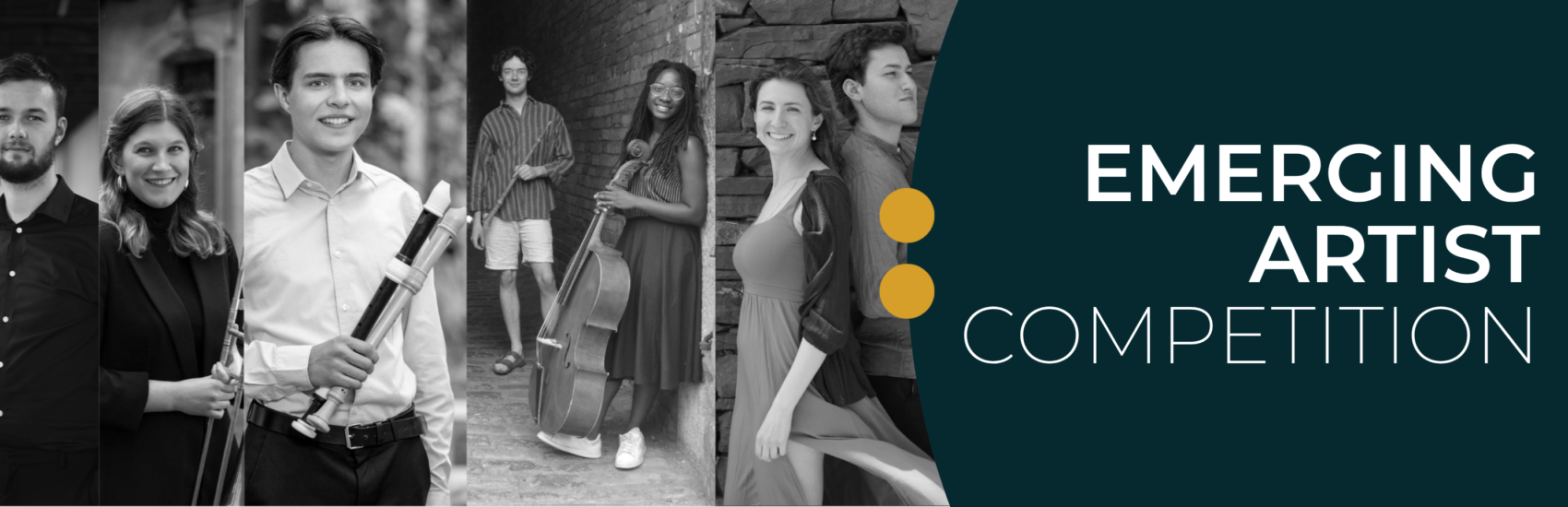
Early Music Vancouver’s Emerging Artist Competition
SUBMISSIONS ARE NOW CLOSED FOR 2026
Stay tuned for this year’s winners in mid-June
We are proudly announcing the fourth edition of our Emerging Artist Competition. This is an online competition for emerging artists 30 and under from around the world. Applicants are invited to create a project based on the following theme: “The future of Early Music.” This competition invites emerging artists to present and share their hopes for the future of early music performance by way of projects, research and/or education. As the next generation of musicians, we want to hear about your approach to early music now and its sustainability.
We encourage you to think up creative ways to present early music with a focus on issues that are important to you.
HOW TO APPLY
Send the following to Sarah Pelzer at sarah@earlymusic.bc.ca by May 15, 2026 with the subject line “EAC Submission 2026”
- Project title and a brief written description
- A 3-5 minute video describing your project
- A 3-5 minute unedited audio/video recording of you or your ensemble playing
- Your resume; if a group, include the group’s resume
Please submit videos and recordings in one of the following formats: MP3, MP4, or as an unlisted YouTube video. Resumes and project descriptions must be provided in PDF format.
Application Details/Rules
- Applications will be accepted from April 1 – May 15, 2026
- Applicants must be 30 years of age or under (Click HERE for MORE DETAILS)
- The competition is open worldwide
- Applicants may include as many supporting musicians in their submissions as desired
This initiative is generously sponsored by Joanie and Samantha Anderson, and an Anonymous Donor.
PRIZES
The Future Prize:
Awarded to a project showing clear, innovative ideas and musical excellence.
$3,500 CAD, your project featured on our website, YouTube channel and social media, plus, a 30-minute interview in our Artist Interview Series.
The Spark Award:
Awarded to a project showing strong creative promise.
$1,500 CAD, your project featured on our website, YouTube channel and social media, plus, personalized feedback on your application by the judges.
The Göttingen Prize:
This is a new special prize in collaboration with the Göttingen International Handel Festival.
Your project featured on our website, YouTube channel and social media, plus an invitation to perform in the prestigious Göttingen International Handel Festival in May, 2027 (Travel and accommodation covered).
Prize amounts are distributed by project, not by the number of musicians who participate in a single project.
JUDGING CRITERIA
LEARN MORE
We are interested in projects that address a need, gap, or question within the field.
We want your project to propose new ways of thinking, making, teaching, or sharing early music.
We will evaluate how your project considers sustainability, relevance, and future impact.
Other criteria:
- Meaningful engagement with one or more of the following Historical Performance Practice pillars:
- Historical knowledge
- Freedom of ornamentation
- Improvisation
- Composition
- Clarity & Intent:
- Is the project’s concept, intention, and potential impact clearly communicated?
- Does your project description address the who, what, where, when, and why?
- Excellence:
- Does your project demonstrate excellence in its research and execution?
- Does your project show signs of readiness and a high-probability of further development?
Previous Winners
Agata Sorotokin & Antonio Pellegrino “A.S.A.P. Duo,” The Hague, The Netherlands
See submission
Their exploration mostly focuses on two recently discovered Neapolitan manuscripts which have yet to be published: MS2-D13 (which contains the music of Rocco Greco and Gaetano Francone) and I-NC 45.1.65 (which compiles fully written pieces and partimenti by Gaetano Greco). Their concert program features works by the Greco brothers, who were among the most prominent musical maestri in Naples in the late 1600s.
“It is a great honour to receive support for a project that carries a deep meaning for us as early musicians. The concert program we’ve created intertwines fully written works from Naples at the turn of the eighteenth century with partially sketched pieces, which we have completed using the clues left by the Neapolitan maestri. We would like to thank EMV’s Emerging Artist Competition team for giving us the opportunity to bring this musical canvas to life — to blur the lines between composer and performer, reuniting these roles within our early music concert life.” – Agata Sorotokin & Antonio Pellegrino
Andreas Kammenos, Remchingen, Baden-Württemberg, Germany
See submission
Developing a project on “The future of early music” means answering the question of what the future of early music is and could look like. It is about preserving a regular audience and at the same time new people to listen. In a world that is always changing, where social media, low-cost leisure activities and the constant search for personal or individual financial fulfilment became the most important things for people, it is not easy to get a wide audience interested in sounds that are mostly new to them and that have an educational feeling on them. That’s why I like to mix early music with other aspects that are lively on their own and are easier to keep alive than an art form that needs to be practiced. And that is why I wanted to use technologies from everyday life and the factor “building” as a supporting element for the future.
The aim of Andreas project entitled Cuckoo call is to develop a platform, a webpage and/or an app, that enables visitors to call up audio and video recordings in various locations. In this way, places that had a significant influence on music between 1400 and 1800 and where decisive stylistic developments took place are to be brought to life, and on the other hand sounds are made visible and music can be communicated in a very simple way.
Twisted Pearl, Montréal, Quebec
See submission
“Terminus Montreal,” the final concert of his Montréal-based baroque band Twisted Pearl’s 2025 season, is its first concert dedicated entirely to new music (though new compositions make an appearance at every concert). Their band’s tendency to include recent compositions relies on their shared belief that a composer need not be dead to be good, and the best result comes when the composer and performer are united through the whole process, including the performance. New music will always possess a certain advantage over historical compositions because of the inherent freshness of what is new. They have no intent to abandon the historical music we love so much, but rather, they wish to include new works alongside it to irrefutably solidify its place in the present and respond to the needs of our day to create a future for early music.
Korneel Van Neste & Emily Saville, Ghent, Belgium
See submission
Korneel and Emily want to bring more awareness to the often overlooked historical tools and methods that can still be applicable today. They believe that using historical approaches such as canons and improvisation, and by engaging more directly with the sources themselves, we can reach a deeper understanding of our genre, and continue breathing new life into Early Music as a movement. In their video we demonstrate that tools such as the Guidonian hand are not simply remnants of a time gone by, but that they are practical, engaging, and creative, and can be introduced to children who can then use them to make music. They also make a case for practising and importantly, performing from original sources so that we can experience more of the creative freedom of ficta choices and text placement for example that would have been a daily part of music making historically. There is no need to exclude young people from this, as we begin to realise that any insecurities beforehand are often projections from us, the adults.