Christ Church Cathedral
Silk Strings
A Chinese-Baroque Musical Dialogue

Artists: Emma Parkinson, mezzo-soprano with the EMV Festival Players & Chinese instrumentalists, directed by Christina Hutten and Edward Top.
Pre-Concert Chat: 06:45pm hosted by Debi Wong with Christina Hutten, Edward Top, Dorothy Chang and Lan Tung.
Runtime: Approximately 70 min + 20-minute interval
East meets West in this dialogue between Baroque and traditional Chinese instruments, whose musical methods of improvisation and ornamentation are remarkably alike.
Combining Baroque and Chinese musical instruments may not be a new idea. Historical records show that musical scores by famous Baroque composers like Corelli and Rameau were discovered in China, and European instruments such as harpsichords and violins were frequently presented as royal gifts in the 17th and 18th centuries.
Join us for this exciting blend of traditional Chinese melodies with Baroque music. Works by Rameau and more will be performed alongside Chinese traditional songs and new compositions by Edward Top, Dorothy Chang, and Lan Tung, played by a diverse ensemble of Baroque players and Chinese instrumentalists.
Click here for concert programme
Click here to read programme notes by Christina Hutten
Generously sponsored by Pam Ratner & Joy Johnson

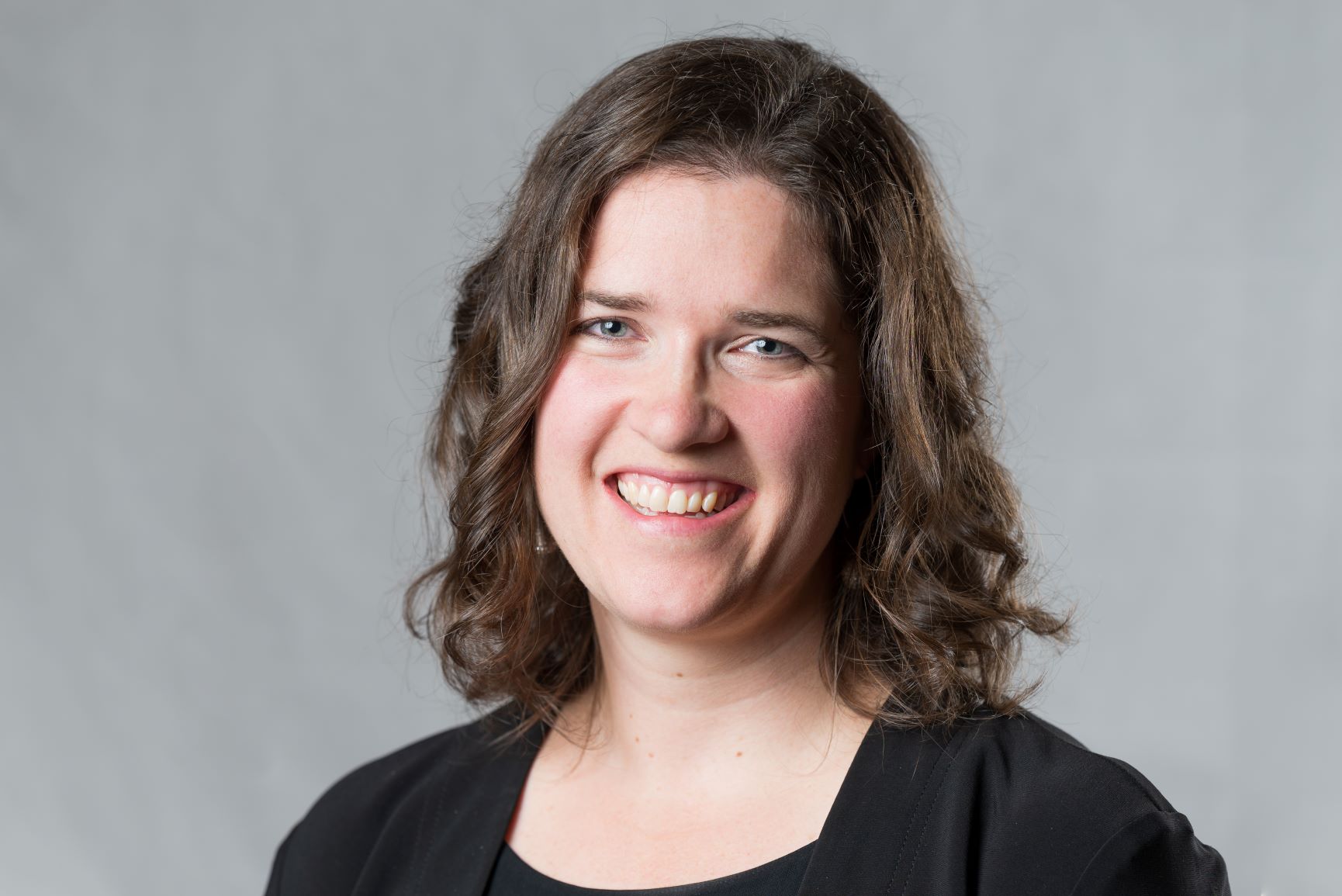
Emma Parkinson, mezzo-soprano
Chinese-Canadian mezzo-soprano Emma Parkinson has performed across Canada and internationally, she has been hailed as “an outstanding voice” (La Scena Musicale). This season, Emma performed in the world premiere of Chinatown with City Opera Vancouver, and in the Canadian premiere of Du Yun’s Angel’s Bone with re:Naissance Opera and Sound the Alarm Music Theatre. Past seasons have seen Emma perform with Vancouver Opera as Jade Boucher in Jake Heggie’s Dead Man Walking, and with Pacific Opera Victoria in the Canadian premiere of Rattenbury.
Emma has appeared with Burnaby Lyric Opera in the title role of Carmen, and, as Suzuki in Madama Butterfly. As an alumnus of the Atelier lyrique of Opéra de Montréal, she performed Orlofsky in Opéra de Montréal’s production of Die Fledermaus. In Europe, Emma debuted with Seefestspiele Berlin as Mercédès in Carmen, and performed a concert with Les Chorégies d’Orange in France. Her concert highlights include soloist appearances with the Alberta Baroque Ensemble, Vancouver Bach Choir, Kingston Symphony Orchestra, Slovak State Philharmonic Orchestra, Montreal Symphony Orchestra, and the Orchestre Métropolitain, under the baton of Yannick Nézét-Seguin. Emma was honoured to perform as a special guest soloist for Ballet BC’s 35th Anniversary Gala.
Christina Hutten, director
Organist and harpsichordist Christina Hutten has presented recitals in Canada, the United States, and Europe. She performs regularly with Pacific Baroque Orchestra and has appeared as concerto soloist with the Okanagan Symphony, the Vancouver Academy of Music Symphony Orchestra, and the Arizona State University Chamber Orchestra. Christina is also an enthusiastic teacher. She coaches and coordinates the early music ensembles at the University of British Columbia and has given masterclasses and workshops at institutions including the Victoria Baroque Summer Program, Brandon University, the University of Manitoba, Wilfrid Laurier University, Canada’s National Music Centre in Calgary, and the Tafelmusik Baroque Summer Institute.
Funded by a generous grant from the Canada Council for the Arts, she pursued historical keyboard studies in Europe with Francesco Cera, François Espinasse, and Bernard Winsemius. She participated in the Britten-Pears Programme, led by Andreas Scholl and Tamar Halperin, for which she was awarded the Loewen Prize. Christina obtained a master’s degree in Organ Performance from Arizona State University under the direction of Kimberly Marshall and an Advanced Certificate in Harpsichord Performance from the University of Toronto, where she studied with Charlotte Nediger. She is now a doctoral candidate in musicology at UBC.

Edward Top, director, composer
Composer Edward Top studied composition and violin at the Rotterdam Conservatoire in The Netherlands. He primarily studied with Peter-Jan Wagemans, but also worked with Klaas de Vries, Peter Eötvös, Pierre Boulez, and Luciano Berio. After living and traveling in the Far East for several years he settled in England in 2003, where he completed a Master’s Degree in musicology at King’s College London where he met with George Benjamin. East-Asian culture remains a predominant presence in Top’s life.
Top is currently the Head of the Composition Department at the Vancouver Academy of Music since 2014. He also maintains a close relationship with the Vancouver Symphony Orchestra, who commissioned seven, and performed ten of his works when he served as its Composer-in-Residence from 2011-2014. The VSO and conductor Bramwell Tovey played the commissioned work Totem in Seattle, Los Angeles, Las Vegas, and Phoenix on a US West Coast tour in 2013. The work Helix, Top’s latest commission for the VSO, was premiered during its centennial season’s opening in 2018, conducted by music director Otto Tausk.
In January 2017, the Toronto Symphony Orchestra, conducted by Peter Oundjian, premiered the commissioned work Eruption on tour in the Canadian cities of Ottawa, Montreal, and Toronto.
Dorothy Chang, composer
Described as “evocative and kaleidoscopic” and “beautiful and gripping”, the music of composer Dorothy Chang reflects an eclectic mix of musical influences ranging from popular and folk music to elements of traditional Chinese music. Many of her works are inspired by place, time, memory, and the question of cultural identity.
Dorothy’s catalog includes over eighty compositions with a particular interest in cross-cultural and interdisciplinary collaboration, including works for mixed Chinese and Western ensembles as well those involving staging, movement, theatre and dance. Her interest in cross-cultural and interdisciplinary collaboration has led to some of her favourite projects including: a radio play adaptation of Gertrude Stein’s White Wines for four vocalists and speaking percussionist; a double concerto Gateways for PEP (Piano and Erhu Project), Flying White (飞白) for mixed Chinese and Western ensemble with Wen Wei Dance; and Shelter, a collaboration with harpist Janelle Nadeau and filmmaker Sean Shaul. Her most recent orchestral work, Precipice, was commissioned by the Montreal Symphony Orchestra and performed as part of the orchestra’s 2023 US tour to the Kennedy Center and Carnegie Hall.
Dorothy’s music has been featured in concerts and festivals across North America and abroad, with performances by the Albany Symphony, Calgary Philharmonic, Houston Symphony, Indianapolis Symphony, Manitoba Chamber Orchestra, Montreal Symphony, New Jersey Symphony, Pittsburgh Symphony, Saint Paul Chamber Orchestra, Seattle Symphony, Toronto Symphony, Vancouver Symphony, Vancouver Island Symphony and Victoria Symphony Orchestras, as well as by chamber ensembles including the Chai Found Music Workshop (Taiwan), Chicago Saxophone Quartet, Collage New Music, eighth blackbird, the Emily Carr String Quartet, Land’s End Ensemble, Music from China, the Orchid Ensemble, PhoeNX Ensemble, the Smith Quartet, Sound of Dragon, Soundstreams, Standing Wave, Turning Point Ensemble, and the Vancouver Intercultural Orchestra, among others.
In 2003, Dorothy joined the music faculty at the University of British Columbia, where she is currently a Professor of Music.
Lan Tung 董籃, erhu 二胡, composer
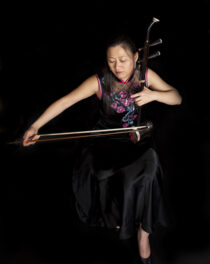
Crossing between Canada’s new music, improvised music and world music scenes, Lan is the artistic director and resident composer of Sound of Dragon Ensemble, Orchid Ensemble, Vancouver Erhu Quartet, Crossbridge Strings, Proliferasian, and So
Originally from Taiwan, Lan has studied graphic score with Barry Guy, improvisation with Mary Oliver, Hindustani music with Kala Ramnath, Uyghur music with Abdukerim Osman, and Mongolian horsehead fiddle with Bayar, in addition to her studies of Chinese music. Lan has toured in Europe (Germany, Switzerland, and the Netherlands), Asia (China, Taiwan, Singapore, Indonesia), Chile, and North America (US, Canada, Mexico).
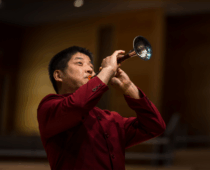
Zhongxi Wu 吳忠喜, suona 嗩吶, sheng 笙
Hailing from the 4th generation of suona players in his family, Zhongxi graduated from the Heilongiang Performing Arts University in 1993. He has toured in China, Japan, the USA, Europe, and Canada, and has been featured in numerous solo, chamber ,and orchestral recordings and performances, spanning a diverse range of styles including traditional Chinese music and opera, contemporary music, experimental theatre, Celtic traditions, and jazz collaborations. “Jasmine Jazz”, his collaboration with the Vancouver Chinese Ensemble and the Jodi Proznick Trio won the Best Instrumental Artist at 2023 Western Canada Music Awards.
As suona and sheng soloist, he premiered Rita Ueda’s double concerto “Birds Calling…From the Canada in You” with the Orchestre Métropolitain de Montréal in 2022. Subsequently, he performed this work to great acclaim in London, UK with the Philharmonia Orchestra in 2023, and in 2024, with the Esprit Orchestra in Toronto, and the Orchestra of St. Luke’s at Lincoln Center in New York, working with conductors Alexandre Bloch, Nicolas Ellis, Alex Pauk, and Steven Mercurio. He has taught at the University of British Columbia and is currently a faculty member at the Vancouver Symphony Orchestra School of Music.
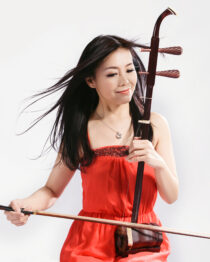
Jun Rong 戎峻, erhu 二胡
Jun has appeared at many concerts, festivals, recordings, and CBC radio broadcast. She is a member of Vancouver Inter-Cultural Orchestra, Vancouver Erhu Quartet, and Silk Road Music Ensemble. She performs as a duo with harpist Lani Krantz. Jun was a guest soloist with the Victoria Symphony, Calgary Symphony, and Vancouver Symphony Orchestra, as well as the internationally renowned Vega String Quartet.
Jun has released a number of CDs, including one featuring the master works of Tian-hua Liu, the most important Chinese composer for erhu music in the 20th century. Jun teaches the erhu at the Capilano University. After graduating from the China Music Academy in Beijing, Jun joined the China Opera & Dance Orchestra before making Vancouver her new home.
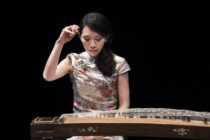
Dailin Hsieh 謝岱霖, zheng 箏
Dailin is a vibrant zheng player based in Vancouver. She graduated from Taiwan’s National Tainan University of the Arts and received a Master’s Degree in Ethnomusicology from National Taiwan Normal University. Aside from receiving numerous awards for her artistry, she has premiered numerous groundbreaking works by Taiwanese and Canadian composers to critical acclaim. Dailin has performed as a soloist with Turning Point Ensemble, Allegra Chamber Orchestra,Taipei Municipal Chinese Orchestra and Little Giant Chinese Chamber Orchestra (Taiwan & European/China/Canada tours).
Dailin is a member of the JUNO nominated Orchid Ensemble, Naadaleela Ensemble, Sound of Dragon Ensemble, BC Chinese Music Ensemble, Qing Ensemble, 88 Strings, and Sounds Global Ensemble. She is a regular collaborator with Music on Main, Vancouver Inter-Cultural Orchestra, and BC Chinese Orchestra. Dailin released contemporary solo CD “Zheng Image” (2014), nominated by Taiwan’s Golden Melody Awards.
Sound of Dragon Society
The Sound of Dragon Society is the only presenter in Canada devoted to presenting contemporary music of Chinese roots or influences. The society preserves ancient traditions of Chinese music and celebrates diversity and creativity in the contemporary applications of this music, resulting from the interaction between musicians of various ethnic and musical backgrounds. Through the bi-annual Sound of Dragon Music Festival, we bring together internationally renowned artists to collaborate with Vancouver musicians. Debuted in 2016, the Sound of Dragon Ensemble gathers musicians and instruments from the East and the West to perform new cross-cultural works and tour internationally.
In addition, we produce/present various innovative projects that showcase the Chinese instruments/musicians in different contexts. The Sound of Dragon Society represents the creativity and diversity of Vancouver’s “Chinese music” community, which has expanded beyond the traditional definition based on ethnic background to include the abundant innovative cross-cultural collaborative projects. With particular emphasis on contemporary application of Chinese traditions, the society supports, presents, and encourages the works of our musicians, composers, and collaborators. With a broader definition of “Chinese music”, it aims to stimulate the Chinese music community to embark on new projects and directions. By presenting musicians and ensembles from different ethnicities, nationalities, and musical trainings/genres, the Sound of Dragon Society re-defines Chinese music and reflects Canada’s multicultural environment and a highly creative music scene.