• My Account
  • Cart
  • About
    • Who is Early Music Vancouver
    • What is Early Music?
    • OUR INSTRUMENT COLLECTION
    • Employment Opportunities
    • Annual General Meeting 2025
    • 2024/25 Annual Report
  • Pacific Baroque Orchestra
    • About
    • August 7 | Vivaldi’s The Four Seasons
    • December 20 | Festive Cantatas
    • October 17 | A Little Night Music with Mozart 
    • March 25, 2027 | Handel’s La Resurrezione
  • EVENTS
    • Summer Festival 2026: The Power of Music
    • EMV’s 2026-2027 Main Season
    • Digital Concert Hall
    • Free Events
    • Past Events
  • Learn
    • PROGRAMMES
    • Artist Interviews
    • Instrument Videos
  • Support Us
    • Donate Now
    • Corporate Opportunities
    • Volunteer
    • Host an EMV Musician
  • Ticketing Info
    • BOX OFFICE
    • Gift Vouchers
    • Venues
  • Press Centre
    • Media Releases
    • EMV PRESS KIT
    • EMV in the News
Early Music Vancouver
  • My Account
  • Cart
  • Donate
  • Buy Tickets
  • Gift Vouchers
  • Get our newsletter
Toggle Menu
  • About
    • Who is Early Music Vancouver
    • What is Early Music?
    • OUR INSTRUMENT COLLECTION
    • Employment Opportunities
    • Annual General Meeting 2025
    • 2024/25 Annual Report
  • Pacific Baroque Orchestra
    • About
    • August 7 | Vivaldi’s The Four Seasons
    • December 20 | Festive Cantatas
    • October 17 | A Little Night Music with Mozart 
    • March 25, 2027 | Handel’s La Resurrezione
  • EVENTS
    • Summer Festival 2026: The Power of Music
    • EMV’s 2026-2027 Main Season
    • Digital Concert Hall
    • Free Events
    • Past Events
  • Learn
    • PROGRAMMES
    • Artist Interviews
    • Instrument Videos
  • Support Us
    • Donate Now
    • Corporate Opportunities
    • Volunteer
    • Host an EMV Musician
  • Ticketing Info
    • BOX OFFICE
    • Gift Vouchers
    • Venues
  • Press Centre
    • Media Releases
    • EMV PRESS KIT
    • EMV in the News
Home  >  Early Music Vancouver Past Events  >  Handel: Hallelujah & Trumpets!

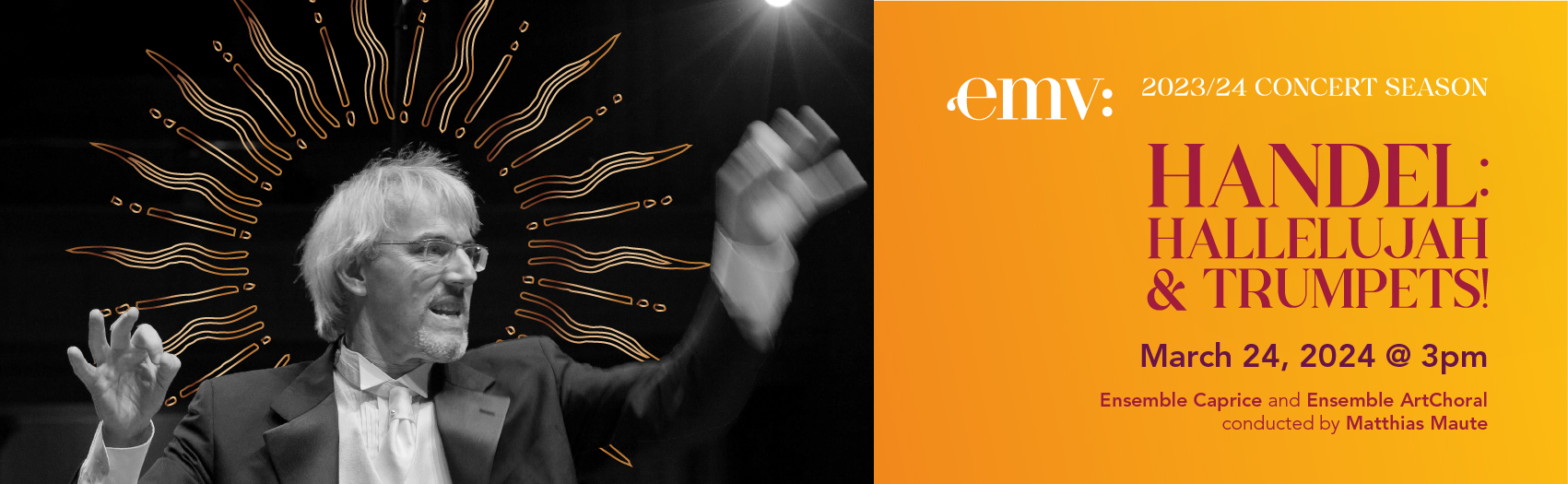
Handel: Hallelujah & Trumpets!

Sunday, March 24th, 2024 | 3:00 p.m. Chan Centre for the Performing Arts


Artists: Ensemble Caprice and Ensemble ArtChoral directed by Matthias Maute

Experience the splendour of Handel’s music!

“Expertly framed by Maute’s intuitive conducting… Ensemble Caprice delivered fully on its reputation as a premier baroque orchestra and a compelling voice on the Canadian contemporary music scene.” (La Scena)

Eternal Source of Light Divine was George Frideric Handel’s first and only court ode and one of his earliest attempts to win the hearts of English listeners with radiant music in their own language. Blessed are they that Considereth the Poor was Handel’s last anthem and a celebration of everyday charity rather than royal power. This concert brings together these two bookends of Handel’s career in England to frame a collection of the composer’s most beloved melodies from the worlds of opera, orchestral, chamber and keyboard music. The programme shows why Handel’s own work has come down to us as an “eternal source” of musical delight, and is complemented by a sparkling setting of the Magnificat by Handel’s contemporary, Johann David Heinichen.

This concert is generously sponsored by Sharon Kahn and Barrie MacFadden

There will be a pre-concert chat with Matthias Maute hosted by composer & writer David Gordon Duke at 2:30 p.m.

Come early to rehearse a special piece – the famous Hallelujah Chorus – with Matthias and participate in an audience ‘singalong‘ during the show!

Run time: 75 min + 20 min intermission.


PROGRAMME

George Frideric Handel (1685-1759)
Ode for the anniversary of the Queen Anne Eternal Source of Light Divine HWV 74 

J.D. Heinichen (1683-1729)
Magnificat in A major  (Seibel 90)

INTERVAL 

George Frideric Handel
Ombra mai fu (from Serse HWV 40) 
I rage, I melt, I burn (from Acis and Galatea, HWV 49)
Lascia ch’io piange (from Rinaldo HWV 7)

G. Ph. Telemann (1681-1767)
Concerto for recorder and flute in e minor

G. F. Handel
Anthem for the Foundling Hospital: Blessed are they that considereth the poor HWV 268 

‘Hallelujah’ from Messiah (HWV56)*

* Performed with audience members as a ‘singalong’
Ensemble Caprice

Since it was founded by flautist Matthias Maute three decades ago, Ensemble Caprice has made its mark as one of the most sought-after ensembles on the classical music scene.

Caprice has gained a solid reputation for its innovative programming and vibrant, compelling performances.The musicians of Ensemble Caprice have travelled to the four corners of the globe, giving performances in dozens of countries on four continents. It has been featured at many prestigious festivals around the world including the Lufthansa Festival of Baroque Music in London, the Felicia Blumental International Music Festival in Tel Aviv, Musikfestspiele Potsdam Sanssouci in Germany, the Boston Early Music Festival, Ottawa Chamber Music Festival, the Elora Festival and the International Festival Domaine Forget. This impressive roadmap bears witness to the fact that Caprice is recognised as being one of today’s leading baroque ensembles.

Besides its international tours, the group performs a regular Montreal concert series in the Montreal Museum of Fine Arts’ Bourgie Hall.Ensemble Caprice also has a flourishing recording career, with some twenty recordings on the Analecta, ATMA Classique and Antes labels, sold in nearly 50 countries. These recordings have received numerous critical distinctions, including a Juno Award and four Prix Opus awards to name only two of many.
Ensemble ArtChoral

Ensemble ArtChoral is a professional choir steeped in the grand tradition of choral music in Quebec for over 40 years, with the mission to present professional choral music in Québec, Canada and internationally.

Ensemble ArtChoral is recipient of the PRIX OPUS Musical Event of the Year 2020. Ensemble ArtChoral has established Maison symphonique as home for its Montreal concert series and is the professional choir in residence 2023-2027 with Festival Classica and le Nouvel Opéra Métropolitain.

With extensive touring in Canada and Quebec, ArtChoral has provided outstanding choral music to cities and communities in all 10 Canadian provinces.  ArtChoral’s annual tour with Handel’s Messiah has become a staple of cultural life in Quebec.

The choir’s director, Matthias Maute, recipient of two JUNO Awards, has earned an international reputation for his work as artistic director of Ensemble ArtChoral, Ensemble Caprice, the Bach Society of Minnesota and as co-artistic director of the Montreal Baroque Festival.
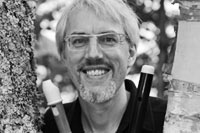
Matthias Maute, conductor

Maestro Maute concertizes as a member of the New York based ensemble REBEL in North America and Europe.  He has been invited to perform as guest soloist or conductor by the world’s most eminent baroque orchestras, including: Seattle Baroque, the Portland Baroque Orchestra, the Cleveland Baroque Orchestra, and the Magnificat Baroque Ensemble. In recent years he has also been invited to conduct other renowned orchestras, including I Musici de Montreal and Symphony of Nova Scotia. Mr. Maute is celebrated for his work as artistic director and conductor of Ensemble Caprice and tours extensively with the ensemble, being regularly invited to take part in prestigious festivals around the globe.

Under his direction, Ensemble Caprice was granted an esteemed JUNO award in 2009 for best vocal/choral classical music album of the year. His compositions are highly regarded and have been published by Breitkopf & Härtel, Amadeus, Moeck, and Carus. He has some thirty recordings to his credit on the Analekta, Vanguard Clasics, Bella Musica, Dorian, Bridge and ATMA Classique labels. Maestro Maute teaches at McGill University’s Schulich School of Music and at the Faculty of Music of the Université de Montréal.

read more...


Media

1254 W 7TH AVE
VANCOUVER, BC, V6H 1B6

(604) 732-1610
staff@earlymusic.bc.ca

  • About EMV
    • What is Early Music?
    • Staff
    • Partners
    • Board of Directors
    • Venues
  • Education & Community
    • BC Scholarship Programme – 2026/2027
    • OUR INSTRUMENT COLLECTION
  • Press Centre
  • Join Our Mailing List
Facebook URLTwitter URLYoutube URLInstagram URL

Copyright © 2026 EARLY MUSIC VANCOUVER | EMV | PHOTOS BY JESS MACALEESE, MARK MUSHET AND JAN GATES.
CONTACT EMV FOR INDIVIDUAL CREDITS. | site by DFS Digital Fusion Studios web designAND MEDIUM RARE Medium Rare Interactive

Een Romantische Johannes Passion

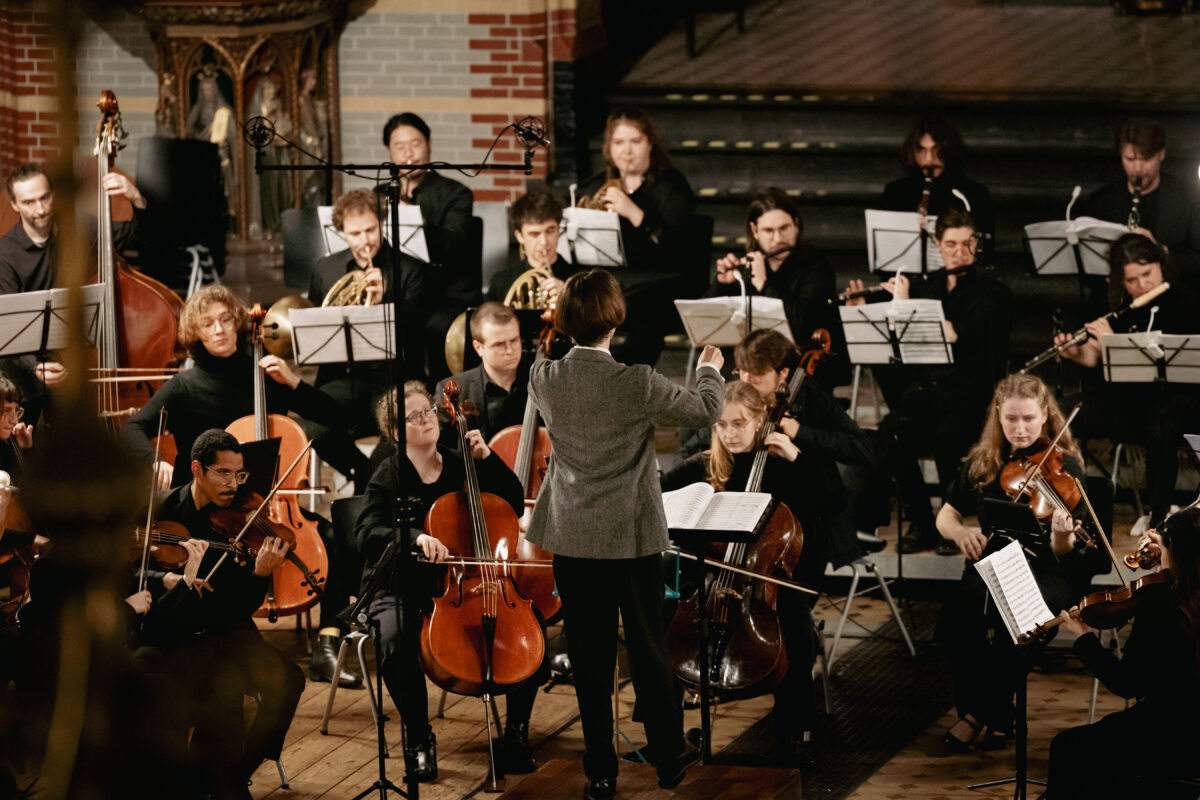
Historical Performance has been steadily looking toward the nineteenth-century as a source of inspiration, and Orchestra Lagrandt wants to lead the charge into Romantic orchestral performance practice. As an orchestra of ambitious musicians in their twenties from 25 different nations, we aspire to represent the voice of the new generation in Historical Performance.

Een Romantische Johannes Passion is an ongoing project to reimagine the Johannes Passion of J. S. Bach in a late nineteenth century style. The first Passion revivals in the Netherlands took place in Rotterdam in 1870, featuring large symphonic orchestrations, and a radically different musical language than that of the HP and modern classical worlds. In our initial performance with the Tangram Chamber Choir, we pushed the boundaries of what Romantic Bach might have sounded like: exploring changes in orchestration, stoic tempi, rubato, phrasing, nineteenth- century bowing practices, and even portamento. We plan to establish this project as an annual tradition every Easter season, reworking the arrangement each time in the spirit of Romantic spontaneity.


One of the wonderful things about the Historical Performance movement is that we are able to use forgotten practices, this time hailing from the nineteenth century, to present such a beloved and well known-work in a new light.

The world is familiar with stories of clever forgers whose life’s mission is to cunningly reproduce the light and shadows of historical masterworks, from Vermeer’s brushstrokes to Da Vinci’s proportional precision… but what if these crimes of craftsmanship were to extend beyond the visual arts? What if the pieces we know to be by Palestrina, Monteverdi or even Johann Sebastian Bach were in fact stylistic copies, artfully composed by a secret circle of music forgers and passed off as the work of the greats? What if those music forgers are at work as we speak? 

This premise inspires our original program The Music Forgery Workshop. Our early music comedy imagines the lives of such a circle of musical criminals, offering a fresh and lively presentation of historical compositions, not as museum artifacts but as living works in progress. The workshop itself is set up on the stage and its members carry forth the plot in music and words. A narrator in the role of a suspicious inspector lends the performance a theatrical flow. The listener is invited into a satire on high society’s art commerce, while the performers make fun of themselves for having devoted their lives to the niche subject of historical music performance. 

Violinist Elizabeth Sommers combines her skills and experience in traditional music with expertise in the performance and improvisation of medieval and Renaissance repertoires. Multi-instrumentalist Eliot X. Dios (keyboards, bagpipes and flutes) works wholeheartedly to employ storytelling techniques developed through the history of literature and cinema in his early music concerts. Composer Gunnar Haraldsson (violin, guitar) seeks to translate the forms and intentions of early composition for a modern audience. Halldór B. Arnarson (keyboards, voice) has devoted his career to bringing musical craftsmanship from the era of counterpoint to the attention of the public and comedy to the early music scene. Singer and storyteller Ásta S. Arnardóttir brings the storyline to the public with personal immediacy, and through her character work defines the different veins of the show, sometimes hilarious and sometimes serious. 

The story is narrated by the character of the Inspector, acted out by the members of the MFW, and told in rhyming Icelandic verse in one musical pillar of the show, a madrigal composed by our very own 

Halldór in the style of Monteverdi. The show has an entertaining educational dimension. The audience is exposed to a broad sweep of historical and musical information in a condensed form, necessary to understand the musical humour, while dramatic rhythm and scenographic effects prevent overwhelm. We also place particular emphasis on theatrical illusion and synchronisation. One example appears in the opening scene, in which the inspector is seen watching television. On stage, this becomes a complex exercise in coordination: each time the inspector presses a button on the remote control, the musicians instantly switch pieces, creating the impression of rapidly changing television channels. 

This opening scene establishes the tone of the entire show, comical and satirical in its storytelling and diverse in its musical language. It not only introduces the wide range of musical styles that appear throughout the performance, but also functions as the plot’s inciting incident, as the inspector hears a news report about the discovery of a previously unknown concerto by Vivaldi. 

Another important scene takes place when one forger is alone on stage in low light, perusing books on medieval music, while the musicians perform and sing offstage, sounding his audiation as he reads. This intimate moment evokes the sleepless nights spent studying facsimiles and learning historical compositional techniques, by which the forger acquires the inspiration and the expertise necessary to his art, and reveals a hidden side of musical performance: the immense amount of study and preparation that precedes the moment on stage. This setting also creates space for visual and musical comedy, as seen in the trailer video, where a 14th-century melody is played backwards because Halldór is unknowingly reading the facsimile upside-down, only realising the mistake when the music begins to sound absurd. 

Fun and friendship are at the heart of the whole project, though the link between music and crime is an important historical consideration. Classical music was often used as the demonstration of a monarch’s power, music teaching as a cover up for secret affairs, and pieces were published under another’s name for profit. Such examples of “inappropriate practices” carry an exciting and attractive element for the audience which the MFW seeks to exploit. Under this light-hearted surface lies a more serious layer of questions concerning our present-day existence, such as excessive materialism in high society and the threat posed on human craftsmanship and skill by the rise of artificial intelligence. 

Please Note:

The main applicant and creative/intellectual driver of the project must be 30 or under (on May 15th).

The average age of all musicians must not be older than 32, and the maximum age of supporting musicians must be no more than 35 (on May 15th.)