Christ Church Cathedral
General Admission Seats Still Available!
To purchase, click on the green box titled “General Admission Pews” at seat select.
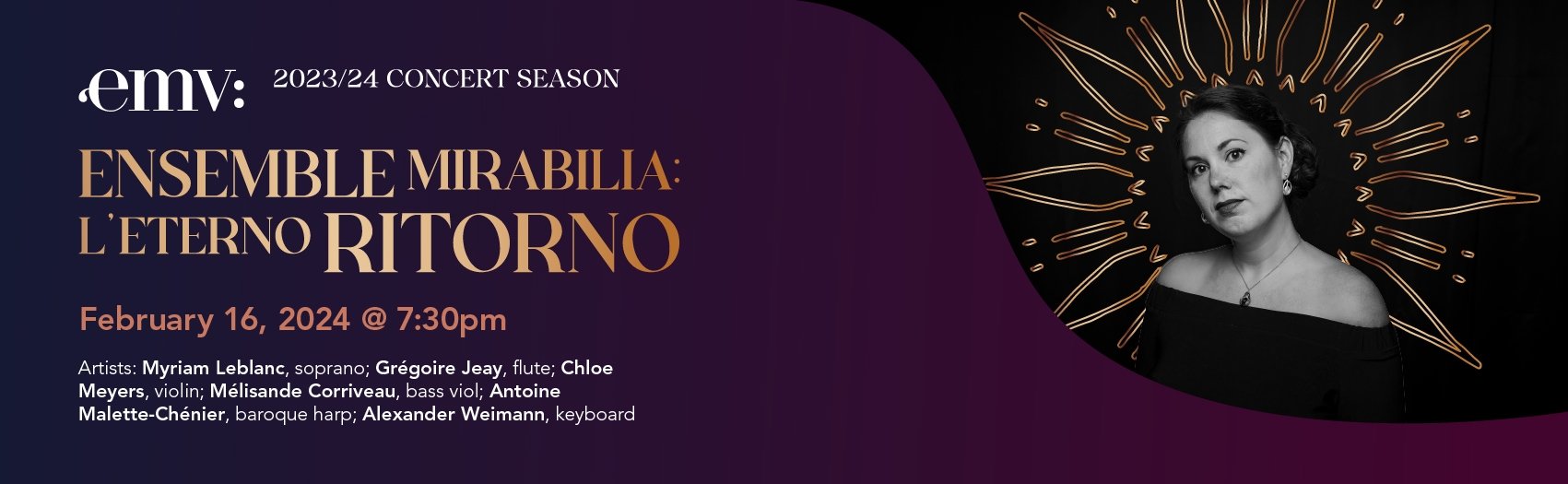
Artists: Myriam Leblanc, soprano, Grégoire Jeay, flute, Chloe Meyers, violin; Mélisande Corriveau, bass viol, Antoine Malette-Chénier, baroque harp and Alexander Weimann, keyboard
Delight in the sensual and moving music of Baroque Italy with soprano Myriam Leblanc and Ensemble Mirabilia!
Featuring works by Vivaldi, Monteverdi, and Barbara Strozzi, this concert focuses on the improvised and fiery character of the chaconne, a Baroque dance form. Celebrate the season of love with these expressive songs on February 16.
“Chaconnes and passacaglias have their roots in popular tradition and have inspired hundreds of compositions since the 16th century. One of the peculiarities of this genre is its decidedly sensual aspect, with the repeated bass causing a certain trance. The improvised character of these pieces are conducive to expressing all kinds of affects, moods and colours, and provide the perfect canvas for the magnificent voice, strong stage presence and incredible charisma of soprano Myriam Leblanc. Of the many composers presented, you’ll delight in the works of Monteverdi, Vivaldi, Legrenzi, Merula and Rossi and a newly composed chaconne by Grégoire Jeay for flute, violin and basso continuo.” – Ensemble Mirabilia
This concert is generously sponsored by Delma Hemming
There will be a pre-concert chat with Myriam Leblanc & Grégoire Jeay hosted by Sylvia L’Ecuyer at 7 p.m.
Runtime: 75min + 15min Interval
PROGRAMME
Luigi Rossi (c.1597–1653)
Mio ben, teco il tormento più
Claudio Monteverdi (1567–1643)
Quel sgardo sdegnosetto , ciaccona
Antonio Caldara (1670–1736)
Chiacona Bb Major
Giovanni Legrenzi (1626–1690)
Lumi potete piangere (La divisione del mondo)
Benedetto Marcello (1686–1739)
Che Inviolabile
Nicola Matteis (1650-1714)
Diverse bizzarrie sopra la Vecchia Sarabanda o pur Ciacona
Antonio Vivaldi (1678–1741)
Piango, Gemo
Anonyme
Tarentelle La Carpinese.
Tarquinio Merula (1595–1665)
Ciaconna a 2 con violone
Antonio Cesti (1623-1669)
Addio Corindo
INTERVAL
Tarquinio Merula
Su la cetra amorosa, aria a voce sola in ciacona
Giovanni Battista Vitali (1632-1692)
Ciaccona a 2 con violone
Barbara Strozzi (1619–1677)
Hor che appolo, excerpt, extrait.
Giovanni Felice Sances (c.1600–1679)
Misera hor si ch’il pianto
Grégoire Jeay (b. 1962)
Chaconne
Léo Ferré (1916–1993)
Col tempo, (Avec le temps)
Benedetto Ferrari (c.1603–1681)
Voglio di vita uscir
The Beatles
Voglio Te (I want you)
PROGRAMME NOTES can be read here.
Ensemble Mirabilia
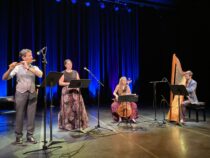
Founded by soprano Myriam Leblanc and flautist Grégoire Jeay, the Mirabilia Ensemble performs mainly baroque music played on period instruments, and also sometimes explores music from other eras. Mirabilia’s mandate is sufficiently broad, allowing it to choose and perform repertoire that, while remaining classical, appeals to an audience of diverse backgrounds and ages. Soprano Myriam Leblanc is renowned for possessing an exceptional talent that gives voice to the great composers of the past. The Ensemble maintains a core of artists ensuring that each voice and instrument speaks directly to the ear of the music lover.
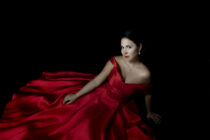
Myriam Leblanc, soprano
A graduate of McGill University, Myriam Leblanc obtained a master’s degree in choral conducting direction from the University of Sherbrooke. She was a First Prize winner and People’s choice Award winner at the Orchestre symphonique de Trois-Rivières Competition, a Jeune Ambassadrice Lyrique in 2014 (Prix Québec-Bavière), Audience Choice Award winner at the Canadian Opera Company Centre Stage Competition, Third Prize winner at the Ottawa Choral Society New Discoveries contest, holder of the Excellence grant given annually by l’Atelier lyrique de l’Opéra de Montréal, First Prize winner in the Mathieu-Duguay Early Music Competition at the 2017 Lamèque International Baroque Music Festival. She has been working in the world of music for few years. Leblanc is recognized for the purity of her tone, a flexible and warm voice and her mastery of both technique and musical expressiveness.
In 2016, she made her debut with the Opéra de Montréal in the role of the High Priestess in Verdi’s Aida. La Presse music critic Caroline Rodgers described her voice as one of “rare beauty”. Her more recent performances (2017-2018) include Milica in Sokolovic’s Svadba with Opéra de Montréal, Micaela in Bizet’s Carmen with Opéra de Québec and concerts with conductors such as Yannick Nézet-Séguin, Kent Nagano, Matthias Maute and Jonathan Cohen. In 2018-2019, she sang a Gilda in Verdi’s Rigoletto, the soprano solos on Handel’s Messiah with Ensemble Caprice, the Mendelssohn’s Symphony No.2 “Lobgesang” with l’Orchestre Metropolitain under Yannick Nézet-Séguin’s direction. Recently, she was a soloist with Les Violons du Roy under Jonathan Cohen’s direction.
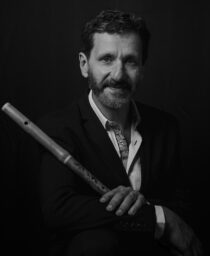
Grégoire Jeay, flute
Baroque flute specialist Grégoire Jeay performs regularly throughout Canada,the US, Europe and as far afield as Turkey. He is recognized for his musicality and expressiveness, and for his sense of ornamentation and improvisation. Mr. Jeay also brings his virtuosity on the transverse flute to the recorder and to flutes from various other cultures. He performs and records regularly with internationally renowned musicians and conductors, including Tafelmusik Baroque Orchestra, Clavecin en concert, La Nef, Theatre of Early Music, L’Harmonie des saisons, Les Voix humaines, Emma Kirkby, Daniel Taylor, Luc Beauséjour, Sylvain Bergeron, and many others. In addition to his regular activities as a flutist, Grégoire Jeay composes and arranges for various ensembles such as Tafelmusik Baroque Orchestra; he also produces music for European and Chinese circuses.
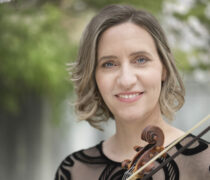
Chloe Meyers | Sponsored by Jill Bodkin, violin
Violinist Chloe Meyers performs with early music ensembles across North America as leader, orchestra member, and chamber musician. She is the concertmaster of the Pacific Baroque Orchestra in Vancouver and co-concertmaster of Arion Baroque Orchestra in Montreal. She has led or appeared as soloist with groups including the Victoria Baroque Players, Pacific MusicWorks, Ensemble Les Boréades, the Theatre of Early Music, Ensemble Masques, and Les Voix Baroques, of which she was a founding member. She has had the pleasure of sharing the stage with international violin stars, performing double concerti with Stefano Montanari, Enrico Onofri, Amandine Beyer, and Cecilia Bernardini. Chloe’s playing may be heard on many award-winning disks, including the 2022 Juno award winning recording “Solfeggio”… in which she leads the orchestra L’Harmonie des Saisons as concertmaster. In 2023 she was nominated as Best Musical Director for her work in Pergolesi’s Stabat Mater with the Edmonton Opera.
Alongside Chloe’s passion for performance and directing, is her love of teaching. As adjunct professor at the University of British Columbia, she trains young artists in the Baroque Orchestra Mentorship Program, chamber music and solo lessons. She has years of teaching children, university and students of all ages and levels! She is an active teacher in the summer Victoria Conservatory teaching programs, as well the UVic Collegium orchestral program.
Chloe lives in Ladner, BC, with her ever growing family and dog.
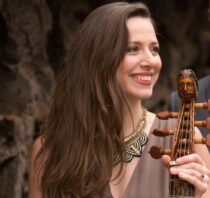
Mélisande Corriveau, bass viol
A specialist in early-music performance, multi-instrumentalist Mélisande Corriveau has been praised for her exceptional musical mastery. She is frequently a guest at major festivals in both North America and Europe, and is an active concert, touring, and recording artist. She regularly performs with a number of celebrated ensembles, and is a member of the ensembles Masques (France), Les Voix humaines, Sonate 1704, and Les Boréades de Montréal. As a soloist, she has been featured with Les Violons du Roy, National Art Center Orchestra, Montreal Symphony Orchestra,Tafelmusik Baroque Orchestra, and has toured with Jordi Savall and Ensemble Hespèrion XXI. Her discography comprises some 50 titles on various labels. Her discs with harpsichordist Eric Milnes - Pardessus de viole and Marin Marais : Badinages - have won numerous accolades including Opus Prizes for early-music CD of the year and classical disc of the year by ICI Radio- Canada (2016). Mélisande Corriveau and her partner Eric Milnes co-direct the two time Juno award-winning vocal and instrumental ensemble L’Harmonie des saisons, which they founded in 2010. In 2014, Ms. Corriveau completed, with honors, a doctorate in pardessus de viole performance at the Université de Montréal. She is recognized as one of the world’s few specialists on this instrument.

Antoine Malette-Chénier, baroque harp
An innovative and creative harpist, Antoine Malette-Chénier plays a repertoire ranging from the Renaissance and the Baroque (on period instruments), to contemporary creations. Principal harp of the Orchestre symphonique de Trois-Rivières, Antoine has played with numerous ensembles in Canada, France and the United States, including the Orchestre symphonique de Montréal, Les Violons du Roy, and the Studio de Musique ancienne de Montréal, both as a soloist, chamber, orchestral and continuo player. Antoine has won many awards, including the 2014 Michael Measures prize from the Canada Council for the Arts, a first prize at the 2013 Montréal Symphony Orchestra Competition, and two scholarships from the National Arts Centre Orchestra. He holds degrees in modern and historical harps interpretation from the Yale School of Music, McGill University, the University of Montréal and the Conservatoire National Supérieur de Musique et de Danse de Lyon.

Alexander Weimann | Sponsored by Bruce Munro Wright, O.B.C., keyboards
The internationally renowned keyboard artist Alexander Weimann has spent his life enveloped by the therapeutic power and beauty of making music. Alex grew up in Munich. At age three he became fascinated by the intense magic of the church organ. He started piano at six, formal organ lessons at 12 and harpsichord at university (along with theatre theory, medieval Latin and jazz piano.) He is in huge demand as a director, soloist and chamber player, traveling the world with leading North American and European ensembles. He is Artistic Director of the Pacific Baroque Orchestra in Vancouver and teaches at the University of British Columbia where he directs the Baroque Orchestra Mentorship Programme.
Alex has appeared on more than 100 recordings, including the Juno-award-winning album “Prima Donna” with Karina Gauvin and Arion Baroque orchestra. His latest album series “The Art of Improvisation” (Volume 1: A Prayer for Peace; Volume 2: Ad libitum; and Volume 3: Canavian Variations, released on Redshift, 2024) unites his passions for both baroque music and improvisation on organ, harpsichord, and piano.