Christ Church Cathedral
Artists: Ensemble Castor; Petra Samhaber-Eckhardt, violin and direction; Hélène Brunet, soprano
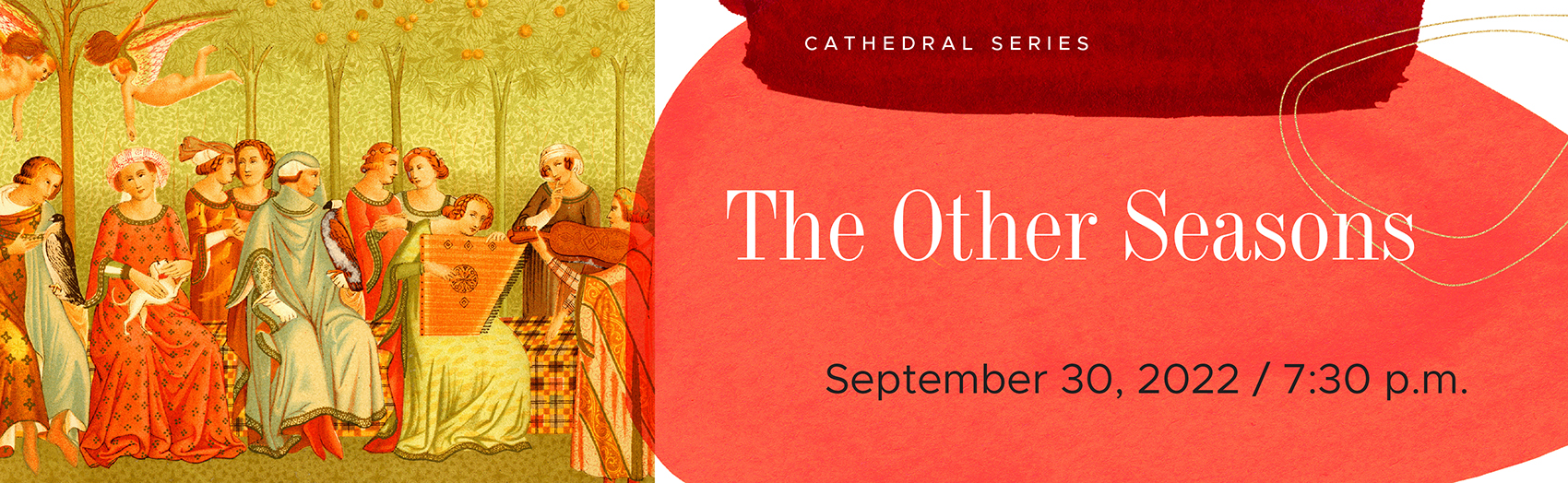
A fun alternative to Vivaldi’s Four Seasons, this concert pairs concertos for Ensemble Castor’s six musicians with arias and motets by the Venetian ‘Red Priest.’ We welcome the wonderful soprano Hélène Brunet who will unleash her dramatic abilities and virtuosic roulades through arias filled with nature characterizations such as birdsongs, tempests, hunts and pastoral life. Vivaldi uses themes from his Four Seasons in several of his vocal arias and ‘Gelido in ogni vena’ echoes the theme of the first movement of his famed Winter concerto.
“These players never fail to find something to say … lovely, imaginative performances on some sweet-sounding instruments!” – Gramophone, August 2017
Ensemble Castor:
Rodolfo Richter, solo violin
Petra Samhaber-Eckhardt and Nina Pohn, violins
Peter Aigner, viola
Kristina Chalmovska, cello
Barbara Fischer, double-bass
Erich Traxler, harpsichord
The Pre-Concert Talk at 7 p.m. features EMV’s Artistic/Executive Director Suzie LeBlanc in conversation with Petra Samhaber-Eckhardt and Hélène Brunet.
This concert is generously supported by Simon Murphy.
PROGRAMME
Antonio Vivaldi (1678-1741)
Concerto for strings in G Major, RV 151, “Alla rustica”
Presto
Adagio
Allegro
Gelido in ogni vena, from Farnace, RV 711
Violin Concerto in F Minor Op. 8 No. 4, RV 297, “L’inverno”
Allegro non molto
Largo
Allegro
Sum in medio tempestatum, RV 632
Allegro non molto: Sum in medio tempestatum
Recitativo: Quid ergo faciam, infelix anima
Largo: Semper maesta, sconsolata
Allegro: Alleluia
Interval
Trio Sonata in D Minor, RV 63, “La Follia”
Agitata infido flatu, from Juditha Triumphans, RV 644
Violin Concerto in E flat major Op.8 No. 5, RV 253, “La tempesta di mare”
Presto
Largo
Presto
Canta in prato, ride in monte, RV 623
Allegro: Canta in prato, ride in monte
Recitativo: Saeva fulgescit nobis
Allegro: Avenae rusticate
Allegro: Alleluia
DOWNLOAD THE PROGRAMME
Download the PDF version of the full programme here.
PROGRAMME NOTES
Unlike Vivaldi’s The Four Seasons, Vivaldi’s Concerto alla Rustica has no descriptive text to go with it; in addition the phrase `alla rustica´ is deceptive because the music is not rustic or provincial in any way. It is a ripieno concerto for orchestra without soloists and constitutes a brilliant example of late Baroque style. Vivaldi both perfected and polarized the concerto; he also established its standard three-movement, fast-slow-fast structure. Such works are important antecedents of the symphony. The Concerto alla Rustica was composed in the mid 1720s, while Vivaldi was working on his Il Cimento dell´Armonia ed inventione op.8, including The Four Seasons.
The aria ‘Gelido in ogni vena’ is the most poignant aria of his opera Farnace, which premiered on the 10th of February, 1727, at the Sant´Angelo theatre in Venice. In this aria, Farnace, King of Pontus – a kingdom on the threshold of Europe and Asia – after having ordered the death of his son to preserve him from enemy hands, collapses at the announcement of the execution of his order. He imagines the ghost of his son and feels his blood turning to ice as it courses through his veins. The aria uses themes from the first movement of Vivaldi’s L´Inverno, the Winter concerto from The Four Seasons.
The motet Sum in medio Tempestatum belongs to the category `per ogni stagioni´ (for all seasons) and can be inserted appropriately into almost any Mass or Vespers service. It is preserved in a collection of sacred music compiled by the Bohemian composer Jan Dismas Zelenka (1679-1745). Like Vivaldi’s Laudate pueri in G Major, it was probably written for a singer attached to the Saxon court who trained in Venice in the 1720s and joined the Hofkapelle in 1730. In the opening aria, the singer likens the human condition to that of a ship in stormy seas. In the following recitative, he (or she) resolves to renounce the temptations of the world and follow the way of Christ. The second, slower aria expresses the singer’s contentment and security in this new-found faith. A vivacious ‘Allelluia’ provides a final burst of exuberance.
Vivaldi’s opus 1 is a youthful homage to the style of Arcangelo Corelli. Vivaldi demonstrates a powerful language of his own, one which then reappears fully fledged later in his famous concerto L´Estro Armonico. The most famous piece of opus 1 is La Follia, a sonata in three parts in the form of theme and variations. It is very similar to Corelli’s famous work on the same theme. In paying homage to Corelli, Vivaldi brings a nervousness to the ancient Iberian theme through an obsessive journey which has little time for lyrical episodes and leads to a series of final variations similar to those of Corelli´s version but more pounding, hyperbolic and impatient.
Juditha Triumphans is Vivaldi’s only surviving oratorio. He wrote it in 1716 for the musically gifted girls of the Opsedale della Pietà, the Venetian orphanage with which he was associated most throughout his working life. From 1713 he was given the opportunity, by the governors of the Pietà, to compose sacred vocal music and his success led to his promotion to the post of Maestro di Concerti in 1716. In the same year, after a long war against the Turks, Venice triumphed in Corfu. The sacred, military oratorio Juditha Triumphans was written right after this battle – a clear allegorical choice to celebrate the Venetian defeat of the Turks. In the aria ‘Agitata infido flatu’ Judith describes her inner turmoil and seems not to know what to do – the enemy turns out to be her beloved.
Vivaldi’s opus 8 was published in Amsterdam in 1725 under the title Il cimento dell´armonica e dell´inventione (The trial between harmony and invention). All twelve concertos in this set are fine works, even if The Four Seasons have come to overshadow the other eight. These other concertos are not accompanied by descriptive texts. The titles rather imply a certain event or emotion and some, if not all, appear to have been given their labels as an afterthought to describe existing music. The vivacious start of La Tempesta di Mare (The Storm at Sea), with its driving descending scales, is dazzling in its virtuosity and a fine example of Vivaldi’s art. Francesco Geminiani best captured the essence of Vivaldi’s Opus 8 when he wrote that the “Intention of Musick is not only to please the Ear, but to express Sentiments, strike the Imagination, affect the Mind, and command the Passions.”
Canta in prato, ride in monte is one of Vivaldi’s most joyful Roman motets and is suited to any festival or saint (who is invoked simply as `Pater Beate´ in the recitative). Vivaldi may have written it for one of the principal singers in his operas. The reference to the nightingale in the first aria, described in classical fashion as `Philomela,´ calls forth some bird-like warbles, familiar from such Vivaldi concertos as Il Gardellino. The second aria stays close to this style with its evocation of the resonance of rustic flutes.
appropriately into almost any Mass or Vespers service. It is preserved in a collection of sacred music compiled by the Bohemian composer Jan Dismas Zelenka (1679-1745). Like Vivaldi’s Laudate pueri in G Major, it was probably written for a singer attached to the Saxon court who trained in Venice in the 1720s and joined the Hofkapelle in 1730. In the opening aria, the singer likens the human condition to that of a ship in stormy seas. In the following recitative, he (or she) resolves to renounce the temptations of the world and follow the way of Christ. The second, slower aria expresses the singer’s contentment and security in this new-found faith. A vivacious ‘Allelluia’ provides a final burst of exuberance.
Vivaldi’s opus 1 is a youthful homage to the style of Arcangelo Corelli. Vivaldi demonstrates a powerful language of his own, one which then reappears fully fledged later in his famous concerto L´Estro Armonico. The most famous piece of opus 1 is La Follia, a sonata in three parts in the form of theme and variations. It is very similar to Corelli’s famous work on the same theme. In paying homage to Corelli, Vivaldi brings a nervousness to the ancient Iberian theme through an obsessive journey which has little time for lyrical episodes and leads to a series of final variations similar to those of Corelli´s version but more pounding, hyperbolic and impatient.
Juditha Triumphans is Vivaldi’s only surviving oratorio. He wrote it in 1716 for the musically gifted girls of the Opsedale della Pietà, the Venetian orphanage with which he was associated most throughout his working life. From 1713 he was given the opportunity, by the governors of the Pietà, to compose sacred vocal music and his success led to his promotion to the post of Maestro di Concerti in 1716. In the same year, after a long war against the Turks, Venice triumphed in Corfu. The sacred, military oratorio Juditha Triumphans was written right after this battle – a clear allegorical choice to celebrate the Venetian defeat of the Turks. In the aria Agitata infido flatu Judith describes her inner turmoil and seems not to know what to do – the enemy turns out to be her beloved.
Vivaldi’s opus 8 was published in Amsterdam in 1725 under the title Il cimento dell´armonica e dell´inventione (The trial between harmony and invention). All twelve concertos in this set are fine works, even if the Four Seasons have come to overshadow the other eight. These other concertos are not accompanied by descriptive texts. The titles rather imply a certain event or emotion and some, if not all, appear to have been given their labels as an afterthought to describe existing music. The vivacious start of La Tempesta di Mare (The Storm at Sea), with its driving descending scales, is dazzling in its virtuosity and a fine example of Vivaldi’s art. Francesco Geminiani best captured the essence of Vivaldi’s Opus 8 when he wrote that the “Intention of Musick is not only to please the Ear, but to express Sentiments, strike the Imagination, affect the Mind, and command the Passions.”
Canta in prato, ride in monte is one of Vivaldi’s most joyful Roman motets and is suited to any festival or saint (who is invoked simply as `Pater Beate´ in the recitative). Vivaldi may have written it for one of the principal singers in his operas. The reference to the nightingale in the first aria, described in classical fashion as `Philomela,´ calls forth some bird-like warbles, familiar from such Vivaldi concertos as Il Gardellino. The second aria stays close to this style with its evocation of the resonance of rustic flutes.
- Notes by Petra Samhaber-Eckhardt
Ensemble Castor
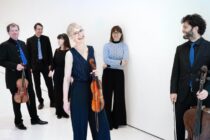
Ensemble Castor was founded in 2010 by internationally successful Austrian musicians, and is devoted to string chamber music of the period between 1600 and 1750. Their main focus is on the Italian Seicento and Settecento as well as on the pre-classical music in Austria and Germany.
The ensemble’s musical director is the Austrian violinist Petra Samhaber-Eckhardt, who studied with Enrico Onofri and Andrew Manze in Italy and London.
Ensemble Castor collaborates with labels as SONY and Note 1 and their recordings have received fantastic international reviews.
Castor works closely together with Enrico Onofri, Rodolfo Richter, Dorothee Oberlinger, Silvia Frigato, Mireille Lebel, Christina Gansch and other famous singers and instrumentalists.
Castor performs at many international festivals such as ‘Internationale Barocktage Melk’, ‘Carinthischer Sommer’, ‘Festival St.Gallen’, Internationale Festwochen Innsbruck, ‘Fränkischer Sommer’, ‘Händel Haus Halle’ , Elbphilharmonie Hamburg, Frankfurt, Mosel Musikfestival, Brucknerhaus and Konzerthaus Vienna, Vancouver Early Music, Boston Early Music, Ottawa and New York.
A great ambition of Ensemble Castor is to work with fortepiano on classical music.
In 2015 Castor won the culture prize of the city of Linz. Many excellent concert reviews give evidence of the high quality of their work: ‘The young ensemble offered fulminant interpretations’, ‘Castor awakes early music to completely new life’.
`These players never fail to find something to say…lovely , imaginative performances on some sweet sounding instruments.´, Grammophone magazine
The name Castor refers to the twin stars Castor and Pollux in the zodiac of Gemini.
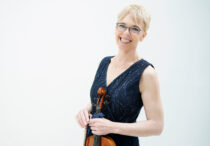
Petra Samhaber-Eckhardt, dir., violin
Petra Samhaber-Eckhardt was born in Linz, Austria. She studied modern violin at the university ‘Mozarteum’ in Salzburg, but discovered very soon her love and passion for the baroque violin and early music. After graduating in Salzburg she moved to London for studies with Andrew Manze and Ingrid Seifert at the ‘Royal College of Music’. There she passed her postgraduate diploma with distinction.
Whilst living in London she won several prizes at early music competitions and was a finalist in the BBC Music Awards. In 2012 she did her Master’s with distinction in Austria with Michi Gaigg and studied for several years with Enrico Onofri at the conservatory in Palermo, Italy.
Beside her passionate work directing and managing Ensemble Castor she is also in great demand leading various orchestras and groups (Innsbrucker Festwochen, Collegium Marianum etc.).
She has participated in many major festivals throughout Europe and South America.
In 2013 her first book ‘Musical – rhetorical figures in Bach’s sonatas for violin and cembalo obligato BWV 1014-1019’ was edited.

Hélène Brunet, soprano
Hélène Brunet is hailed as “a singer of tremendous quality” with “a voice of perfect beauty and sincere expression.” Recognized for her interpretations of Bach, Handel, and Mozart, her repertoire extends from Baroque to the music of the 20th and 21st centuries. Hélène is the recipient of a prestigious Juno award (2022) for her first solo album Solfeggio (ATMA Classique) with renowned ensemble L‘Harmonie des saisons. Hélène is the first artist to ever win for a solo album in the category Large Ensembles at the Junos.
The critics describe Solfeggio as “a first-rate vocal achievement” (La Presse) and a “red carpet that displays Hélène’s superb and enveloping tone” (Le Devoir). Accolades continue with Solfeggio being selected as one of CBC Music’s Top 20 Classical albums of the year. On the stage, Hélène sings with the American Classical Orchestra at Lincoln Center in New York City, with American Bach Soloists in San Francisco, and the Orchestre Métropolitain under the baton of Yannick Nézet-Séguin, who says, “Hélène Brunet is the embodiment of class, refinement, and purity.” Hélène is the recipient of generous grants from Musicaction and the Canada Council for the Arts. She studies with voice teacher Neil Semer in New York.