Christ Church Cathedral
Subscriptions: To purchase tickets to this performance as part of a subscription to 3 or more concerts and receive a 25% discount off the full ticket price, please call Early Music Vancouver’s box office at 604-732-1610 or email boxoffice@earlymusic.bc.
Artists: Suzie LeBlanc, soprano; Vincent Lauzer, recorder; Marie Nadeau-Tremblay, violin; Sylvain Bergeron, archlute and baroque guitar
There is no doubt that the majority of traditional Acadian songs come from France, their origins can even be traced back to certain regions. Songs, just like people, are nomadic: they have no borders! The lyrics, like the melodies, often change as they travel. Songs also varied, not only from one Acadian region to another, but also from one performer to another, with each artist lending their own version.
Here, we juxtapose Acadian folk songs from Shippagan with 17th century ‘airs de cour’ from France and the court of Louis the XIV. The folksongs from Shippagan were collected by Dr. Joseph Dominique Gauthier between 1950 and 1957 who, after receiving a visit from two folklorists from Laval University, embarked on his own quest to find songs. Doctor Gauthier, a physician in Shippagan, said that getting songs and stories from his informants was the best way to do geriatrics!
The songs collected by Dr. Gauthier have melismas that are reminiscent of the ornamentation found in French ‘air de cour’ and this reveals the presence of certain archaisms in this isolated northeastern region of New Brunswick.
This concert is generously supported by Anthony Morgan and Jocelyn Pritchard
PURCHASING TICKETS
Click here to purchase tickets.
Subscriptions: To purchase tickets to this performance as part of a subscription to 3 or more concerts and receive a 25% discount off the full ticket price, please call Early Music Vancouver’s box office at 604-732-1610 or email boxoffice@earlymusic.bc.
PROGRAMME
The amorous nightingale / Le Rossignol en amour
Traditionnel – Chanson de Shippagan
Rossignol sauvage
Jean-Baptiste Drouart de Bousset (1662-1725), Michel Blavet (1700-1768)
Pourquoi doux rossignol
Jacques-Martin Hotteterre (1673-1763)
Je suis aimé de celle que j’adore
Honoré d’Ambruis (16..-17..?)
Pour charmer les ennuits
The fickle lovers / Les amants volages
Robert de Visée (1650-1725)
Prélude, Sarabande et Gigue en sol mineur
Traditionnel – Chanson de Shippagan
Le Berger
Michel Lambert (1610-1696)
Ma bergère
Traditionnel – Chanson de Shippagan
Chanson des amants
Michel Lambert
Jugez de ma douleur
Sweet Rest / Le repos
Robert de Visée
Chaconne en sol majeur
Michel Lambert
Goûtons un doux repos
Menagerie / La ménagerie
Traditionnel – Chanson de Shippagan
Le Coq et la Poule
Louis-Claude Daquin (1694-1772)
Le coucou
Traditionnel – Chanson de Shippagan
Le Matou
PROGRAMME NOTES
My curiosity and interest in traditional Acadian songs began some twenty years ago. I have since recorded four albums of Acadian songs with ATMA Classique (2004, 2007, 2014 and 2022). La Veillée de Noël – De la France à l’Acadie, released in 2014, featured pieces from a collection of French Christmas songs that my cousin Pius LeBlanc found in the local bakery in Memramcook, New Brunswick, my father’s hometown. These songs from different parts of France, which Pius’s mother used to sing, were the inspiration for this programme, a juxtaposition of French airs de cour and Acadian songs.
There is no doubt that the majority of traditional Acadian songs come from France; their origins can even be traced back to the various regions. Songs, just like peoples, are nomadic: they have no borders! The lyrics, like the melodies, often change as they travel. For example, the original French song L’alouette et le pinson became L’alouette et le poisson upon its arrival in Acadia—since the finch (“pinson”), not indigenous to Acadia, was then unknown in the region. Versions also varied, not only from one Acadian region to another, but also from one performer to another, with each artist giving their own special touch.
In this evening’s programme, combining early Acadian songs with 17th-century French airs de cour, we are staying faithful to period practice for the Airs de cour and taking liberties with the arrangements for the Acadian songs. Although early sacred works were slightly more popular than arias and cantatas in New France, thanks to the presence of the clergy, these common and noble airs may very well have crossed the Atlantic stowed in the baggage of musicians and noblemen who came as settlers. It is well known that the French nobility who had settled in Quebec in the 17th century wanted to reproduce the glories of Versailles, and some of these airs de cour may have reached the shores of Shippagan.
***
The Acadian songs from Shippagan in this programme were collected by Doctor Joseph Dominique Gauthier between 1950 and 1957 and published by the Presses de l’Université Laval in 1975. After receiving the visit of two folklorists from Laval University in 1950—Félix-Antoine Savard and Luc Lacourcière—Doctor Gauthier, then a physician in Shippagan, embarked on his own quest to find songs. He said that getting songs and stories from his informants was the best way to do geriatrics! Many of the songs contain melisma similar to those used in French baroque ornamentation, which reveals the presence of certain archaisms in this isolated region of northeastern New Brunswick. For this project, we have chosen texts that range from the serious to the comical and that use popular pastoral themes from 17th-century airs de cour.
***
After Louis XIV established his court in Versailles in 1682, it became an unrivalled musical hub. Among the many celebrated artists to be there were court flautist Jacques Hotteterre, guitarist Robert de Visée, who instructed the King, and one of the most famous composers of airs de cour, Michel Lambert.
The air de cour, a subtle art form, played a major role in the evolution of French song. It appeared in the late 16th century, for solo or multiple voices, and gradually became an acclaimed form of art for virtuoso soloists accompanied by the lute or theorbo. Seventeenth-century singers and composers such as Pierre de Nyert, Bénigne de Bacilly and Michel Lambert took this virtuosity further and wrote highly elegant and refined doubles notated with astonishing precision, such as those found in Honoré D’Ambruys’s Pour charmer les ennuits que je souffre en aymant.
In Michel Lambert’s Ma bergère est tendre et légère and Jugez de ma douleur, published by Christophe Ballard in 1689, the doubles are replaced by instrumental ritornelli. With French opera flourishing after the arrival of Lully, Lambert felt a compelling need to write more melodic and harmonic variations to please an audience who had grown accustomed to Lully’s more straightforward style.
- Suzie LeBlanc
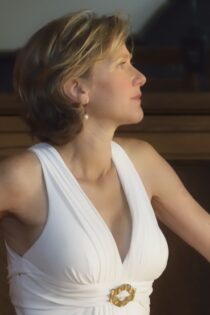
Suzie LeBlanc, soprano
Born in Acadia, the charismatic soprano Suzie LeBlanc provides convincing evidence for the popularity of Early Music while exploring French art song, lieder, contemporary repertoire, and Acadian traditional music. She has performed on famous stages of the world in recitals and opera and has made over 60 recordings ranging from medieval to contemporary music.
Many of her recordings received international praise and prestigious awards, notably a Grammy award for Lully’s Thésée and several Opus awards. In addition to her passion for Early Music, she is an advocate for Canadian contemporary music. Her album “I am in need of music” on poems by Elizabeth Bishop won ECMA’s Best Classical Album and her album “mouvance”, which unites the words of 13 contemporary Acadian poets to the music of Jérôme Blais, was nominated for a JUNO in the category album of the year – solo artist, in 2024. Her most recent album with the Viadana Collective explores the sacred works by Lodovico Viadana and was released on May 1st, 2024, on the Passacaille label.
Appointed to the Order of Canada in 2015, she was recently awarded the rank of Knight of the Order of Arts and Letters from the French Republic. As the Artistic and Executive Director of Early Music Vancouver, she enjoys presenting a wide range of artists in the field of historical performance and welcomes the opportunity to sing from time to time.

Vincent Lauzer, recorder
Révélation Radio-Canada 2013-2014 and Breakthrough Artist of the Year (2012 Opus Awards), recorder player Vincent Lauzer graduated from McGill University where he studied with Matthias Maute. He is the artistic director of the Lamèque International Baroque Music Festival in New-Brunswick. In October 2018, his recording of Vivaldi’s concertos with Arion Baroque Orchestra and Alexander Weimann was awarded a Diapason d’Or by the famous French magazine Diapason.
Winner of several prizes in national and international competitions, he has been awarded the Fernand Lindsay Career Award, a scholarship given to a young promising Canadian musician for the development of an international career. Vincent received the Béatrice-Kennedy-Bourbeau Award at the Prix d’Europe 2015. In 2012, he won the First Prize at the Stepping Stone of the Canadian Music Competition and the Career Development Award from the Women’s Musical Club of Toronto. In 2009, he was awarded the First Prize and the Audience Appreciation Prize in the Montreal International Recorder Competition.
Vincent is a member of Flûte Alors! and Les Songes, two ensembles with whom he has toured Eastern Canada with Jeunesses Musicales Canada. Vincent performs as a soloist with Arion Baroque Orchestra, La Bande Montréal Baroque, the Montreal Symphony Orchestra, the Pacific Baroque Orchestra, and Les Violons du Roy. He has played in various series and festivals in Canada and in the United States as well as in Mexico, France, Germany, Spain and Belgium.
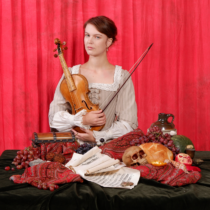
Marie Nadeau-Tremblay, violin
During the final session of her undergraduate degree in violin performance at McGill University, Marie Nadeau- Tremblay decided to try her hand at the Baroque. She joined the university’s Baroque orchestra and fell head over heels in love! Transported by the beauty of this music— and finding resonance with its mode of expression— she decided to plunge headfirst into the Baroque world. After obtaining a Licentiate Degree, she pursued further studies under the tutelage of Hank Knox, Lena Weman, and Olivier Brault, receiving a Master’s Degree in Early Music Performance. After being awarded numerous prizes and scholarships at McGill — including the prestigious Mary McLaughlin prize, which she won four years in a row — Marie Nadeau-Tremblay received an Early Music America grant in 2017. More recently, in 2019, she swept the honor roll of the Concours de musique ancienne Mathieu Duguay with an unprecedented four awards: First Prize, the People’s Choice Award, the Festival Montréal Baroque Prize, and the Été musical de Barachois Prize.
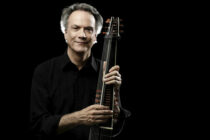
Sylvain Bergeron, archlute, baroque guitar
Considered “a supremely refined, elegant and cerebral musician” (Ottawa Citizen), Sylvain Bergeron is a master of the lute and family of plucked instruments, including the theorbo, archiluth and baroque guitar. He is in great demand on the North American music scene as a soloist and continuist. He is one of the pioneers of early music in Canada and has helped establish the lute as a viable instrument at the highest level of professionalism. His work has confirmed the importance of plucked instruments and helped validate their place in Baroque ensembles and orchestras in Canada.
Sylvain Bergeron has participated in more than 70 recordings, many of which have won prizes and awards. His most recent solo album, Gioseppe Antonio Doni’s Lute Book, published by ATMA Classique in 2015, was widely praised for his “strong lute technique combined with outstanding musical intelligence and impeccable phrasing” (The WholeNote ), while the magazine Goldberg described his game as “imbued with both great rhythmic vitality, delicacy and nuance”.
Co-founder and co-artistic director of La Nef, Mr. Bergeron has directed several award- winning productions of this Montreal ensemble since 1991. He has taught lute at McGill University and the Université de Montréal since 1992.
Media