VanDusen Botanical Gardens (Heron Lake)
This event is SOLD OUT
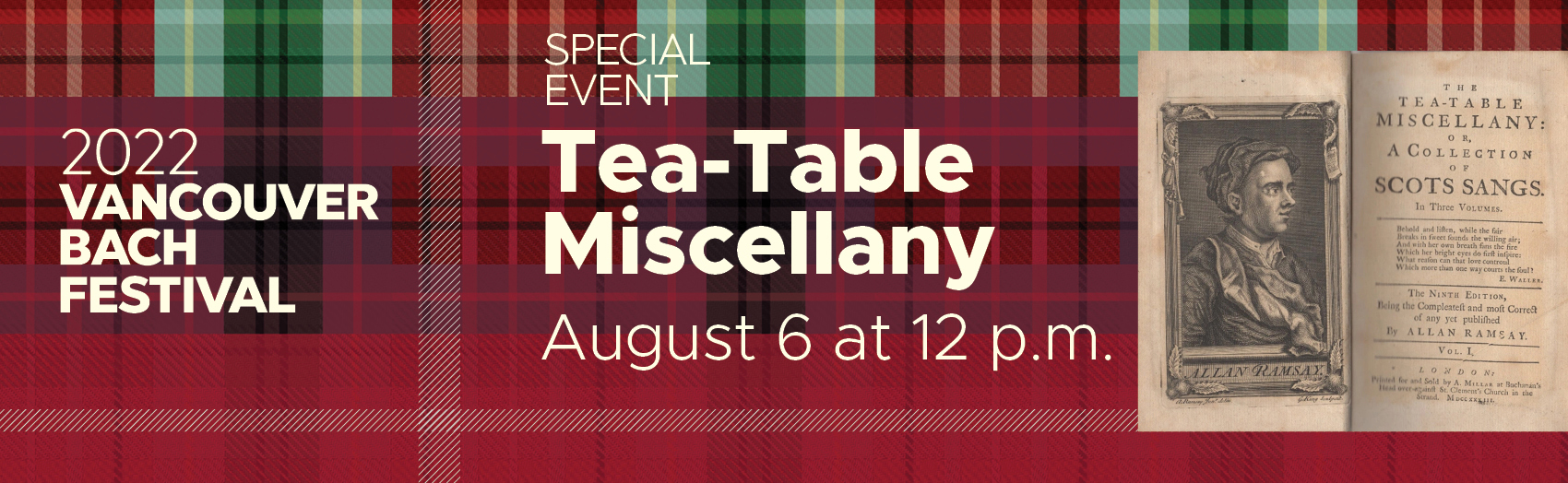
The Tea-Table Miscellany is the first printed collection of Scottish songs in the Scots dialectic, though it also contains English-language songs. It features the words of 18th- century poet, dramatist and book-seller Allan Ramsay and contains poetry as well as broadside ballads. The songs in Tea-Table Miscellany were said to be sung by young Edinburgh ladies at the tea-table since drinking tea was a female social pastime. As time went on, men began attending the gatherings and drinking and political songs found their way next to the songs about wealth and marriage.
Also on the programme are songs from Ramsay’s Gentle Shepherd, a pastoral comedy about a literary shepherd, which Ramsay turned into a Ballad Opera. Like John Gay’s Beggar’s Opera, it was enormously popular.
This concert is generously sponsored by the Drance Family.

PURCHASING TICKETS
Click here to purchase tickets.
Please note this concert is not eligible in combination with the EMV discount programs or concert subscription discount.
PROGRAMME
Songs by Allan Ramsay from The Tea-Table Miscellany, vol. I (Edinburgh, 1723)
and his pastoral comedy The Gentle Shepherd (Edinburgh, 1725-6)
William McGibbon (1690-1756)
The Bonniest Lass in a’ the World
Allan Ramsay (1686-1758)
My Jo Janet
James Oswald (1710–1769)
Ettrick Banks
Allan Ramsay
Up in the Air
The Gentle Shepherd, Sang I. The Wawking of the Faulds
John McLachlan (born c. 1670)
Bonny Kirsty
Allan Ramsay
A South Sea Sang
The Gentle Shepherd Act 2 Scene 4, including
Sang X. Winter was cauld, and my Cleathing was thin
Sang XI. By the Delicious Warmness of thy Mouth
John McLachlan
The Scots Chaconne
Allan Ramsay
The Bonny Scot
James Oswald
Cromlit’s Lilt
Allan Ramsay
Auld Rob Moris
The Toast
TEXTS & TRANSLATIONS
For texts and translations click here.
PROGRAMME NOTES
Allan Ramsay the elder (c. 1684-1758) was a key cultural figure in Edinburgh’s Enlightenment. A poet, playwright, song collector, antiquarian, editor, bookseller and entrepreneur, he had a profound effect on the city, establishing at various times a lending library, a dance assembly, a bookshop, and a theatre. Today’s concert includes songs from his most celebrated publications, the song collection The Tea-Table Miscellany and the pastoral comedy and ballad opera The Gentle Shepherd, along with music by his friends from the Edinburgh Music Club. In May 2022 Edinburgh University Press began to publish a new complete edition of Ramsay’s works, with The Gentle Shepherd as volume 1, and the musical sources edited by David McGuinness.
The Tea-Table Miscellany is perhaps an unexpected title for a songbook, and for such an enormously successful one. The dedication is
To ilka lovely British Lass,
Frae Ladys Charlote, Anne and Jean,
Down to ilk bony singing Bess,
Wha dances barefoot on the Green.
‘Britain’ was still a novel concept as a state and as a culture, and Scots were soon to make sure that their place in that culture was to be substantial. There is just a little truth in the notion that the English were too busy building an empire to notice that they had a culture of their own, and so Scots in London were very happy to present their music and culture as truly British, rather than just North British.
The tea-table itself was also a recent innovation, only available in polite society, and as the names in Ramsay’s verse suggest, a predominantly female environment, because gentlemen would be drinking coffee or claret elsewhere. It’s clear that there was some intention for the book to control the culture of this space into which men were not invited:
E’en while the Tea’s fill’d reeking round,
Rather than plot a tender Tongue,
Treat a’ the circling Lugs wi’ Sound,
Syne safely sip when ye have sung.
The songs themselves, all set to well-known tunes, range from Ramsay’s sometimes over-wrought Augustan poetry, to traditional songs and broadsides ‘improved’ for a middle-class environment, which prefigure and influence Robert Burns’s work later in the century. However, it soon becomes clear that the tea-table was not the only intended market for the book. There are plenty of songs which are undoubtedly male in voice and intent, whether in toasts to the lassies, drinking songs, or what reads now as outright misogyny. Also, within three years of the Miscellany’s first appearance, the Scots singer William Thomson took fifty of Ramsay’s songs, added ornate arrangements to reflect the style of his own singing, and published them in London as a very large and expensive book with a dedication to the Princess of Wales, called Orpheus Caledonius. Ramsay was not best pleased. Nonetheless, the success of Thomson’s second edition in 1733 was largely responsible for the interest in Scots tunes and songs taken by Italian composers such as Barsanti, Geminiani and Veracini.
The Gentle Shepherd began life as a ‘pastoral comedy’ to be read aloud – the plot is too labyrinthine to recount fully here, but in brief, the shepherd Patie is found to be of noble birth, has to be torn from his lover Peggy to embrace a new lifestyle and education, and . . . everything eventually works out in the end. The real joy of the piece is in Ramsay’s energetic and subtle use of the Scots language, and while there were some performances in the early 1720s, it wasn’t until a few years later that the piece began to find a regular home on the stage.
Ramsay had met John Gay by 1724, and impressed by Gay’s The Beggar’s Opera, he added songs to bring to the total from four to 21, and turn his pastoral comedy into a ballad opera based on well-known Scottish tunes. He approved a translation into English for a London theatre audience which cut the original five acts down to two, and by the second half of the 18th century, the piece had become a regular fixture on the professional stage, and had performances as far afield as New York and Charleston. Steve Newman has noted that there were more than 100 printings of the text by 1800, and that it inspired more visual representations in the 18th century than any other British text not by Shakespeare. In the 1800s it had another life as a staple in the repertoire of amateur dramatic societies, and short extracts provided ready material for vaudeville and music hall acts. The uncut text remained in print for nearly 200 years, and even in the first decade of the 20th century there were performances in Melbourne and in Frederick, Maryland.
Within a few decades of its writing, the music for The Gentle Shepherd had undergone some changes: the more obscure, difficult or awkwardly Scottish-sounding tunes were readily replaced with new ones, and the arrangements are refashioned to suit whichever musical styles were current. One particularly successful score was composed by Thomas Linley the elder for the Theatre Royal, Drury Lane in London. Finding Allan Ramsay’s original intentions for the music (if he had any at all) is very difficult, as he left behind no musical notation of his own, and the book he published of Musick for Allan Ramsay’s Songs is of instrumental arrangements, some of which are quite unsingable.
Fortunately his friends in the Edinburgh Music Club included some skilled composers who published their own books which include the tunes, and with the help of many earlier tunebooks surviving in manuscript form, it’s possible to build up a picture of the tunes which were current in Edinburgh in the 1720s, and which might have been in Ramsay’s head while he was composing the words. In The Gentle Shepherd, only one song, ‘Sang XI. By the Delicious Warmness of thy Mouth’ appears to have been specially composed for the piece, and even then there is no composer’s name attached to it.
The violinist John McLachlan was from the previous generation of Edinburgh musicians, but the tunes in his repertoire were clearly still current, as several are the basis for songs in the Tea-Table Miscellany. William McGibbon was the most successful Scottish musician of his generation, embodying the fiddle tradition in the first half of the century before strathspeys and reels began to dominate the repertoire. And Ramsay himself wrote a valedictory epistle to composer James Oswald on his leaving Edinburgh for London in 1741. After some affectionate joking about some of Oswald’s previous exploits, it includes this encouragement for his commercial enterprises in the British capital:
O publish a’ your works, and send them soon.
We’ll a’ subscribe, as we did for the past,
And play while bows may wag or strings can last.
Ramsay clearly saw in Oswald a kindred spirit, who like him understood that in Enlightenment Scotland, art had to be sustained by commerce.
- David McGuinness
David Greenberg, violin
For three decades, David has enjoyed a double career as a Baroque violinist and Cape Breton fiddler. His fluency and experience in these two genres makes him uniquely qualified to interpret the wild music of 18th-century Scotland.
David is a graduate of Indiana University’s Early Music Institute, where he studied with Stanley Ritchie. He has performed, taught, and recorded primarily in North America and Western Europe, as well as in Australia, New Zealand, and the Far East.
David has performed with Tafelmusik, Red Priest, Les Musiciens de Saint-Julien, Concerto Caledonia, Apollo’s Fire, Ensemble Caprice, La Nef, Toronto Consort, Seattle Baroque, Les Voix Humaines, Chris Norman, Suzie LeBlanc, Doug MacPhee, and Musica Pacifica. He has performed as guest soloist/director with several orchestras, including the Calgary Symphony Orchestra and Symphony Nova Scotia.
He has recorded over 80 CDs, including with most of these ensembles and collaborators, as well as three groundbreaking Scottish-Cape Breton-Baroque recordings with his own ensemble Puirt A Baroque in the 1990s.
David co-authored The DunGreen Collection (1996), an influential treatise on Cape Breton fiddling. He is also a composer and arranger. Many of his tunes have been recorded by Cape Breton musicians such as Buddy MacMaster, Carl MacKenzie, Jerry Holland, and The Rankins.
David enjoys sharing his passion and knowledge about Baroque and Cape Breton music in workshop settings. His current solo touring program is called Bach & Tunes: Multiple Voices for One.
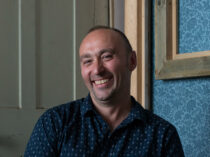
David McGuinness, dir., harpsichord
David McGuinness divides his time between historical Scottish music and contemporary work. As director of early music ensemble Concerto Caledonia he has made fifteen albums, mostly of newly-rediscovered repertoire, and collaborated with musicians in a variety of genres from folk to punk cabaret.
Recently he has been playing historical pianos in traditional music: 2018’s What News is a collection of traditional Scots ballads with the singer Alasdair Roberts and sound artist Amble Skuse, and in 2022 he recorded an instrumental album with concertina player Simon Thoumire. In the ongoing performance project Nathaniel Gow’s Dance Band, Concerto Caledonia plays late 18th-century Scottish dance music while the audience dances the original figures.
David has been a music producer and composer for television and radio, most notably on several seasons of E4’s TV drama Skins. In 2007 he produced John Purser’s 50-part history of Scottish music for BBC Radio Scotland and co-ordinated the station’s observance of No Music Day with the artist Bill Drummond. In 2019 Sony Music reissued the Prefab Sprout album I Trawl the Megahertz, for which he provided the string arrangements.
He is Senior Lecturer in music at the University of Glasgow, and was principal investigator on the AHRC-funded research project Bass Culture in Scottish Musical Traditions. 2022 sees the publication of his edition of the music for Allan Ramsay’s ballad opera The Gentle Shepherd for Edinburgh University Press, and a recording with Concerto Caledonia of Ramsay’s songs.
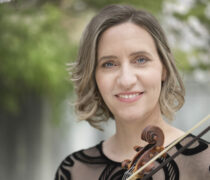
Chloe Meyers | Sponsored by Jill Bodkin, violin
Violinist Chloe Meyers performs with early music ensembles across North America as leader, orchestra member, and chamber musician. She is the concertmaster of the Pacific Baroque Orchestra in Vancouver and co-concertmaster of Arion Baroque Orchestra in Montreal. She has led or appeared as soloist with groups including the Victoria Baroque Players, Pacific MusicWorks, Ensemble Les Boréades, the Theatre of Early Music, Ensemble Masques, and Les Voix Baroques, of which she was a founding member. She has had the pleasure of sharing the stage with international violin stars, performing double concerti with Stefano Montanari, Enrico Onofri, Amandine Beyer, and Cecilia Bernardini. Chloe’s playing may be heard on many award-winning disks, including the 2022 Juno award winning recording “Solfeggio”… in which she leads the orchestra L’Harmonie des Saisons as concertmaster. In 2023 she was nominated as Best Musical Director for her work in Pergolesi’s Stabat Mater with the Edmonton Opera.
Alongside Chloe’s passion for performance and directing, is her love of teaching. As adjunct professor at the University of British Columbia, she trains young artists in the Baroque Orchestra Mentorship Program, chamber music and solo lessons. She has years of teaching children, university and students of all ages and levels! She is an active teacher in the summer Victoria Conservatory teaching programs, as well the UVic Collegium orchestral program.
Chloe lives in Ladner, BC, with her ever growing family and dog.
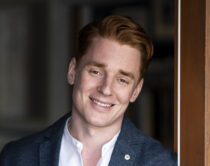
Isaiah Bell, tenor
Canadian-American tenor Isaiah Bell sings across North America as a soloist in concert and opera. Having distinguished himself early as an interpreter of Handel, Benjamin Britten, and Bach’s Evangelists (Lincoln Center, Edinburgh Festival, Toronto Symphony), he has also found an artistic home in new creations. He was Antinous in the world premiere of Rufus Wainwright and Daniel MacIvor’s Hadrian at the Canadian Opera Company (2018), and brought “immense stage presence” and a “powerful, beautiful instrument” to La Reine-garçon (Bilodeau/Bouchard, 2024) at Opéra de Montréal. Reviewing his queer pandemic-era revamp of Poulenc’s La voix humaine, Opera Canada admired “a finely tuned performance, so perfectly married to his own sensitive and intelligent adaptation.”
Isaiah also composes and writes for the theatre. His chamber-opera/cabaret-theatre solo show The Book of My Shames has garnered overwhelming audience response: “impossibly beautiful” … “broke my heart wide open with the pure honesty, raw vulnerability and humanity of it” … “I honestly thought this was one of the most compelling shows I’ve ever seen.” The piece, a genre-defying, funny, and shockingly candid theatrical fusion co-created with director Sean Guist, has toured Canada in versions for piano, chamber ensemble, and orchestra.
Upcoming engagements for Isaiah include a return to La Reine-garçon (Canadian Opera Company, 2025), Haydn’s Creation with the Vancouver Symphony and the Elora Festival, and the world premiere of Leslie Uyeda’s opera Silence, commissioned to celebrate Opera NUOVA’s 25th season. He also returns to “Banned from the Concert Hall” (an irreverent mashup he co-created for Victoria Baroque and Early Music Vancouver) and “The Traveller,” an interweaving of the music of Robert Schumann with folk songs and original compositions and poetry. Isaiah also appears on the newly released world premiere recording of Mendelssohn’s transcription of the Matthew Passion, with the Bach Choir of Bethlehem.
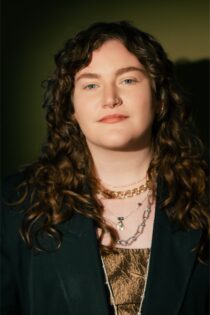
Len Torrie, soprano
Len Torrie is an Ontario-born, soprano and project maker living in Montreal who just completed a master’s degree in early music performance at McGill University under the tutelage of Dominique Labelle. Most recently, Len sang the title role in Charpentier’s oratorio Judith with ensemble Capella Antica and is lead soprano at Christ Church Cathedral, Montreal.
While studying music therapy at Acadia University, Len appeared frequently as a soloist with local ensembles including Symphony Nova Scotia, and was lead soprano of the Manning Chapel Choir from 2014-2018. In 2017, Len was awarded the Canadian Federation of University Women scholarship which funded their participation in Accademia Europea Dell’Opera in Lucca, Italy, where they played Oberto in Handel’s Alcina. This experience motivated Len to pursue a career in performance and upon graduation, Len moved to Montreal to study with soprano Suzie LeBlanc.
Len frequently returns to the Maritimes for solo recitals, collaborations, and residencies. Len also recently completed an artist residency at Banff Arts and Creativity Centre with Canadian tenor Kerry Bursey, as the newly formed early music/folk duo Kalliope. Len is currently exploring the practice of self-accompanying early music on baroque guitar. As a queer, non-binary musician, Len is inspired by the possibility that their queer ancestors had their own musical traditions and that through research, creative speculation, and performance, we can tell a more inclusive and rich story about music and humanity.
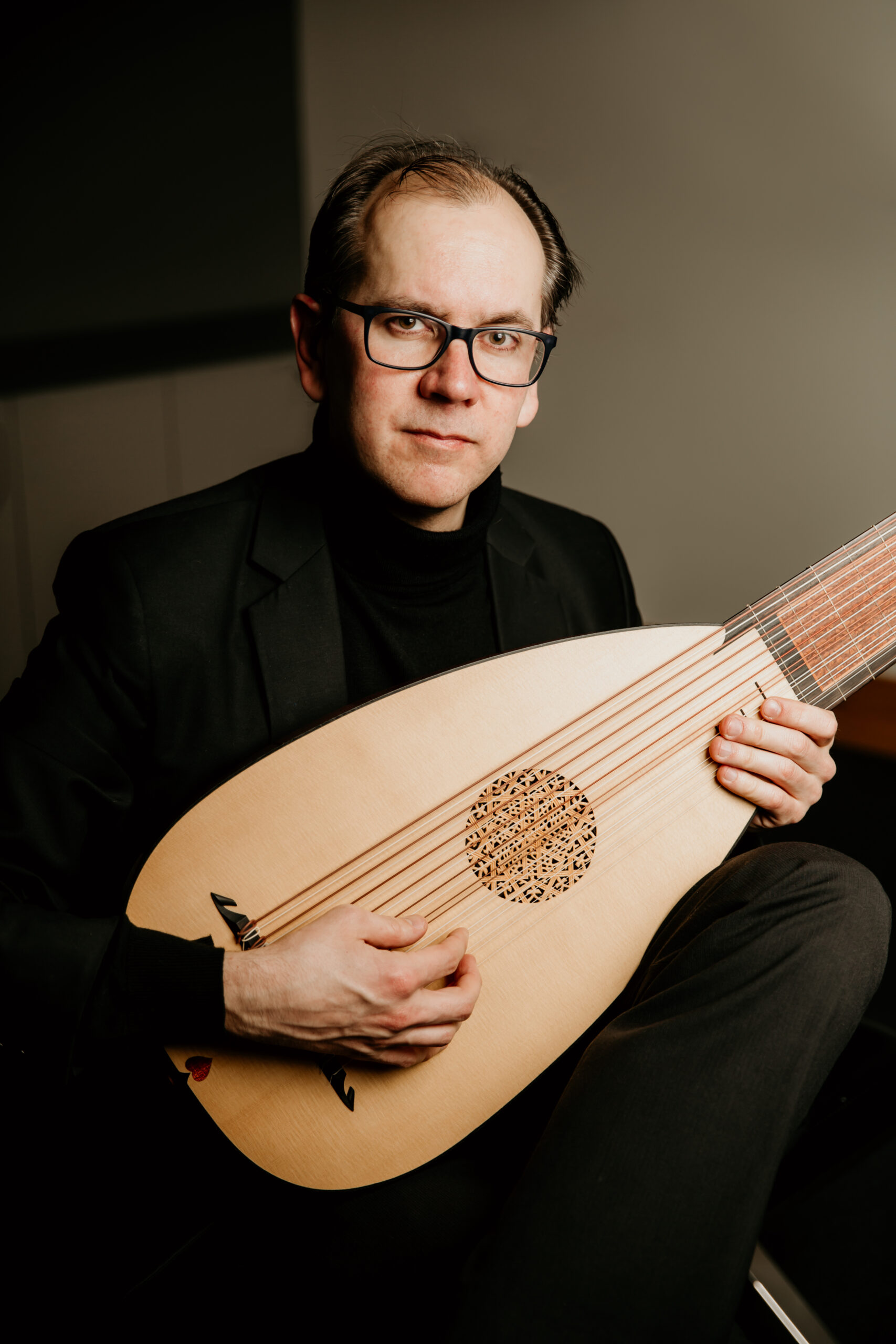
Lucas Harris, baroque guitar
Toronto-based Lucas Harris discovered the lute during his undergraduate studies at Pomona College, and went on to study the lute and early music at the Civica scuola di musica di Milano and at the Hochschule für Künste Bremen. He is a founding member of the Toronto Continuo Collective, the Vesuvius Ensemble and the Lute Legends Collective (an association of specialists in ancient plucked-string traditions from diverse cultures) and is the regular lutenist for Tafelmusik Baroque Orchestra. Lucas plays with many other ensembles in Canada and the USA and has worked with the Smithsonian Chamber Players, Atalante, and Jordi Savall / Le Concert des Nations amongst others.
He teaches at the Tafelmusik Summer and Winter Baroque Institutes, Oberlin Conservatory’s Baroque Performance Institute, and the Canadian Renaissance Music Summer School, and is a regular guest artist with Early Music Vancouver. Lucas is also the Artistic Director of the Toronto Chamber Choir, for which he has created and conducted more than twenty themed concert programs. One of Mr. Harris’ many pandemic projects was the reconstruction of 12 solo voice motets by the Italian nun Chiara Margarita Cozzolani.
Amanda Keesmaat, cello
Amanda Keesmaat (Montreal) performs as principal cellist with Arion Baroque Orchestra. As creator and director of Space Time Continuo, her project first presented by La Nef in 2019, she had recorded two cd's and presented numerous concerts and video recordings. Amanda is an original member of Skye Consort, a member of Les Idées Heureuses, and plays regularly with Clavecin en Concert, Studio de Musique Ancienne de Montréal (SMAM) and Galileo. As a specialist on basse de violon, Amanda belongs to Rendez-Vous Baroque Français, an ensemble specializing in French baroque music. Amanda has also toured with Les Violons du Roy (Quebec), Pacific Baroque Orchestra (Vancouver) and Tafelmusik (Toronto).