• My Account
  • Cart
  • About
    • Who is Early Music Vancouver
    • What is Early Music?
    • OUR INSTRUMENT COLLECTION
    • Employment Opportunities
    • Annual General Meeting 2025
    • 2024/25 Annual Report
  • Pacific Baroque Orchestra
    • Goldberg Variations Tour 2025
  • EVENTS
    • Summer Festival 2026: The Power of Music
    • EMV’s 2026-2027 Main Season
    • Digital Concert Hall
    • Free Events
    • Past Events
  • Learn
    • PROGRAMMES
    • Artist Interviews
    • Instrument Videos
  • Support Us
    • Donate Now
    • Corporate Opportunities
    • Volunteer
    • Host an EMV Musician
  • Ticketing Info
    • BOX OFFICE
    • Gift Vouchers
    • Venues
  • Press Centre
    • Media Releases
    • EMV PRESS KIT
    • EMV in the News
Early Music Vancouver
  • My Account
  • Cart
  • Donate
  • Buy Tickets
  • Gift Vouchers
  • Get our newsletter
Toggle Menu
  • About
    • Who is Early Music Vancouver
    • What is Early Music?
    • OUR INSTRUMENT COLLECTION
    • Employment Opportunities
    • Annual General Meeting 2025
    • 2024/25 Annual Report
  • Pacific Baroque Orchestra
    • Goldberg Variations Tour 2025
  • EVENTS
    • Summer Festival 2026: The Power of Music
    • EMV’s 2026-2027 Main Season
    • Digital Concert Hall
    • Free Events
    • Past Events
  • Learn
    • PROGRAMMES
    • Artist Interviews
    • Instrument Videos
  • Support Us
    • Donate Now
    • Corporate Opportunities
    • Volunteer
    • Host an EMV Musician
  • Ticketing Info
    • BOX OFFICE
    • Gift Vouchers
    • Venues
  • Press Centre
    • Media Releases
    • EMV PRESS KIT
    • EMV in the News
Home  >  Early Music Vancouver Past Events  >  Pilgrimage to Bach feat. Jonathon Adams, baritone, Pacific Baroque Orchestra | Digital Concert Hall

Pilgrimage to Bach feat. Jonathon Adams, baritone, Pacific Baroque Orchestra | Digital Concert Hall

Wednesday, October 13, 2021 | 7:30PMOnline

Pacific Baroque Orchestra; Alexander Weimann | Sponsored by Bruce Munro Wright, O.B.C., Music Director; Jonathon Adams, Baritone; Alan Corbishley, Stage Director


Pilgrimage to Bach is a concert of two solo Bach performances by EMV’s summer artist-in-residence, Jonathon Adams, a Two-Spirit, nêhiyaw michif (Cree-Métis) baritone and the Pacific Baroque Orchestra led from the organ and harpsichord by Alexander Weimann. BWV 82 “Ich habe genug” (It is enough) and BWV 56 – “Ich will den Kreuzstab gerne tragen” (I will carry the burden) are particularly relevant to current times. The cantatas, which work as companion pieces, represent a solo journey, or transition, from this world to the next. In BWV 82, Alan Corbishley stages the cantata as a multimedia performance, heightening the tension between the self and the caged spirit within.

A co-production with Sound the Alarm: Music/Theatre (www.soundthealarm.ca)

This concert is generously supported by an anonymous donor and is presented with support from SoundON, Creative BC, and the Province of British Columbia. 

  • Chan Centre Logo


Programme

J.S. Bach

Cantata BWV 82
“Ich habe genug”

Cantata BWV 56
“Ich will den Kreuzstab gerne tragen”


Texts & Translations

To view/download texts & translations for this concert, click here.


Programme Notes

For many Indigenous people, including myself, there exists a complex relationship to Christianity. Although there is a clear and well documented pattern of indoctrination and cultural genocide against Indigenous communities by the church over many centuries, many Indigenous people remain practicing Christians or retain some nostalgia for Christian symbols and aspects of ritual. On the other hand, many in our communities have preserved or returned to the older, traditional spiritual practices of Turtle Island [North America]. Understandably, there exists a tension there. Although raised Lutheran, I am not Christian. I have begun the decolonizing work to separate my Western European musical practice from my deeply rooted spiritual identities – but I cannot fully unknow the deep impact Christian music, ritual and texts have had on me. In this way I function as an artistic medium at the intersection of historical performance and contemporary Indigenous discourse.

When I sing the sacred music of Bach, I am aware that I am occupying an historically white, Christian, heteronormative space as a queer, two-spirit, Cree-Metis singer. This form of take-over or occupation, the interruption of a lineage, is an interesting form of resistance and resurgence for me. By lending my Indigenous gaze and my critical lens to the performance of this music, I exhume and challenge histories of genocide, white supremacy, queer-phobia within this repertoire while finding ways to celebrate its beauty.

– Jonathon Adams, Baritone

Through Canada’s current awakening to its destructive and oppressive past, with colonial infrastructures and toxic power structures, this artistic program aims to challenge historically white, Christian, heteronormative narratives as they relate to personal and cultural identity.  Baritone Jonathon Adams has stated above that this concert is intended to be a “takeover” of colonial and Christian baroque music.  As a gay man myself, I, too, struggle with the complex relationship that Christianity and its social ideology has forced onto LGBTQ2S communities and the pressure to “other” ourselves into conformity. It is this damaging lifelong gaslighting that generates a deep struggle in healthy identity.  Through this programme, we are ‘sounding the alarm’ on mental health and the need to reclaim healthy identities from within contained and limiting ideologies.

As a musical symbol for Christian and colonial infrastructures, we have chosen two of Bach’s most glorious sacred cantatas to theatrically explore.  The first is his famous BWV 82 “Ich habe genug” (It is enough). This 25-minute monodrama for baritone is dramatically centred around the spirit’s yearning to escape the physical self through death.  “Ah! if only the Lord would free me from my body’s enslavement; Ah! If indeed my liberation were soon, With joy I would say to you, O World, It is enough.”

Our live, multi-media approach explores this idea of physical being, layered against a digital realization of the internal self and its multitudes.  Due to toxic internal narratives, added to our oppressive societal ‘scripts’, this tension of being, often amounts to an array of mental health issues and an inevitable yearning for release.  In this presentation, we don’t aim to speak directly to a literal death, but rather the process of emancipation from a fragmented identity, into a healthier alignment of self.

– Alan Corbishley:  Stage Director and Co-Producer, www.alancorbishley.com  www.soundthealarm.ca

Pacific Baroque Orchestra

The ‘house band’ of Early Music Vancouver, The Pacific Baroque Orchestra (PBO) is recognized as one of Canada’s most exciting and innovative ensembles performing “early music for modern ears.” Formed in 1990, the orchestra quickly established itself as a force in Vancouver’s burgeoning music scene with the ongoing support of Early Music Vancouver.  In 2009, PBO welcomed Alexander Weimann as Director. His imaginative programming, creativity and engaging musicianship have carved out a unique and vital place in the cultural landscape of Vancouver.

PBO regularly joins forces with internationally-celebrated Canadian guest artists, providing performance opportunities for Canadian musicians while exposing West Coast audiences to a spectacular variety of talent. The Orchestra has also toured throughout BC, the northern United States, and across Canada. Their 2019 East Coast Canadian tour with Canadian soprano Karina Gauvin culminated in a critically acclaimed album, Nuit Blanches, released by Atma Classique. 

read more...

Alexander Weimann | Sponsored by Bruce Munro Wright, O.B.C., Music Director

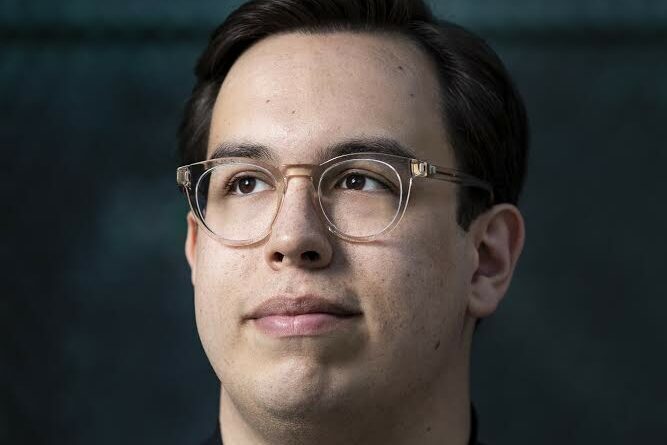
The internationally renowned keyboard artist Alexander Weimann has spent his life enveloped by the therapeutic power and beauty of making music. Alex grew up in Munich. At age three he became fascinated by the intense magic of the church organ. He started piano at six, formal organ lessons at 12 and harpsichord at university (along with theatre theory, medieval Latin and jazz piano.) He is in huge demand as a director, soloist and chamber player, traveling the world with leading North American and European ensembles. He is Artistic Director of the Pacific Baroque Orchestra in Vancouver and teaches at the University of British Columbia where he directs the Baroque Orchestra Mentorship Programme.

Alex has appeared on more than 100 recordings, including the Juno-award-winning album “Prima Donna” with Karina Gauvin and Arion Baroque orchestra. His latest album series “The Art of Improvisation” (Volume 1: A Prayer for Peace; Volume 2: Ad libitum; and Volume 3: Canavian Variations, released on Redshift, 2024) unites his passions for both baroque music and improvisation on organ, harpsichord, and piano.
read more...

Jonathon Adams, Baritone

Jonathon Adams is a Cree-Métis two-spirit baritone from amiskwaciwâskahikan (Edmonton, AB). They have appeared as a soloist under Masaaki Suzuki, Philippe Herreweghe, Laurence Equilbey, and Alexander Weimann, among others, with the New York Philharmonic, National Symphony, San Francisco Symphony, and Toronto Symphony Orchestras, the Washington Bach Consort, Tafelmusik, Ricercar Consort, B’Rock, Vox Luminis, the Netherlands Bach Society, and il Gardellino. In 2021 they were named the first artist-in-residence at Early Music Vancouver. They have lectured and led workshops at the Universities of Toronto, Manitoba, British Columbia, Alberta (Augustana), Bard College, Festival Montréal Baroque, and the Juilliard School.

Jonathon was featured in Against the Grain Theatre’s 2020 film MESSIAH/COMPLEX, in Sidi Larbi Cherkaoui’s MEA CULPA with Ballet Vlaanderen, and on Jessica McMann’s most recent album ‘Prairie Dusk’. They attended the Victoria Conservatory of Music, the Royal Academy of Music, and the Conservatorium van Amsterdam, studying with Nancy Argenta, Emma Kirkby and Rosemary Joshua.
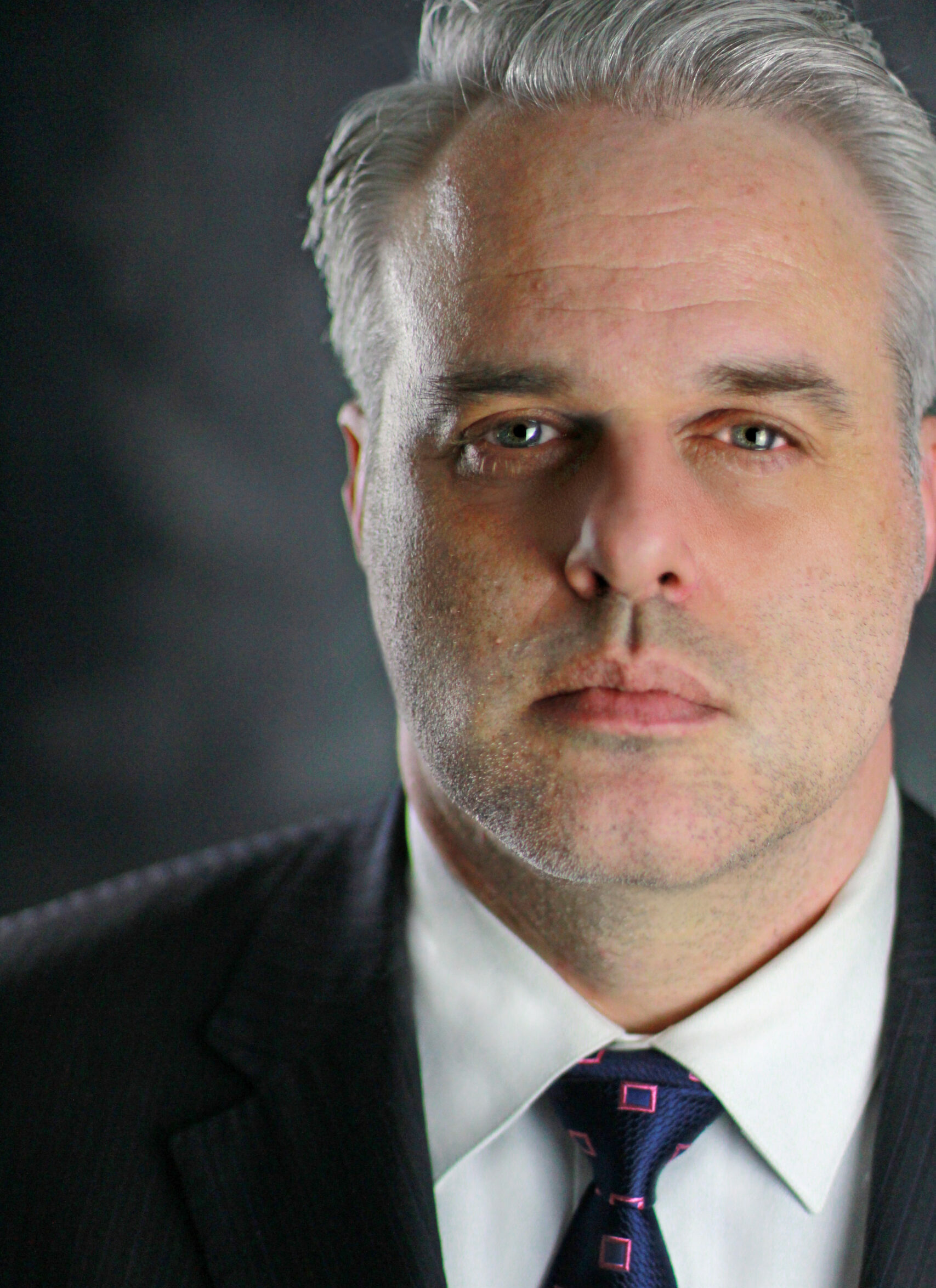
read more...

Alan Corbishley, Stage Director

Alan is known as a baritone having sung throughout North America and Europe and is now more focused on producing and stage direction.  As a producer, Alan is the founding Artistic Director of Sound the Alarm:  Music/Theatre and is also the current Director of Concerts with City Opera Vancouver.  As a stage director, his productions have been called “Poetry on Stage”, and have been named in Vancouver’s Annual Best Music Events by vanclassicalmusic.com, including “Best Opera Production in 2017” for Handel’s Acis & Galatea through Sound the Alarm, and “Vancouver’s Best Experiment of 2018” for City Opera Vancouver’s production of Nigredo Hotel in 2018.  He has found a home with City Opera Vancouver having also directed their production of The Lost Operas of Mozart, and more recently, co-created and directed their production Berlin:  The Last Cabaret, presented at the 2020 PuSh Festival to sold-out crowds.  In 2016, his original cinematic concert Dragging Piaf was featured at Vancouver’s Queer Arts Festival to rave reviews and in 2014, Alan wrote and directed his “silent play”, based on the life of Charlie Chaplin entitled Silent Chap, for Western Canada Theatre’s mainstage season.   Upcoming, he is the Creative Director for Moonwake:  Theatre for the Ears!, a series of audio-dramas for Sound the Alarm, as well as a co-director and co-producer for the Canadian opera premiere of Angel’s Bone.  For more information, please visit www.alancorbishley.com


Media

https://www.youtube.com/watch?v=RBSwpSr94so

1254 W 7TH AVE
VANCOUVER, BC, V6H 1B6

(604) 732-1610
staff@earlymusic.bc.ca

  • About EMV
    • What is Early Music?
    • Staff
    • Partners
    • Board of Directors
    • Venues
  • Education & Community
    • BC Scholarship Programme – 2026/2027
    • OUR INSTRUMENT COLLECTION
  • Press Centre
  • Join Our Mailing List
Facebook URLTwitter URLYoutube URLInstagram URL

Copyright © 2026 EARLY MUSIC VANCOUVER | EMV | PHOTOS BY JESS MACALEESE, MARK MUSHET AND JAN GATES.
CONTACT EMV FOR INDIVIDUAL CREDITS. | site by DFS Digital Fusion Studios web designAND MEDIUM RARE Medium Rare Interactive

Een Romantische Johannes Passion

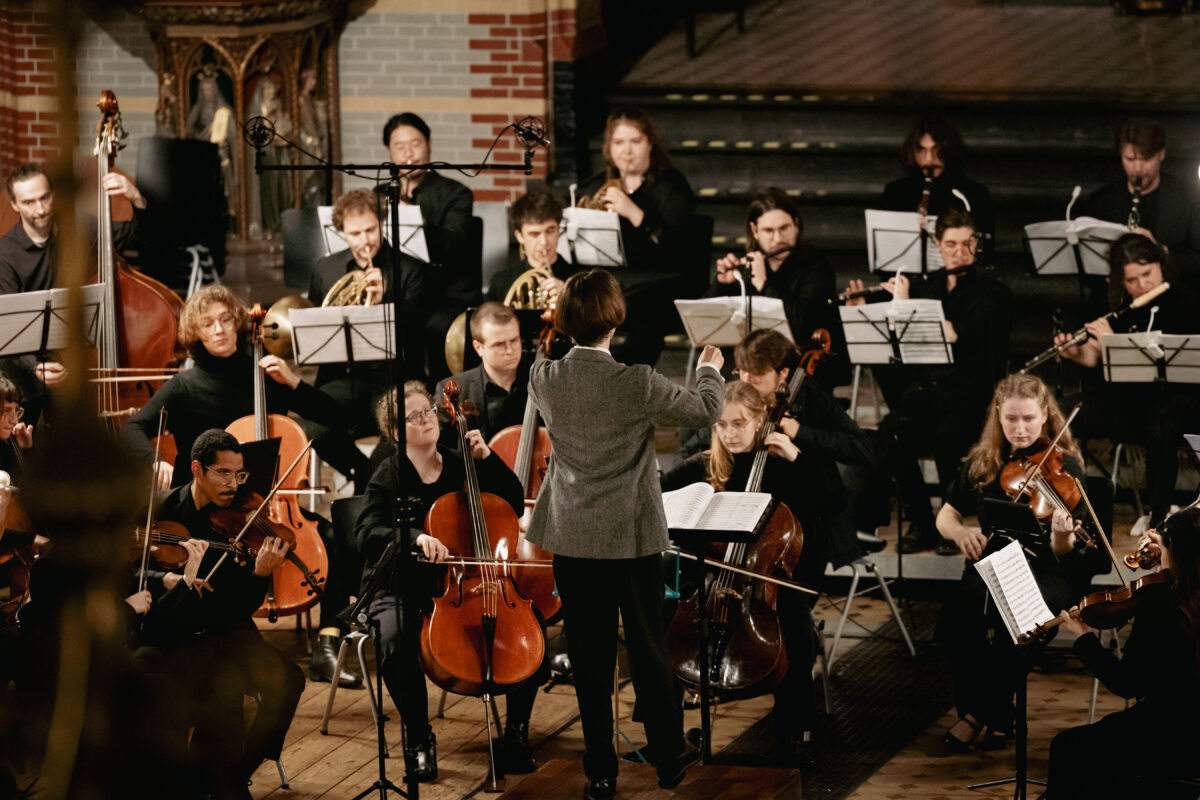
Historical Performance has been steadily looking toward the nineteenth-century as a source of inspiration, and Orchestra Lagrandt wants to lead the charge into Romantic orchestral performance practice. As an orchestra of ambitious musicians in their twenties from 25 different nations, we aspire to represent the voice of the new generation in Historical Performance.

Een Romantische Johannes Passion is an ongoing project to reimagine the Johannes Passion of J. S. Bach in a late nineteenth century style. The first Passion revivals in the Netherlands took place in Rotterdam in 1870, featuring large symphonic orchestrations, and a radically different musical language than that of the HP and modern classical worlds. In our initial performance with the Tangram Chamber Choir, we pushed the boundaries of what Romantic Bach might have sounded like: exploring changes in orchestration, stoic tempi, rubato, phrasing, nineteenth- century bowing practices, and even portamento. We plan to establish this project as an annual tradition every Easter season, reworking the arrangement each time in the spirit of Romantic spontaneity.


One of the wonderful things about the Historical Performance movement is that we are able to use forgotten practices, this time hailing from the nineteenth century, to present such a beloved and well known-work in a new light.

The world is familiar with stories of clever forgers whose life’s mission is to cunningly reproduce the light and shadows of historical masterworks, from Vermeer’s brushstrokes to Da Vinci’s proportional precision… but what if these crimes of craftsmanship were to extend beyond the visual arts? What if the pieces we know to be by Palestrina, Monteverdi or even Johann Sebastian Bach were in fact stylistic copies, artfully composed by a secret circle of music forgers and passed off as the work of the greats? What if those music forgers are at work as we speak? 

This premise inspires our original program The Music Forgery Workshop. Our early music comedy imagines the lives of such a circle of musical criminals, offering a fresh and lively presentation of historical compositions, not as museum artifacts but as living works in progress. The workshop itself is set up on the stage and its members carry forth the plot in music and words. A narrator in the role of a suspicious inspector lends the performance a theatrical flow. The listener is invited into a satire on high society’s art commerce, while the performers make fun of themselves for having devoted their lives to the niche subject of historical music performance. 

Violinist Elizabeth Sommers combines her skills and experience in traditional music with expertise in the performance and improvisation of medieval and Renaissance repertoires. Multi-instrumentalist Eliot X. Dios (keyboards, bagpipes and flutes) works wholeheartedly to employ storytelling techniques developed through the history of literature and cinema in his early music concerts. Composer Gunnar Haraldsson (violin, guitar) seeks to translate the forms and intentions of early composition for a modern audience. Halldór B. Arnarson (keyboards, voice) has devoted his career to bringing musical craftsmanship from the era of counterpoint to the attention of the public and comedy to the early music scene. Singer and storyteller Ásta S. Arnardóttir brings the storyline to the public with personal immediacy, and through her character work defines the different veins of the show, sometimes hilarious and sometimes serious. 

The story is narrated by the character of the Inspector, acted out by the members of the MFW, and told in rhyming Icelandic verse in one musical pillar of the show, a madrigal composed by our very own 

Halldór in the style of Monteverdi. The show has an entertaining educational dimension. The audience is exposed to a broad sweep of historical and musical information in a condensed form, necessary to understand the musical humour, while dramatic rhythm and scenographic effects prevent overwhelm. We also place particular emphasis on theatrical illusion and synchronisation. One example appears in the opening scene, in which the inspector is seen watching television. On stage, this becomes a complex exercise in coordination: each time the inspector presses a button on the remote control, the musicians instantly switch pieces, creating the impression of rapidly changing television channels. 

This opening scene establishes the tone of the entire show, comical and satirical in its storytelling and diverse in its musical language. It not only introduces the wide range of musical styles that appear throughout the performance, but also functions as the plot’s inciting incident, as the inspector hears a news report about the discovery of a previously unknown concerto by Vivaldi. 

Another important scene takes place when one forger is alone on stage in low light, perusing books on medieval music, while the musicians perform and sing offstage, sounding his audiation as he reads. This intimate moment evokes the sleepless nights spent studying facsimiles and learning historical compositional techniques, by which the forger acquires the inspiration and the expertise necessary to his art, and reveals a hidden side of musical performance: the immense amount of study and preparation that precedes the moment on stage. This setting also creates space for visual and musical comedy, as seen in the trailer video, where a 14th-century melody is played backwards because Halldór is unknowingly reading the facsimile upside-down, only realising the mistake when the music begins to sound absurd. 

Fun and friendship are at the heart of the whole project, though the link between music and crime is an important historical consideration. Classical music was often used as the demonstration of a monarch’s power, music teaching as a cover up for secret affairs, and pieces were published under another’s name for profit. Such examples of “inappropriate practices” carry an exciting and attractive element for the audience which the MFW seeks to exploit. Under this light-hearted surface lies a more serious layer of questions concerning our present-day existence, such as excessive materialism in high society and the threat posed on human craftsmanship and skill by the rise of artificial intelligence. 

Please Note:

The main applicant and creative/intellectual driver of the project must be 30 or under (on May 15th).

The average age of all musicians must not be older than 32, and the maximum age of supporting musicians must be no more than 35 (on May 15th.)