• My Account
  • Cart
  • About
    • Who is Early Music Vancouver
    • What is Early Music?
    • OUR INSTRUMENT COLLECTION
    • Employment Opportunities
    • Annual General Meeting 2025
    • 2024/25 Annual Report
  • Pacific Baroque Orchestra
    • Goldberg Variations Tour 2025
  • EVENTS
    • Summer Festival 2026: The Power of Music
    • EMV’s 2026-2027 Main Season
    • Digital Concert Hall
    • Free Events
    • Past Events
  • Learn
    • PROGRAMMES
    • Artist Interviews
    • Instrument Videos
  • Support Us
    • Donate Now
    • Corporate Opportunities
    • Volunteer
    • Host an EMV Musician
  • Ticketing Info
    • BOX OFFICE
    • Gift Vouchers
    • Venues
  • Press Centre
    • Media Releases
    • EMV PRESS KIT
    • EMV in the News
Early Music Vancouver
  • My Account
  • Cart
  • Donate
  • Buy Tickets
  • Gift Vouchers
  • Get our newsletter
Toggle Menu
  • About
    • Who is Early Music Vancouver
    • What is Early Music?
    • OUR INSTRUMENT COLLECTION
    • Employment Opportunities
    • Annual General Meeting 2025
    • 2024/25 Annual Report
  • Pacific Baroque Orchestra
    • Goldberg Variations Tour 2025
  • EVENTS
    • Summer Festival 2026: The Power of Music
    • EMV’s 2026-2027 Main Season
    • Digital Concert Hall
    • Free Events
    • Past Events
  • Learn
    • PROGRAMMES
    • Artist Interviews
    • Instrument Videos
  • Support Us
    • Donate Now
    • Corporate Opportunities
    • Volunteer
    • Host an EMV Musician
  • Ticketing Info
    • BOX OFFICE
    • Gift Vouchers
    • Venues
  • Press Centre
    • Media Releases
    • EMV PRESS KIT
    • EMV in the News
Home  >  Early Music Vancouver Past Events  >  Bach’s Sons feat. Elinor Frey, cello & Pacific Baroque Orchestra | Digital Concert Hall

Bach’s Sons feat. Elinor Frey, cello & Pacific Baroque Orchestra | Digital Concert Hall

Wednesday, November 24, 2021 | 7:30PMOnline

Elinor Frey, Cello; Pacific Baroque Orchestra; Alexander Weimann | Sponsored by Bruce Munro Wright, O.B.C., Music Director


Of J.S. Bach’s children that survived into adulthood, four became composers whose music we still perform. While their musical facility reflects their father’s influence, each son had a very different path of travel, employment, and development of their musical voice. Johann Christian’s Chromatic Fugue on B-A-C-H pays homage to the serious, contrapuntal style of the past, but usually, the Bach sons write in the galant style of their own generation, characterized by simplicity and immediacy of appeal. The closeness of the Bachs sometimes complicates the attribution of their music. The Orchestral Suite in G minor, BWV 1070, once thought to be by father Johann Sebastian, was more likely written by Wilhelm Friedemann. The Cello Sonata in A Major of Johann Christoph Friedrich seems liberated, natural, and comprehensible when played on a cello fit with a fifth string whereas the Cello Concerto in A minor of his older brother, Carl Philipp Emanuel fits well on the more popular 4-string instrument. Each work demonstrates the language of Sensibility (Empfindsamkeit): intimate, sensitive, and subjective. In their music, emotions are fleeting and instantaneous and, above all, the beauty of melody is emphasized.

This concert is generously supported in memory of Vic Baker

  • Chan Centre Logo

Programme

WILHELM FRIEDEMANN BACH (1710-1784)
BWV 1070 Suite for orchestra in g minor

Larghetto – Un poco allegro
Torneo
Aria
Menuetto
Capriccio

JOHANN CHRISTOPH FRIEDRICH BACH (1732-1795)
Sonata for cello and basso continuo in A major

Larghetto
Allegro
Tempo di Minuetto

JOHANN CHRISTIAN BACH (1735-1782)
Chromatic Fugue on B-A-C-H in F major for keyboard solo

CARL PHILLIPP EMANUEL BACH (1714-1788)
Concerto for violoncello, strings, and basso continuo in A minor, [H. 432]

Allegro assai
Andante
Allegro assai


DOWNLOAD THE PROGRAMME

To read or download and print the full programme click here.


Programme Notes

The four sons of Johann Sebastian Bach had long careers as professional musicians, each unique in their musical output and personal character. In his lifetime, the eldest son (and sometimes named favourite?), Wilhelm Friedmann Bach (1710-1784), achieved some measure of success through official posts in Dresden and Halle as an organist and built a reputation as a brilliant improviser. The end of his life was spent in Berlin somewhat floundering as a performer, barely active as a composer. The royal courts of mid-eighteenth century Berlin were lively crossroads for some of the greatest musicians of the time. Court musicians and visitors were famous virtuosos performing music full of expressivity and fantasy. It is in this context that the second-eldest, Carl Philipp Emmanuel Bach (1714-1788), found a thriving career as a keyboard player and composer before succeeding his godfather, Telemann, as Kapellmeister in Hamburg. Emmanuel Bach kept in close contact with his two half-brothers, Johann Christoph Friedrich Bach (1732-1795), longtime Konzertmeister of the Bückeburg Hofkapelle, and the youngest of the four, Johann Christian Bach (1735-1782), who is known for his career in London but first moved to Berlin to study and live with his brother after the death of their father, Johann Sebastian, in 1750.

Although the Orchestral Suite in G Minor was given a BWV number in the catalog of J.S. Bach, it is generally thought to belong among the works of Wilhelm Friedmann. The suite departs from the father’s practices for orchestral suites in two main ways: the form of the opening movement and the use of a different key for the Aria (J.S. Bach’s suites remain in one key). The suite also features some unusual and interesting movements including a Torneo (tournament) which implies a sporting event, perhaps even an extravagant equestrian ballet. Overall, the suite makes use of both galant idioms and a more strict counterpoint, a mixing of styles often characteristic of Wilhelm Friedmann’s music.

His half-brother Johann Christoph Friedrich’s Cello Sonata in A Major also exhibits many hallmarks of the Galant and also the correlated Empfindsamer stil, calling for various changes in dynamic, both abrupt and subtle, at the service of beautiful melodies and expressive fantasy. Friedrich’s close association with his brother, Carl Philipp Emmanuel, is evidenced by the printing of the sonata in the latter’s Musikalisches Vierlerley of 1770, a kind of subscription-based publication of various chamber works from well-known composers such as Graun, Fasch, and Kirnberger. This Sonata in A Major follows the Slow-Fast-Fast form which O’Loghlin calls the “Berlin sonata schema” in which the opening movement is long and substantial and ends with a cadenza. The five-string cello particularly supports passagework using a pedal on the open E-string. Indeed, many mid-18th century sonatas for cello seem liberated, natural, and comprehensible when played on an instrument fitted with a fifth string, even if this instrument was not named in the score. The most famous example of 18th-century music that expressly calls for a 5-string cello is J.S. Bach’s sixth suite.

J.S. Bach educated his sons and was a source of inspiration throughout their lives, as well as for countless other students and colleagues. The Bach family name was synonymous with music as the lineage of Bach musicians went back for generations. Sebastian Bach famously employed the musical cryptogram “B-A-C-H” in his Art of the Fugue and in a few other works. This melodic fragment created by the family name, B-flat, A, C, B-natural, was also taken up by Johann Christian Bach in his Chromatic Fugue in F Major.
Like A Major Sonata by J.C.F. Bach, the Cello Concerto in A Minor of Carl Philipp Emanuel Bach also demonstrates the language of Sensibility (Empfindsamkeit): an expression of sadness, anger, wrath, joy, love, and praise. In their music, emotions are fleeting and instantaneous and, above all, the beauty of melody is emphasized. As is the case with cello works produced in other European musical centres, C.P.E. Bach’s cello concertos are closely tied to prosperous patrons and to the presence of elite professionals in Berlin (in particular at three of the Hohenzollern courts, those of King Frederick II “the Great”, his sister Anna Amalia, and his nephew, the Crown Prince Friedrich Wilhelm II). The cello may also have been featured at many of the flourishing musical academies and private concerts throughout Berlin.
Cello repertoire and cello playing are not often thought to be among the principal contributions of mid-eighteenth-century Berlin composers. More prolific and renowned were the performers on the flute (Quantz, Frederick the Great himself), violin (Benda, J.G. Graun), gamba (L.C. Hesse), and keyboards (C.P.E. Bach). Viola da gamba repertoire flourished under the presence of Ludwig Christian Hesse and the enthusiasm of his student, Crown Prince Friedrich Wilhelm II. The Prince supposedly favoured the cello after the 1769 departure of Hesse and employed both Carlo Graziani and Jean-Pierre Duport as his private instructors in subsequent years, and was the dedicatee of works by Boccherini, Beethoven, and Mozart. In any case, it’s in Berlin in 1750 (the year of J.S. Bach’s death) that CPE Bach wrote the Concerto in A Minor for cello and strings. Likely performed at a chamber music society event by one of the various prominent cellists of court ensembles, Bach later transcribed the work as a keyboard concerto and then again as a flute concerto. The unusual 3/2 meter in the opening Allegro assai sets the stage for a tempestuous and dramatic work. Fragmented and blustery exchanges between soloist and orchestra permeate the concerto, including in the Andante, which abounds in contrast as well as tenderness.
  • Elinor Frey

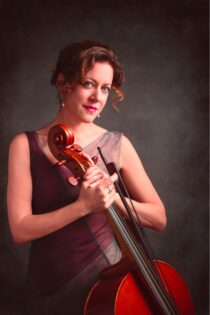
Elinor Frey, Cello

Elinor Frey is a leading Canadian-American cellist, gambist, and researcher. Her albums on the Belgian label Passacaille and Canadian label Analekta  – many of which are world premiere recordings – are the fruit of long collaborations with artists such as Suzie LeBlanc, Marc Vanscheeuwijck, and Lorenzo Ghielmi, as well as with composers including Maxime McKinley, Linda Catlin Smith, Christian Mason, and Lisa Streich. Elinor’s recording of cello sonatas by Giuseppe Clemente Dall’Abaco received a Diapason d’Or and her critical editions of Dall’Abaco’s cello music is published in collaboration with Walhall Editions. Early Italian Cello Concertos, her album in collaboration with Rosa Barocca orchestra, won the 2023 JUNO Award for Classical Album of the Year (small ensemble).

Elinor is the artistic director of Accademia de’ Dissonanti, an organization for performance and research, and she has performed throughout the Americas and in Europe in recital and with numerous chamber ensembles and orchestras (Constantinople, Les idées heureuses, Il Gardellino, Tafelmusik, Pacific Baroque Orchestra, etc.). In March 2023, she performed Boccherini and Sammartini concertos with the Australian Brandenburg Orchestra.

Recipient of dozens of grants and prizes supporting performance and research, including the US-Italy Fulbright Fellowship (studying with Paolo Beschi in Como, Italy) and a recent research residency at the Orpheus Institute in Ghent, Elinor holds degrees from McGill, Mannes, and Juilliard. She teaches Baroque cello and performance practice at McGill University and the Université de Montréal and is a Visiting Fellow in Music (2020–2023) at Lady Margaret Hall, Oxford University. Frey was awarded Québec’s Opus Prize for “Performer of the Year” in 2021.

read more...

Pacific Baroque Orchestra

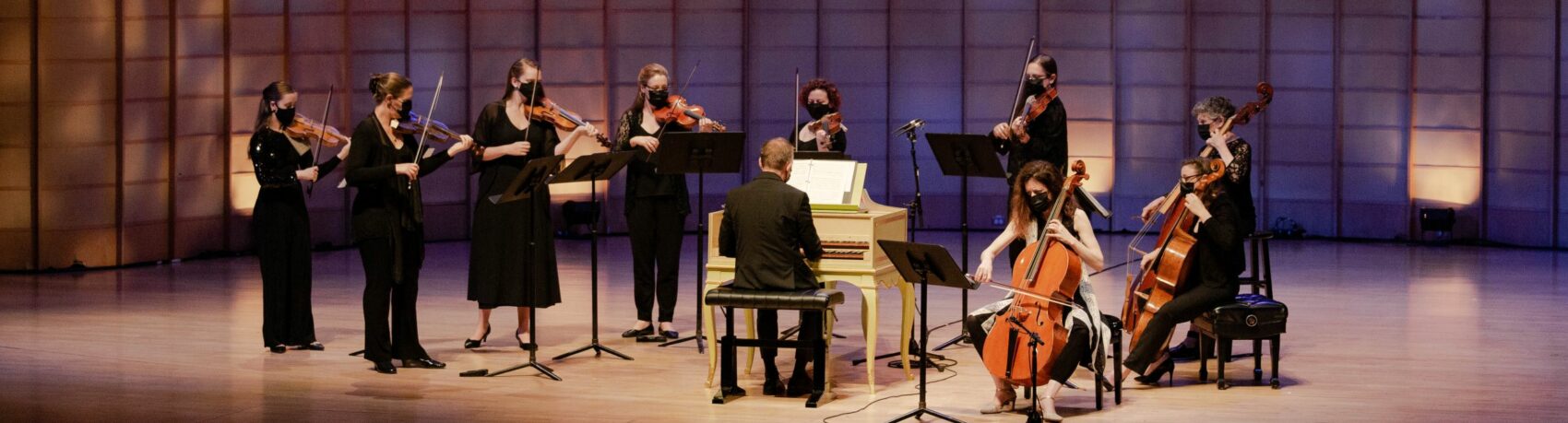
The ‘house band’ of Early Music Vancouver, The Pacific Baroque Orchestra (PBO) is recognized as one of Canada’s most exciting and innovative ensembles performing “early music for modern ears.” Formed in 1990, the orchestra quickly established itself as a force in Vancouver’s burgeoning music scene with the ongoing support of Early Music Vancouver.  In 2009, PBO welcomed Alexander Weimann as Director. His imaginative programming, creativity and engaging musicianship have carved out a unique and vital place in the cultural landscape of Vancouver.

PBO regularly joins forces with internationally-celebrated Canadian guest artists, providing performance opportunities for Canadian musicians while exposing West Coast audiences to a spectacular variety of talent. The Orchestra has also toured throughout BC, the northern United States, and across Canada. Their 2019 East Coast Canadian tour with Canadian soprano Karina Gauvin culminated in a critically acclaimed album, Nuit Blanches, released by Atma Classique. 

read more...

Alexander Weimann | Sponsored by Bruce Munro Wright, O.B.C., Music Director

The internationally renowned keyboard artist Alexander Weimann has spent his life enveloped by the therapeutic power and beauty of making music. Alex grew up in Munich. At age three he became fascinated by the intense magic of the church organ. He started piano at six, formal organ lessons at 12 and harpsichord at university (along with theatre theory, medieval Latin and jazz piano.) He is in huge demand as a director, soloist and chamber player, traveling the world with leading North American and European ensembles. He is Artistic Director of the Pacific Baroque Orchestra in Vancouver and teaches at the University of British Columbia where he directs the Baroque Orchestra Mentorship Programme.

Alex has appeared on more than 100 recordings, including the Juno-award-winning album “Prima Donna” with Karina Gauvin and Arion Baroque orchestra. His latest album series “The Art of Improvisation” (Volume 1: A Prayer for Peace; Volume 2: Ad libitum; and Volume 3: Canavian Variations, released on Redshift, 2024) unites his passions for both baroque music and improvisation on organ, harpsichord, and piano.

read more...

1254 W 7TH AVE
VANCOUVER, BC, V6H 1B6

(604) 732-1610
staff@earlymusic.bc.ca

  • About EMV
    • What is Early Music?
    • Staff
    • Partners
    • Board of Directors
    • Venues
  • Education & Community
    • BC Scholarship Programme – 2026/2027
    • OUR INSTRUMENT COLLECTION
  • Press Centre
  • Join Our Mailing List
Facebook URLTwitter URLYoutube URLInstagram URL

Copyright © 2026 EARLY MUSIC VANCOUVER | EMV | PHOTOS BY JESS MACALEESE, MARK MUSHET AND JAN GATES.
CONTACT EMV FOR INDIVIDUAL CREDITS. | site by DFS Digital Fusion Studios web designAND MEDIUM RARE Medium Rare Interactive

Een Romantische Johannes Passion

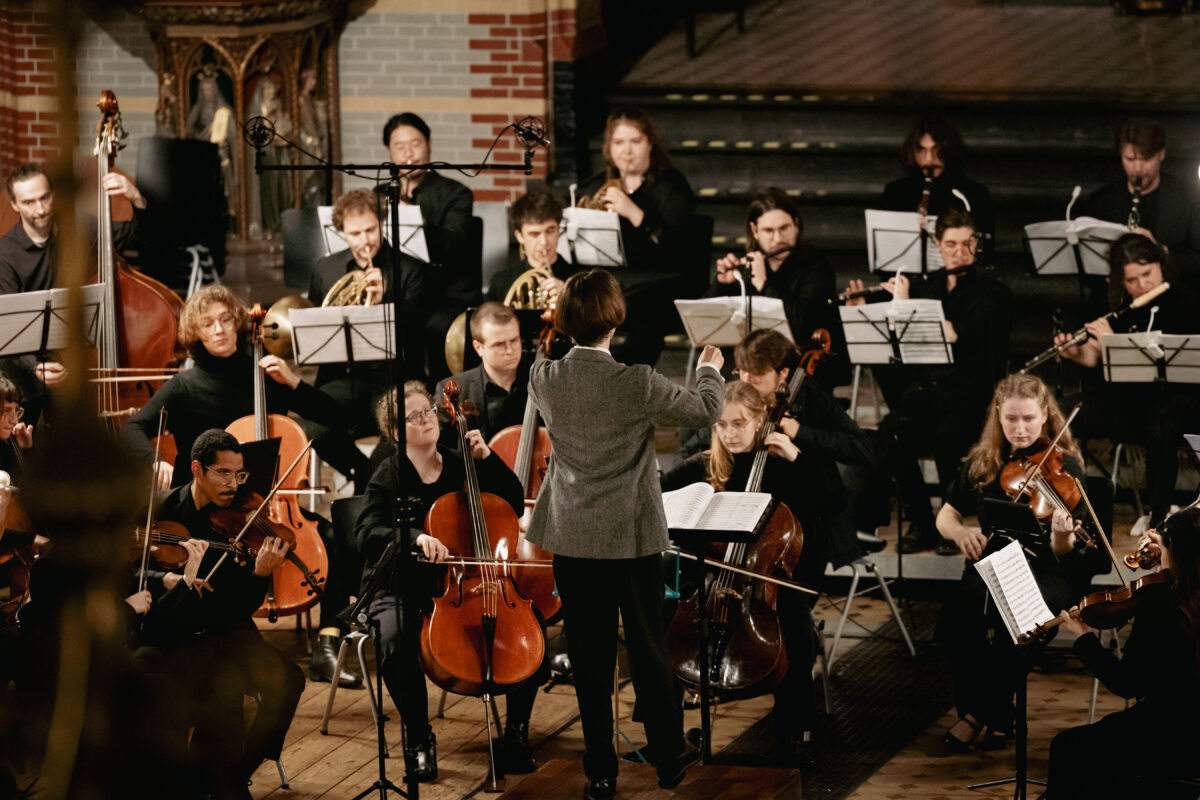
Historical Performance has been steadily looking toward the nineteenth-century as a source of inspiration, and Orchestra Lagrandt wants to lead the charge into Romantic orchestral performance practice. As an orchestra of ambitious musicians in their twenties from 25 different nations, we aspire to represent the voice of the new generation in Historical Performance.

Een Romantische Johannes Passion is an ongoing project to reimagine the Johannes Passion of J. S. Bach in a late nineteenth century style. The first Passion revivals in the Netherlands took place in Rotterdam in 1870, featuring large symphonic orchestrations, and a radically different musical language than that of the HP and modern classical worlds. In our initial performance with the Tangram Chamber Choir, we pushed the boundaries of what Romantic Bach might have sounded like: exploring changes in orchestration, stoic tempi, rubato, phrasing, nineteenth- century bowing practices, and even portamento. We plan to establish this project as an annual tradition every Easter season, reworking the arrangement each time in the spirit of Romantic spontaneity.


One of the wonderful things about the Historical Performance movement is that we are able to use forgotten practices, this time hailing from the nineteenth century, to present such a beloved and well known-work in a new light.

The world is familiar with stories of clever forgers whose life’s mission is to cunningly reproduce the light and shadows of historical masterworks, from Vermeer’s brushstrokes to Da Vinci’s proportional precision… but what if these crimes of craftsmanship were to extend beyond the visual arts? What if the pieces we know to be by Palestrina, Monteverdi or even Johann Sebastian Bach were in fact stylistic copies, artfully composed by a secret circle of music forgers and passed off as the work of the greats? What if those music forgers are at work as we speak? 

This premise inspires our original program The Music Forgery Workshop. Our early music comedy imagines the lives of such a circle of musical criminals, offering a fresh and lively presentation of historical compositions, not as museum artifacts but as living works in progress. The workshop itself is set up on the stage and its members carry forth the plot in music and words. A narrator in the role of a suspicious inspector lends the performance a theatrical flow. The listener is invited into a satire on high society’s art commerce, while the performers make fun of themselves for having devoted their lives to the niche subject of historical music performance. 

Violinist Elizabeth Sommers combines her skills and experience in traditional music with expertise in the performance and improvisation of medieval and Renaissance repertoires. Multi-instrumentalist Eliot X. Dios (keyboards, bagpipes and flutes) works wholeheartedly to employ storytelling techniques developed through the history of literature and cinema in his early music concerts. Composer Gunnar Haraldsson (violin, guitar) seeks to translate the forms and intentions of early composition for a modern audience. Halldór B. Arnarson (keyboards, voice) has devoted his career to bringing musical craftsmanship from the era of counterpoint to the attention of the public and comedy to the early music scene. Singer and storyteller Ásta S. Arnardóttir brings the storyline to the public with personal immediacy, and through her character work defines the different veins of the show, sometimes hilarious and sometimes serious. 

The story is narrated by the character of the Inspector, acted out by the members of the MFW, and told in rhyming Icelandic verse in one musical pillar of the show, a madrigal composed by our very own 

Halldór in the style of Monteverdi. The show has an entertaining educational dimension. The audience is exposed to a broad sweep of historical and musical information in a condensed form, necessary to understand the musical humour, while dramatic rhythm and scenographic effects prevent overwhelm. We also place particular emphasis on theatrical illusion and synchronisation. One example appears in the opening scene, in which the inspector is seen watching television. On stage, this becomes a complex exercise in coordination: each time the inspector presses a button on the remote control, the musicians instantly switch pieces, creating the impression of rapidly changing television channels. 

This opening scene establishes the tone of the entire show, comical and satirical in its storytelling and diverse in its musical language. It not only introduces the wide range of musical styles that appear throughout the performance, but also functions as the plot’s inciting incident, as the inspector hears a news report about the discovery of a previously unknown concerto by Vivaldi. 

Another important scene takes place when one forger is alone on stage in low light, perusing books on medieval music, while the musicians perform and sing offstage, sounding his audiation as he reads. This intimate moment evokes the sleepless nights spent studying facsimiles and learning historical compositional techniques, by which the forger acquires the inspiration and the expertise necessary to his art, and reveals a hidden side of musical performance: the immense amount of study and preparation that precedes the moment on stage. This setting also creates space for visual and musical comedy, as seen in the trailer video, where a 14th-century melody is played backwards because Halldór is unknowingly reading the facsimile upside-down, only realising the mistake when the music begins to sound absurd. 

Fun and friendship are at the heart of the whole project, though the link between music and crime is an important historical consideration. Classical music was often used as the demonstration of a monarch’s power, music teaching as a cover up for secret affairs, and pieces were published under another’s name for profit. Such examples of “inappropriate practices” carry an exciting and attractive element for the audience which the MFW seeks to exploit. Under this light-hearted surface lies a more serious layer of questions concerning our present-day existence, such as excessive materialism in high society and the threat posed on human craftsmanship and skill by the rise of artificial intelligence. 

Please Note:

The main applicant and creative/intellectual driver of the project must be 30 or under (on May 15th).

The average age of all musicians must not be older than 32, and the maximum age of supporting musicians must be no more than 35 (on May 15th.)