Christ Church Cathedral - an online version will be available from March 23, 2022. This concert originally premiered live on March 4.
This concert showcases the music of 18th-century female composers who, though forgotten or ignored by history, in their day shared the stage with and enjoyed the respect and friendship of composers we now regard as musical giants, including Haydn and Mozart. Like their male colleagues, these women were highly acclaimed both as composers and as performing musicians. They include the star singer and playwright Amélie-Julie Candeille; the stateswoman, keyboard player, and opera composer Maria Antonia, Electress of Saxony; the master violinist Maddalena Laura Sirmen, who was trained at one of Venice’s famous musical orphanages; and the virtuoso singer and pianist Marianne Anna Katharina von Martinez, a frequent duet partner of Mozart’s, an influence on his compositional style, and a member of the prestigious Accademia Filarmonica in Bologna. Their music is brimming with the elegance and eloquence of the Classical era.
This concert is generously supported by Dorothy Jantzen
Online Version – Purchase Tickets and HOW TO WATCH:
Online: Streaming by fee for $25 starting Wednesday, March 23, 2022, at 7:30 PM.
Click here to purchase a ticket to the online concert.
Programme
Marianne Anna Katharina von Martinez (1744 – 1812)
Sinfonia in C-major 12’
Allegro con spirito
Andante ma non troppo
Allegro spiritoso
Amélie-Julie Candeille (1767 – 1834)
Keyboard Concerto in D-major
Allegro Maestoso
Andante Gratioso con Espressione
Rondo Allegro Spirituoso
Interval
Maria Antonia Walpurgis (1724 – 1780)
Ouverture to “Trionfo della Fedeltà”
Allegro
Andantino grazioso
Presto
Cecilia Maria Barthélemon
Sonata G-major Op, 2 no.1
Allegro Moderato con Espressione
Maddalena Laura Sirmen (1745 – 1818)
Violin concerto A-major, Op, 3 no. 3
Allegro
Adagio
Rondo Allegretto
DOWNLOAD THE PROGRAMME
To read or download and print the full programme click here.
Programme Notes
This program presents music by five women at the centre of European musical life during the late eighteenth century, appearing on opera and concert stages, associated with eminent educational institutions as pupils and teachers, fostering courtly music as patrons and performers and offers hospitality and cultural enrichment as salonnières.
Several of these women participated in their family business of music-making, trained by their fathers or other relatives, much as Maria Anna “Nannerl” Mozart was. Cecilia Maria Barthélemon (1767-1859), for instance, was the daughter of singer-actor Maria Barthélemon and François-Hippolyte Barthélemon, the leader of the orchestra of the King’s Theatre in London. As a ten-year-old child, she toured Europe with her parents, singing for the King of Naples and for Marie Antoinette, Queen of France. She must also have been a gifted keyboard player for she published several solo and chamber sonatas, one of which she dedicated to Joseph Haydn, a family friend who undoubtedly enjoyed her dramatic flair and musical wit.
The opera stage was one of the first places where female musicians were permitted to perform publicly. Musicologist Judith Tick, a pioneer in the study of women and music, notes that professional singing gave women “a rhetorical authority, a previously unknown power to move and seduce audiences.” Like Barthélemon, Julie Candeille (1767-1834) was trained by her father and presented to the public as a child prodigy. By age 14, she was engaged by the Paris Opéra as a singer and a year later sang the title role in one of Christoph Willibald Gluck’s operas. As a young adult, she began writing theatrical music, and her semi-autobiographical comedy Catherine, ou La belle fermière (1792) for which she wrote the libretto, the music, and sang the title role was an outstanding success, performed over 150 times in the 35 years after it premièred. Also a formidable pianist, Candeille debuted on the Concert Spirituel concert series at the age of 17. Her performance of a concerto by Muzio Clementi was such a success that she was invited to return less than a year later to perform one of her own. Candeille actively supported other women musicians. In her later years, she taught piano and found the time to write and publish several novels.
Maddalena Laura Sirmen received her musical education at one of Venice’s four Ospedale, schools for orphaned girls famous for their music education. The daughter of an impoverished aristocratic family apparently without musical background, she was accepted into the ensemble of the Ospedale on account of her outstanding musical aptitude. Although the lives of the pupils were carefully controlled – girls were permitted to leave only to marry – Maddalena Laura was sent to Padua to study with violin virtuoso Giuseppe Tartini. Before their first lesson, Tartini wrote her a detailed letter explaining how to progress in the study of the violin. The letter appeared in print almost immediately in Italian and in an English translation by music historian Charles Burney as “An Important Lesson to Performers on the Violin.” Eventually, Maddalena Laura married violinist Lodovico Sirmen. Some have speculated that theirs was a marriage of convenience because after initially touring Europe together, Lodovico settled in Italy, while his wife continued to tour widely as a concert violinist and to publish chamber music and violin concertos. Leopold Mozart heard one of her concertos and was so struck by its beauty that he wrote to his son Wolfgang about it.
In the eighteenth century, music was central to the culture of many European courts and musical proficiency was considered a sign of virtue and was consequently an important element of the education of princes and princesses. Maria Antonia Walpurgis, daughter of the Elector of Bavaria, received a musical education from her father’s court musicians and continued her studies in Dresden with renowned opera composers Nicola Porpora and Johann Adolph Hasse after her marriage to Friedrich Christian, Prince of Saxony. She performed at court as a singer and a keyboard player patronized the rich cultural life of the court, and composed the texts and music of two operas, which were published and translated into several languages. The overture to her opera Il trionfo della fedeltà is on this program.
Salons, gatherings of intellectual and artistic elite held in the reception room of a large home and hosted by prominent high society women, bridged private and public spheres. In a society where women were forbidden to participate in orchestras and where professional public performance was considered the labour of the lower classes, the semi-private salon allowed upper-class women like Marianne von Martínez to perform for an audience, sell their compositions, and attract students. Martínez inherited a substantial fortune from her tutor Pietro Metastasio, celebrated opera librettist and poet laureate of the imperial court in Vienna. Metastasio so esteemed his pupil that he also gave her his harpsichord and his music library. He was not the only one who held her in high regard. While still in her twenties, she became an honorary member of the Bologna Accademia Filarmonica, a prestigious institution of music education whose members included Arcangelo Corelli, Mozart, J.C. Bach, and later Rossini, Verdi, and many others. Martinez hosted regular musical soirées at which Haydn and Mozart were frequent guests and opened an excellent singing school in her house.
Highly esteemed in their day, the names and compositions of these women were all but forgotten by music history. In the nineteenth century, “women’s music” became a pejorative term synonymous with “tinkering” and the creative abilities of women were largely rejected. For instance, while women could study performance at many European conservatories, they were barred from studying composition. Music historian Emil Naumann went so far as to assert that “all creative work in music is well-known as being exclusive work of men” in his widely circulated and translated Musikgeschichte (1880). However, thanks to the work of scholars of women’s studies, the increasing digital availability of historical music prints and manuscripts, and the sharing power of recorded media, the musical voices of these eighteenth-century women can communicate with many today.
- Christina Hutten

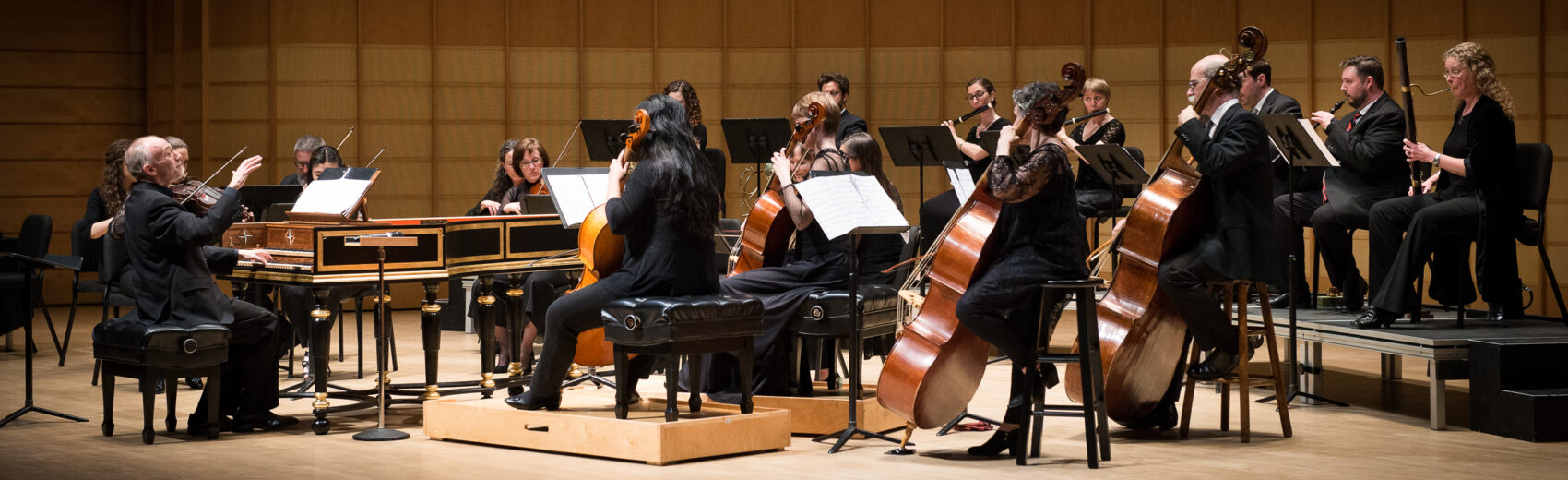
Pacific Baroque Orchestra
Learn more about the PBO by clicking here.
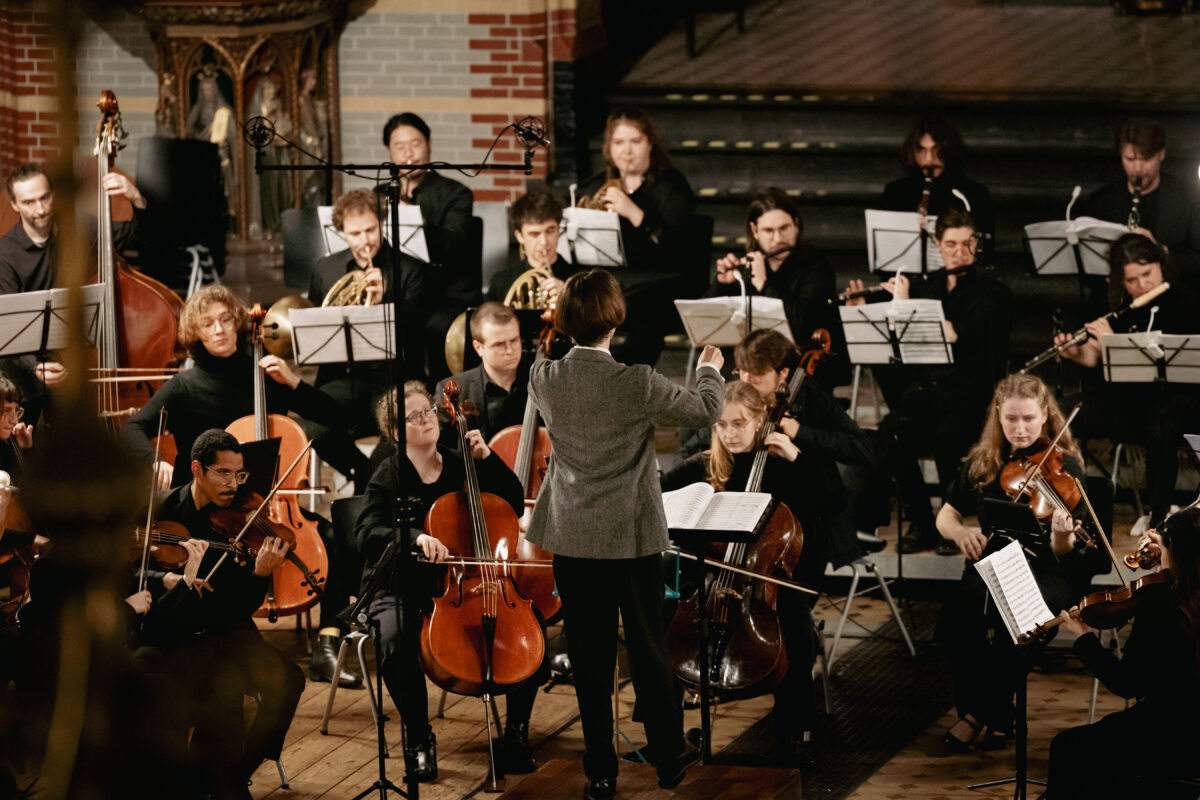
The ‘house band’ of Early Music Vancouver, The Pacific Baroque Orchestra (PBO) is recognized as one of Canada’s most exciting and innovative ensembles performing “early music for modern ears.” Formed in 1990, the orchestra quickly established itself as a force in Vancouver’s burgeoning music scene with the ongoing support of Early Music Vancouver. In 2009, PBO welcomed Alexander Weimann as Director. His imaginative programming, creativity and engaging musicianship have carved out a unique and vital place in the cultural landscape of Vancouver.
PBO regularly joins forces with internationally-celebrated Canadian guest artists, providing performance opportunities for Canadian musicians while exposing West Coast audiences to a spectacular variety of talent. The Orchestra has also toured throughout BC, the northern United States, and across Canada. Their 2019 East Coast Canadian tour with Canadian soprano Karina Gauvin culminated in a critically acclaimed album, Nuit Blanches, released by Atma Classique.

Alexander Weimann | Sponsored by Bruce Munro Wright, O.B.C., Dir.
The internationally renowned keyboard artist Alexander Weimann has spent his life enveloped by the therapeutic power and beauty of making music. Alex grew up in Munich. At age three he became fascinated by the intense magic of the church organ. He started piano at six, formal organ lessons at 12 and harpsichord at university (along with theatre theory, medieval Latin and jazz piano.) He is in huge demand as a director, soloist and chamber player, traveling the world with leading North American and European ensembles. He is Artistic Director of the Pacific Baroque Orchestra in Vancouver and teaches at the University of British Columbia where he directs the Baroque Orchestra Mentorship Programme.
Alex has appeared on more than 100 recordings, including the Juno-award-winning album “Prima Donna” with Karina Gauvin and Arion Baroque orchestra. His latest album series “The Art of Improvisation” (Volume 1: A Prayer for Peace; Volume 2: Ad libitum; and Volume 3: Canavian Variations, released on Redshift, 2024) unites his passions for both baroque music and improvisation on organ, harpsichord, and piano.
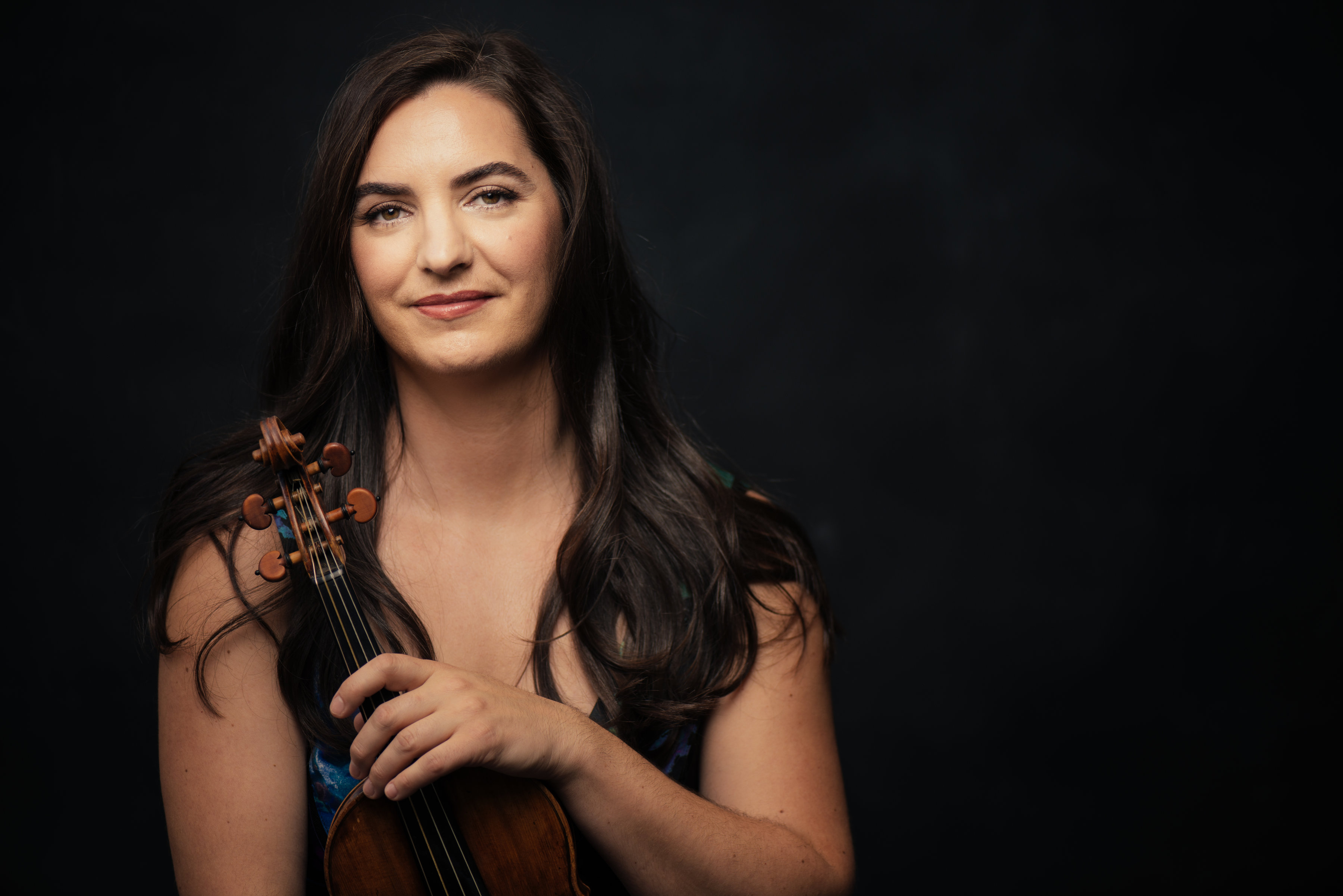
Tekla Cunningham, Solo Violin
Praised as “a consummate musician whose flowing solos and musical gestures are a joy to watch”, and whose performances have been described as “ravishingly beautiful”, “stellar”, “inspired and inspiring”, violinist Tekla Cunningham enjoys a multi-faceted career as a chamber musician, concertmaster, soloist and educator devoted to music of the baroque, classical and romantic eras. She is concertmaster and orchestra director of Pacific MusicWorks, and is an artist-in-residence at the University of Washington. She founded and directs the Whidbey Island Music Festival, now entering its fourteenth season, producing and presenting vibrant period-instrument performances of music from the 17th through 19th centuries, and plays regularly as concertmaster and principal player with the American Bach Soloists in California.
Tekla’s first solo album of Stylus Phantasticus repertoire from Italy and Austria will be released next year – music by Farina, Fonatana, Uccellini to Biber, Schmelzer and Albertini, with an extravagant continuo team of Stephen Stubbs, Maxine Eilander, Williams Skeen, Henry Lebedinsky.
Tekla received her undergraduate degree in History and German Literature at Johns Hopkins University while attending Peabody Conservatory. She studied at the Hochschule für Musik und Darstellende Kunst in Vienna Austria with Josef Sivo and Ortwin Ottmaier, and earned a Master’s Degree in violin performance at the San Francisco Conservatory with Ian Swenson.
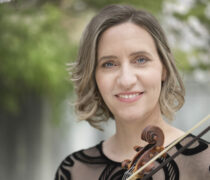
Chloe Meyers | Sponsored by Jill Bodkin, Concert Master
Violinist Chloe Meyers performs with early music ensembles across North America as leader, orchestra member, and chamber musician. She is the concertmaster of the Pacific Baroque Orchestra in Vancouver and co-concertmaster of Arion Baroque Orchestra in Montreal. She has led or appeared as soloist with groups including the Victoria Baroque Players, Pacific MusicWorks, Ensemble Les Boréades, the Theatre of Early Music, Ensemble Masques, and Les Voix Baroques, of which she was a founding member. She has had the pleasure of sharing the stage with international violin stars, performing double concerti with Stefano Montanari, Enrico Onofri, Amandine Beyer, and Cecilia Bernardini. Chloe’s playing may be heard on many award-winning disks, including the 2022 Juno award winning recording “Solfeggio”… in which she leads the orchestra L’Harmonie des Saisons as concertmaster. In 2023 she was nominated as Best Musical Director for her work in Pergolesi’s Stabat Mater with the Edmonton Opera.
Alongside Chloe’s passion for performance and directing, is her love of teaching. As adjunct professor at the University of British Columbia, she trains young artists in the Baroque Orchestra Mentorship Program, chamber music and solo lessons. She has years of teaching children, university and students of all ages and levels! She is an active teacher in the summer Victoria Conservatory teaching programs, as well the UVic Collegium orchestral program.
Chloe lives in Ladner, BC, with her ever growing family and dog.