
Christ Church Cathedral
The Baroque ensemble Quicksilver has had to cancelled their tour due to the rising cases of Covid 19. We look forward to when they’ll be able to perform with us in the future.
When the Holy Roman Emperor Ferdinand II moved his court to Vienna in 1619, this great Hapsburg city became home to a thriving international musical scene. Emissaries sought out the best players and composers from all over Italy to make Ferdinand’s court as cosmopolitan and sophisticated as possible. This was the birth of what we could call today the very first Viennese school, long before the great Classical period. Like the Classical composers, these musicians made a specialty of the great instrumental form of the sonata. But unlike those of Mozart and Haydn, the seventeenth-century sonata was a novel and experimental form that supported a way to create a purely instrumental discourse in music.
This concert is generously supported by José Verstappen.
Purchasing Tickets
Tickets are no longer available for this concert.
Programme
Johann Heinrich Schmeltzer (c. 1623–1680)
Sonata 7 à 5 from Sacro–profanus concentus musicus (1662)
Giovanni Legrenzi (1626–1678)
Sonata terza à 2 from La cetra, sonate a 2–4, Libro Terzo Op. 10 (1673)
Johann Caspar Kerll (1627–1693)
Sonata à tre in G minor, from the Düben Collection, Uppsala
Antonio Bertali (1605–1669)
Sonata à 3 in A minor, from the Düben Collection, Uppsala
Johann Heinrich Schmeltzer (c. 1623–1680)
Sonata à 4 “La Carolietta,” from the Kroměříž Library, 1669
— intermission —
Johann Rosenmüller (1617–1684)
Sonata X à 5 from Sonate à 2, 3, 4, e 5 (Nuremberg, 1682)
Johann Caspar Kerll (1627–1693)
Passagaglia variata from Toccate, Canzoni, et altre Sonate (1675)
Johann Joseph Fux (1644–1704)
Sonata à 4 in g minor, from the Kroměříž Library, 1717
Johann Kaspar Kerll (1627–1693)
Sonata à 2 in F major, from the Rost MS (Baden-Baden, c.1660)
Romanus Weichlein (1650–1706)
Sonata III from Encaenia musices, Op.1 (Innsbruck, 1695)
Programme Notes
Vienna, that splendid city on the very edge of Europe, is best known today in music for two great epochs: the era of Mozart and Haydn in the 1780s, and the “Second Viennese School” of Schoenberg, Berg, and Webern in the 1900s. But there was another, earlier, historical period in which Austrian music flourished. This was during the seventeenth century when the court of the Holy Roman Emperors became the only serious European rival to the more famous court of Louis XIV in Versailles. This very first Viennese school began with the patronage of the Hapsburg Emperor Ferdinand II and continued to flourish under his successor Ferdinand III, reaching a high point with the music-loving Leopold I, who came to the throne in 1658.
The Italian musicians who sought employment at the wealthy Viennese court brought with them their most recent invention, the sonata. Unlike its later Classical descendant, the early sonata has no agenda but the imagination of the composer, and no standardized form except the passionate give-and-take of friends in conversation.
The sonata was quickly taken up by the Austrian virtuosi at the Imperial court. Towards the end of the century, Vienna even had a native-born Kapellmeister, Johann Schmeltzer. Schmeltzer’s great mid-century collection of ensemble pieces, the Sacro-profanus concentus musicus, includes several sonorous five-part works, among them the highly atmospheric Sonata settima.
The gifted composer and organist Giovanni Legrenzi was one Italian who, despite his best efforts, did not win a position in Vienna. He spent much of his career in cities like Bergamo and Ferrara. As part of his efforts to win favor in Vienna, Legrenzi named one of his books of sonatas “La Cetra” after Emperor Leopold’s emblem; the word means both “The Scepter” and “The Lyre.” Sonata Terza from this collection is an excellent example of how the sonata was changing by mid-century, influenced by the lyricism of Venetian opera composers like Cavalli and Cesti.
Among Leopold’s musicians was the organist Johann Caspar Kerll, who first studied with Valentini before traveling to Rome to study with Carissimi. In Sonata à 2, Kerll explores the extravagance of the sonata concertata, with extended solos for both violins, but places all this virtuosity in a characteristically South German lyric melancholy.
Yet another influential Italian migrant was the “valoroso nel’violino” Antonio Bertali, who arrived in Vienna around 1624 and became Kapellmeister to the Emperor in 1649. His Sonata à 3, with a heartfelt adagio that frames a truly rocking ciaconna, is a striking example of his highly theatrical style. This sonata turns up in at least two sources. We use the version that appears as the fourth sonata in Book II of Prothimia suavissima, with a da capo return to the opening Adagio after the spectacular ciaconna.
Johann Schmeltzer’s fame reached far beyond Vienna. By the mid-1660s, he was in correspondence with Karl Lichtenstein-Castelcorno, the Prince-Bishop of Olmütz and son of Emperor Ferdinand II. Karl kept an elaborate musical establishment at his court in the town of
Kremsier (modern-day Kroměříž). He commissioned several works from Schmeltzer including the festive Sonata la Carolietta, probably written in celebration of the Prince-Bishop’s name-day.
With Johann Rosenmüller, we come to a major composer whose unexpected life events led to some interesting musical developments. Rosenmüller’s instrumental music had been largely made up of dance suites in Leipzig, but once he got to Venice, he discovered the power of operatic melody and theatrical gesture. The Sonata Decima à 5 comes from his last set of sonatas published in 1682, which combine heartbreaking adagios with dramatic, precipitous allegros.
Like Froberger, Johann Caspar Kerll’s keyboard works fall into two styles: Italian toccatas and canzonas and French dance suites. His elaborate Passagaglia is a great example of how the South Germans incorporated Italian virtuosity into this classic French form.
Johann Jacob Fux is best known today for his guide to counterpoint, the Gradus ad Parnassum. Fux’s music, like his career, traces a generational shift. Some of his chamber works like the Sonata à 4 are very much in the mode of the seventeenth-century sonata, but by the end of his career, he was creating High Baroque trio sonatas.
Kerll’s Sonata à 2 appears in a huge anthology of 157 trio sonatas assembled by a cleric, Franz Rost. In this sonata, Kerll explores the extravagance of the sonata concertata, with extended solos for both violins, but places all this virtuosity in a characteristically South German lyric melancholy.
We close with a work by the Austrian monastic Romanus Weichlein, a student of Biber’s in Salzburg. His wonderful collection of Encænia musices indulge in a very Southern German atmosphere of rhapsodic melancholy; the third sonata in this collection features a large Bassagaglia in the middle, which unrolls its motives with a great sense of spaciousness.
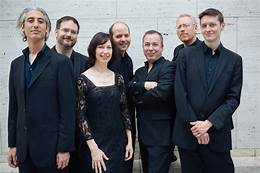
Quicksilver
"Revered like rock stars within the early music scene” (The New York Times), Quicksilver brings together some of North America’s top historically-informed performers. Described as “drop dead gorgeous with a wonderful interplay of timbres” (Early Music America) and praised as “irresistible” (Fanfare Magazine), Quicksilver vibrantly explores the rich and virtuosic chamber music repertoire from the early modern period to the High Baroque.
The ensemble has been featured at numerous music series and prestigious festivals, receiving critical acclaim, standing ovations and repeat invitations. Recent and upcoming appearances include the group’s European debut at Tage Alter Musik Regensburg, Friends of Chamber Music Kansas City, San Francisco Performances, Carnegie Hall, Mostly Mozart Festival at Lincoln Center, The Library of Congress, Buffalo Chamber Music Society, Coleman Chamber Concerts (Pasadena), Early Music in Columbus, CU Presents Artist Series (Colorado), Early Music Vancouver, Edmonton Chamber Music, the Miller Theatre at Columbia University, Arizona Early Music, Boston Early Music Festival, Berkeley Festival and Exhibition, Shriver Hall Concert Series, Chamber Music Tulsa, Dumbarton Oaks Concert Series (Washington, DC), and Music Before 1800 in New York City.
Quicksilver’s debut recording, Stile Moderno, was described as “Breakthrough of the Year" (Huffington Post) and “convincing . . . terrific” (Early Music-Oxford Journal). Quicksilver’s second recording, Fantasticus, was named one of The New Yorker’s Ten Notable Recordings of 2014 and praised as “Fantasticus, indeed” (Gramophone). Quicksilver's latest recording, Early Moderns: The (very) First Viennese School, has been described as "highly addictive...utterly captivating" (Limelight Magazine, Editor's Choice).