

The Chan Centre for the Performing Arts
Chloe Kim, Violin; Christi Meyers, Violin; Christina Mahler, Cello; Christina Hutten, Harpsichord
Eight notes of one famous bass line have placed Johann Pachelbel among the world’s most well- recognized composers. Yet there is much more to him than his ever-popular Canon. This program presents two rarely heard suites from Pachelbel’s major surviving chamber music work, Musikalische Ergötzung (Musical Delight). Featured gems for solo violin and continuo include ciaconnas by Italian composers Antonio Bertali and Nicola Matteis. Both were violin virtuosi who left their native country for successful careers in Vienna and London, respectively. Matteis contributed to steering the English taste toward the florid and fiery Italian school of violin playing. From the earthly to the ethereal, explore the remarkable spectrum of what the chaconne has to offer with these four talented local artists.
This concert is generously supported by David McMurtry
This concert is dedicated to the memory of Jeanne Lamon
Please note that this concert will be filmed.
Programme
Marco Uccellini (1603-1680)
Bergamasca in D Major
Arcangelo Corelli (1653-1713)
Ciaccona in G Major, Op. 2 No. 12
Johann Pachelbel (1653-1706)
Suite in E Minor P. 373 from Musikalische Ergötzung
Sonata
Aria
Courant
Aria
Ciacona
Nicola Matteis (???-1714)
Diverse bizzarie Sopra la Vecchia Sarabanda ó pur Ciaccona
Girolamo Frescobaldi (1583-1643)
Toccata I (Libro II)
Balletto Terzo (Libro I)
Corrente del Balletto
Passacagli
Johann Heinrich Schmelzer (1623-1680)
Sonata Quarta in D Major
Antonio Caldara (1670-1736)
Sonata da camera in B Flat Major Op. 2, No. 2
Preludio. Largo
Allemanda. Allegro
Corrente. Allegro
Gavotta. Allegro
Antonio Caldara (1670-1736)
Chiacona in B Flat Major
Dieterich Buxtehude (1637-1707)
Passacaglia, Sonata III Op. 2 in G Minor
Johann Pachelbel (1653 -1706)
Suite in C Major P. 374 from Musikalische Ergötzung
Sonata
Aria
Treza
Ciacona
Programme Notes
“I heard that stupendous violin, Sigr Nicholao (with other rare musicians), whom I never heard mortal man exceed on that instrument. He had a stroak so sweete, and made it speak like the voice of a man, and, when he pleas’d, like a consort of severall instruments. He did wonders upon a note and was an excellent composer… nothing approcah’d the violin in Nicholao’s hand. He seem’d to be spiritato’d and plaied such ravishing things on a ground as astonish’d us all.” English gentleman writer John Evelyn recorded this experience of Nicholas Matteis’ playing in his diary on November 19, 1674. Matteis must have performed music similar to his Diverse bizzarie – improvisatory variations over a repeating bassline called a “ground” in English. In the seventeenth and eighteenth centuries, flexible variation structures based on ostinatos or repeating harmonic patterns enabled instrumentalists to display both virtuosity and ingenuity. Popular patterns had names related to the song, dance, or location from which they originated, such as the “Bergamasca,” a rustic dance from town of Bergamo, which Marco Uccellini sets as a lively, rhythmic duel between two violinists. Ground bass patterns were the 12-bar blues or boogie-woogie basslines of their day.
One of the most popular was the chaconne or ciacona featured in many of the pieces on this program. The earliest examples of it survive in Spanish sources from the sixteenth century. The chaconne seems to have been a dance song imported from the Americas, and its name may be an onomatopoeic reference to the sound of castanets “chac-chac-chac”. In the early seventeenth century, the chaconne appears in guitar tutors as a formula for practicing chord strumming, often alongside a similar pattern called the passacaglia. Girolamo Frescobaldi, the first European composer to focus mainly on instrumental music, was fascinated by the relationship between the faster, energetic chaconne, the more melancholic passacaglia, and other popular dance forms of his day. In his last publication, he examines how they might be combined into suites like the one on this program or large-scale pieces like his astounding Cento partite sopra passacagli to tell extended musical narratives without the help of sung text, using instead diverse musical textures, tempos, and modulations.
Variation structure allowed composers to expand the limits of instrumental technique as Johann Heinrich Schmelzer does in his Sonata Quarta, first exploring the lyrical abilities of the violin, then variation by variation unfolding increasingly virtuosic dance rhythms, scales, and arpeggios traversing the entire range of the instrument. It became common to conclude a published collection of sonatas with a chaconne as a sort of catalogue of one’s musical invention. The chaconnes by Arcangelo Corelli and Antonio Caldara are both the twelfth and final sonatas in their respective Trio Sonatas, Op. 2. Corelli, an influential violinist, teacher, and orchestra leader in Rome, became a European phenomenon through the dissemination of his publications. His sonatas and concertos were so beloved, widely played, and imitated that they might be considered the first “classics” of Western instrumental music. Famed for his elegant and expressive playing, Corelli handles the violin wonderfully idiomatically, but without exploiting extremes of register or technical fireworks that would disturb a singing style. Caldara, a renowned cellist and one of the most highly paid opera composers of his day, established his reputation as a young composer by demonstrating that he had thoroughly mastered the art of composing in the manner of Corelli.
Johann Pachelbel, a south German organist and a friend and teacher of members of the Bach family, bears responsibility for the best-known set of variations on a ground bass ever written, the so-called “Canon in D.” If he could time-travel, he would undoubtedly be shocked by the way this piece shot to prominence in the late twentieth century. Perhaps he would have guessed that, if anything, the suites of his Musikalische Ergötzung (Musical Delights) would be most likely to survive the test of time. Designed to be approachable and engaging for amateurs, these lovely pieces unite Italian violin style, which Pachelbel seeks to teach using alternate “scordatura” violin tunings that make the violin easier to navigate; with French courtly and theatrical dance styles; and Pachelbel’s personal serenity and compositional facility acquired over many years of improvising and composing organ preludes.
You might think of this program of chaconnes as a series of musical poems, using the familiarity of their repeating harmonic “rhyme schemes” to draw you into and through the stories they spin. In fact, a contemporary account of Corelli likens him to a bard in the moment of dramatic inspiration. “It was usual for his countenance to be distorted, his eyes to become as red as fire, and his eyeballs to roll as if in agony.”
- Christina Hutten
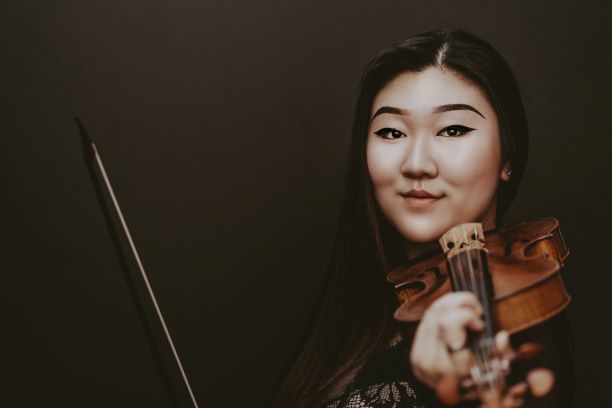
Chloe Kim, Violin
Praised as a “rising superstar” (The Georgia Straight) who performs with “passion and intensity to electrifying effect” (The Vancouver Sun), Canadian violinist Chloe Kim is in high demand internationally as a performer with leading period instrument ensembles. She appears regularly with groups such as Voices of Music, Philharmonia Baroque Orchestra, The English Concert, and the Orchestra of the Age of Enlightenment.
A passionate advocate for historically informed performance, Chloe is the recipient of numerous accolades, including the 2021 American Bach Society Grant, the 2020/21 Mercury–Juilliard Fellowship, and a feature on CBC’s 30 Under 30 list in 2020. She was elected a Fellow of The English Concert in America in 2021 and has served on multiple occasions as a panelist for the BC Arts Council.
Some favorite past projects include performing an all-women Vivaldi program with Monica Huggett, touring Scandinavia with Yale’s Schola Cantorum, and leading Juilliard415 as concertmaster in acclaimed performances of Dido and Aeneas at Opera Holland Park and the Opéra Royal de Versailles. In the upcoming season, Chloe will appear with the Orchestra of the Age of Enlightenment, Academy of Ancient Music, La Nuova Musica, and the Irish Baroque Orchestra.
Outside of music, Chloe is a self-proclaimed linguaphile and cinema obsessive. She is known amongst friends as monstrous company before (and occasionally after) coffee, and her partner insists she should come with a warning label. She is a devoted reader and a lover of a well-crafted cocktail. Chloe is deeply grateful to her dear friends and mentors Heilwig von Königslöw, Elizabeth Blumenstock, and Jeanne Lamon for their enduring support and inspiration.
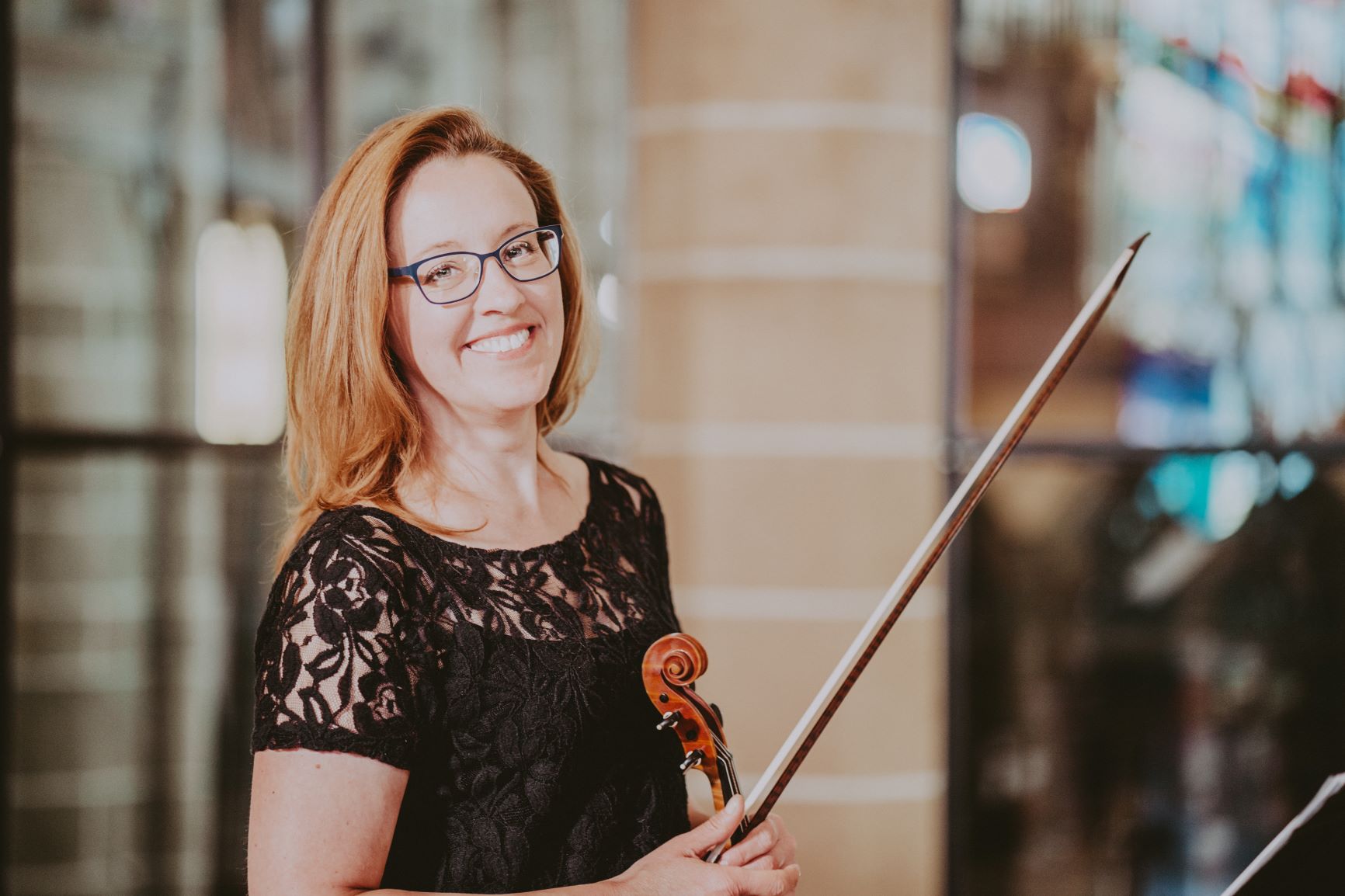
Christi Meyers, Violin
Christi Meyers has had a prominent role in the musical life of Victoria, BC for almost 15 years. Assistant Concertmaster of the Victoria Symphony since 2001, she has also been active playing in musical organizations locally such as the Galiano Ensemble, Odyssey String Quartet and away, for the Vancouver Symphony, Sinfonia Rotterdam (NL) and the European Camerata (UK).
She has also nurtured her love of baroque violin playing as a member of the Victoria Baroque Players, performing also with Pacific Baroque Orchestra and on numerous projects with Early Music Vancouver. As an educator, she coaches the violins of the Greater Victoria Youth Orchestra, maintains a small private studio, and was on the music faculty at the University of Victoria from 2005-10. Christi has recorded chamber music for both CBC radio and television and can be heard on baroque recordings for ATMA (QB) and Marquis (ON). Born in Montreal and raised in Grande Prairie, Alberta, she holds degrees from McGill, Western, and the Vancouver Academy of Music, where she studied with Gwen Thompson and Sonia Jelikova.
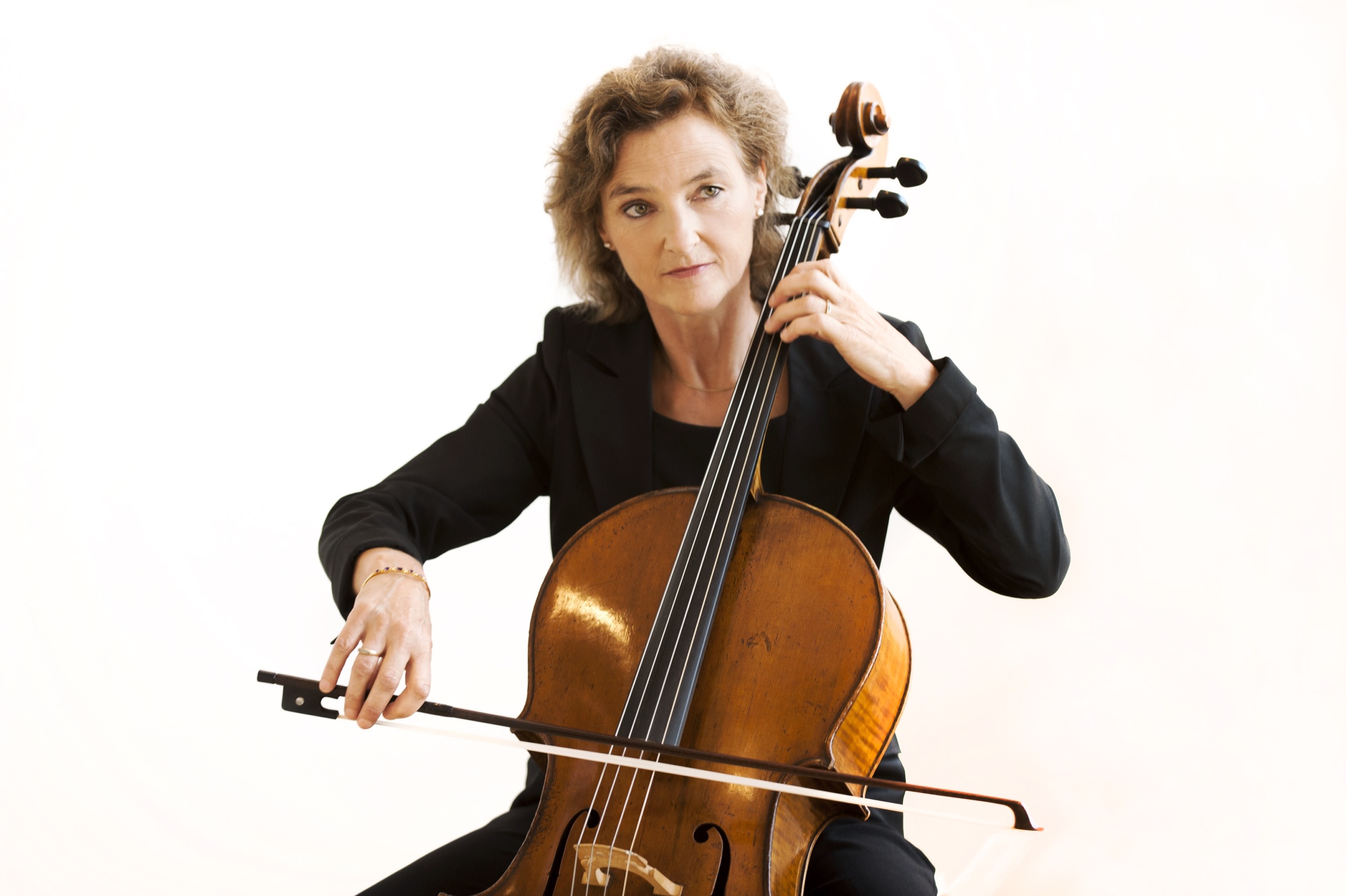
Christina Mahler, Cello
Dutch cellist Christina Mahler immigrated to Canada in 1981 to serve as principal cellist of the Tafelmusik Orchestra, a position she held until June of 2019. Reviews often praise her rich sound, energetic playing, and insightful musicianship. Christina has played and recorded numerous concertos with Tafelmusik, including works by Boccherini, Haydn, Vivaldi, C.P.E. Bach, and Leonardo Leo. She is very fortunate to own a beautiful baroque cello made by José Contreras, the “Stradivarius” of Spain. Christina is a very devoted and gifted teacher, and students have come from around the world to study with her, not only through the Tafelmusik Summer and Winter Institutes, but also at the University of Toronto and in her private studio. After 38 years as principal cellist of Tafelmusik, Christina has moved to Victoria where she is focusing on chamber music, teaching and pursuing her hobbies, such as pottery.
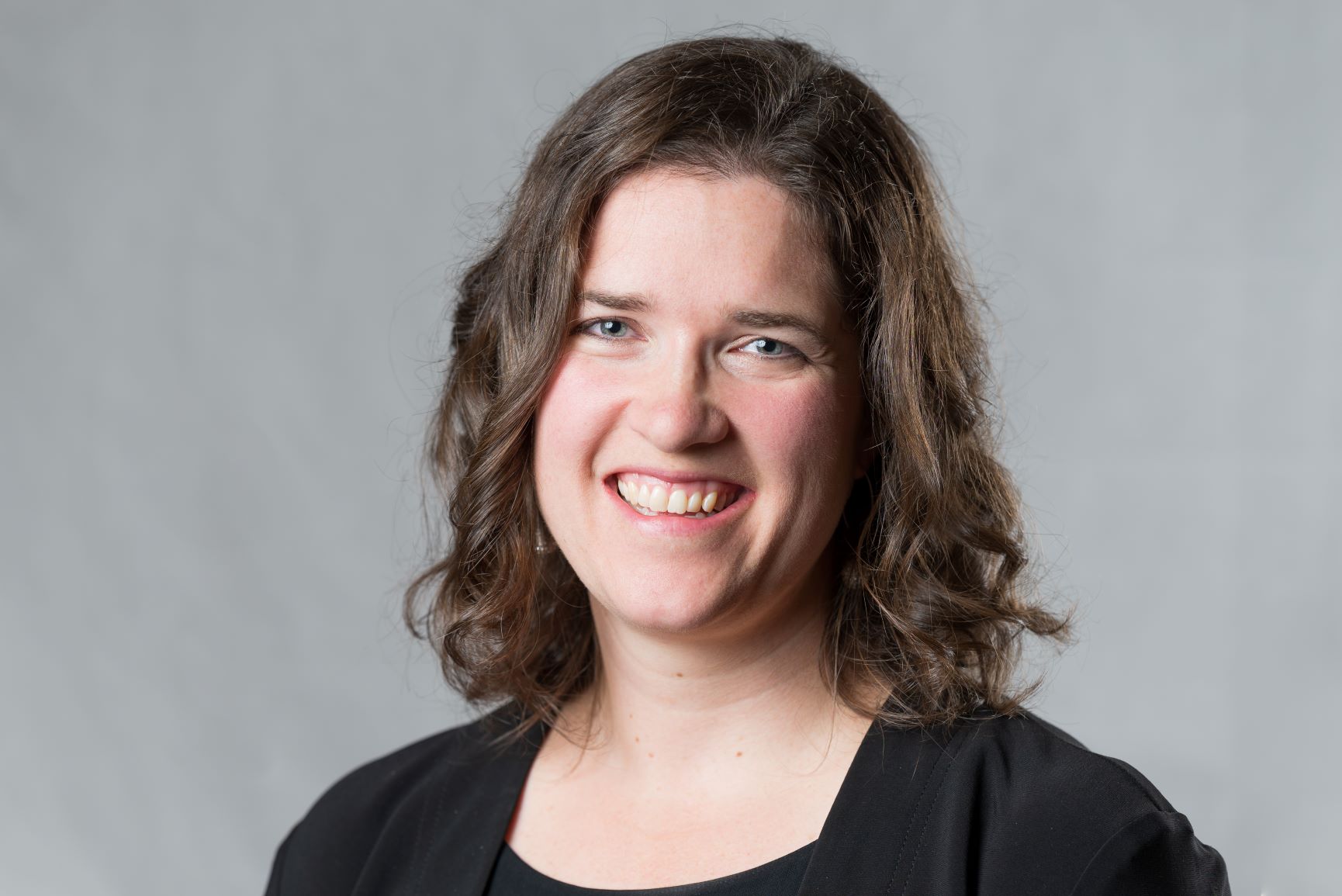
Christina Hutten, Harpsichord
Organist and harpsichordist Christina Hutten has presented recitals in Canada, the United States, and Europe. She performs regularly with Pacific Baroque Orchestra and has appeared as concerto soloist with the Okanagan Symphony, the Vancouver Academy of Music Symphony Orchestra, and the Arizona State University Chamber Orchestra. Christina is also an enthusiastic teacher. She coaches and coordinates the early music ensembles at the University of British Columbia and has given masterclasses and workshops at institutions including the Victoria Baroque Summer Program, Brandon University, the University of Manitoba, Wilfrid Laurier University, Canada’s National Music Centre in Calgary, and the Tafelmusik Baroque Summer Institute.
Funded by a generous grant from the Canada Council for the Arts, she pursued historical keyboard studies in Europe with Francesco Cera, François Espinasse, and Bernard Winsemius. She participated in the Britten-Pears Programme, led by Andreas Scholl and Tamar Halperin, for which she was awarded the Loewen Prize. Christina obtained a master’s degree in Organ Performance from Arizona State University under the direction of Kimberly Marshall and an Advanced Certificate in Harpsichord Performance from the University of Toronto, where she studied with Charlotte Nediger. She is now a doctoral candidate in musicology at UBC.