
Mireille Lebel, mezzo-soprano; Alexander Weimann | Sponsored by Bruce Munro Wright, O.B.C., fortepiano
Ariadne/Arianna was performed in London in February 1791 by the soprano castrato Gasparo Pacchierotti, with Haydn accompanying on the harpsichord. At the time a prominent critic wrote: “It abounds with such a variety of dramatic modulations—and is so exquisitely captivating in its larmoyant passages, that it touched and dissolved the audience.” Join one of Canada’s most promising young singers, mezzo-soprano Mireille Lebel for a riveting account of one of Haydn’s most spectacular works for voice.
Access to the concert is free, but donations are greatly appreciated. Concert will remain online one year from the premiere date.
This concert is generously supported by Dorothy Jantzen, an anonymous donor, and Dr. Katherine E. Paton in tribute to Stephen Drance


How to watch:
ONLINE: Watch the concert online by clicking here
This concert is available to watch for free thanks to the generosity of donors. To support our programming by making a tax-deductible donation, click here.
Concert will remain online one year from premiere date
Programme
Sehnsucht nach dem Fruehling
Der Zauberer
Abendempfindung
Arianna a Naxos Hob. XXVlb:2
Texts & Translations
To view/download the texts & translations, click here.
Programme Notes
The second half of the eighteenth century saw the decline of a major form of vocal music at the rise of another: the cantata, the dominant genre for accompanied solo voice, waned in popularity, while the fledgling art song began to emerge. Stemming from the seventeenth-century preoccupation with vivid text expression, the cantata evolved alongside opera as a much more intimate genre with the same goal: to use music to bring texts to life. Cantatas used the same musical languages as opera: recitative and aria. Recitative in the early seventeenth century was a supple, unctuous mode of heightened declamation that often sought to represent the meaning of a text through literal musical analogues. For example, words such as “fly”, “flee”, and “run” resulted in cascades of notes over a single syllable of text, and dissonant melodic intervals underscored pained utterances. Though some critics decried this form of text painting as overly literal, it remained a staple of vocal music composition indefinitely. By the late seventeenth century, however, recitative became increasingly formulaic and purely concerned with efficient, speech-like delivery, so much so that if composers wanted to give heightened expression to a text—including text painting—they needed to turn to newer ways to set the words if they did not wish to write a full-scale aria. The result of this pursuit was the invention of a new mode of text expression: accompanied recitative.
Haydn’s Ariadne auf Naxos, which he described as a cantata, relies heavily on accompanied recitative. Plain recitative by the eighteenth century was called secco (“dry”), and its speech-like nature required the continued use of flexible, improvised continuo to follow the singer(s). The text of Haydn’s Ariadne, however, is so emotionally charged that such a setting would be inappropriate. In accompanied recitative, the rhythm of the words largely dictates the singer’s part as in secco recitative, but occasional bouts of text painting and a much more robust, fully written-out accompaniment helps underscore the emotional impetus of the text. Only two arias break up this texture in the piece, where melody finally overtakes declamation.
The story follows Ariadne, in love with Theseus, as she wakes to discover that he is absent. She tricks herself into thinking that he will return, but upon realizing that he will not, she gives into despair. The work is relatively late in Haydn’s output, likely composed in 1789 for an amateur singer, given the vocal part’s lack of robust ornamentation and fairly modest range. It was published in Vienna in 1790 and taken to London by a visiting Briton with whom Haydn was friendly. A London publication appeared in 1791, and a public performance by a professional soprano castrato took place there to high acclaim in the same year. A review of the work in London’s Morning Chronicle described the piece as a “scena”, or “scene”, which might be a more appropriate classification for the work than “cantata.” The popularity of the cantata genre had diminished by the late eighteenth century, as its recitatives depended on the practice of continuo. As the improvised continuo accompaniment fell out of favor in many genres, fully composed accompaniments, especially in keyboard-accompanied vocal and instrumental works, became the norm. Because of this, Haydn’s cantata both simultaneously seems to draw upon both modern and antiquated aesthetics: the constant melodic drive of the keyboard accompaniment is foreign to the earlier cantata genre, while the highly expressive text setting in a mainly declamatory style harkens back to the cantata’s origins.
As the cantata became more rare, the art song rose in status, though it remained in a fairly infantile stage up to the end of the eighteenth century. Single-movement songs for solo voice had been published since the beginning of the Baroque, primarily for amateur singers. Mozart’s songs are no exception. “Der Zauberer” (“The Sorcerer”) is the earliest song on this programme, completed in May of 1785. Like most of Mozart’s songs, it is short and strophic, meaning that the same music is used for the several stanzas of text in the poem. “Sehnsucht nach dem Frühling” (“Yearning for Spring”), was written in January of the year of Mozart’s death, 1791. It was subsequently published and became so popular that it almost took on the status of a folk song with its tuneful, repetitious, and short melody. It too is strophic. “Abendempfindung” (“Evening thoughts”), composed in June of 1787, is an outlier, given the seriousness of its text and the fact that it is throughcomposed (meaning that there is no formulaic repetition). Though the subject is death, Mozart’s setting glows with peaceful resolve (a brief passage in the middle notwithstanding). Mozart in fact voiced such an accepting, serene attitude toward death in a contemporaneous letter to this piece. Both his thoughts and his text setting represent the ideals of the Enlightenment well.
Notes by Justin Henderlight
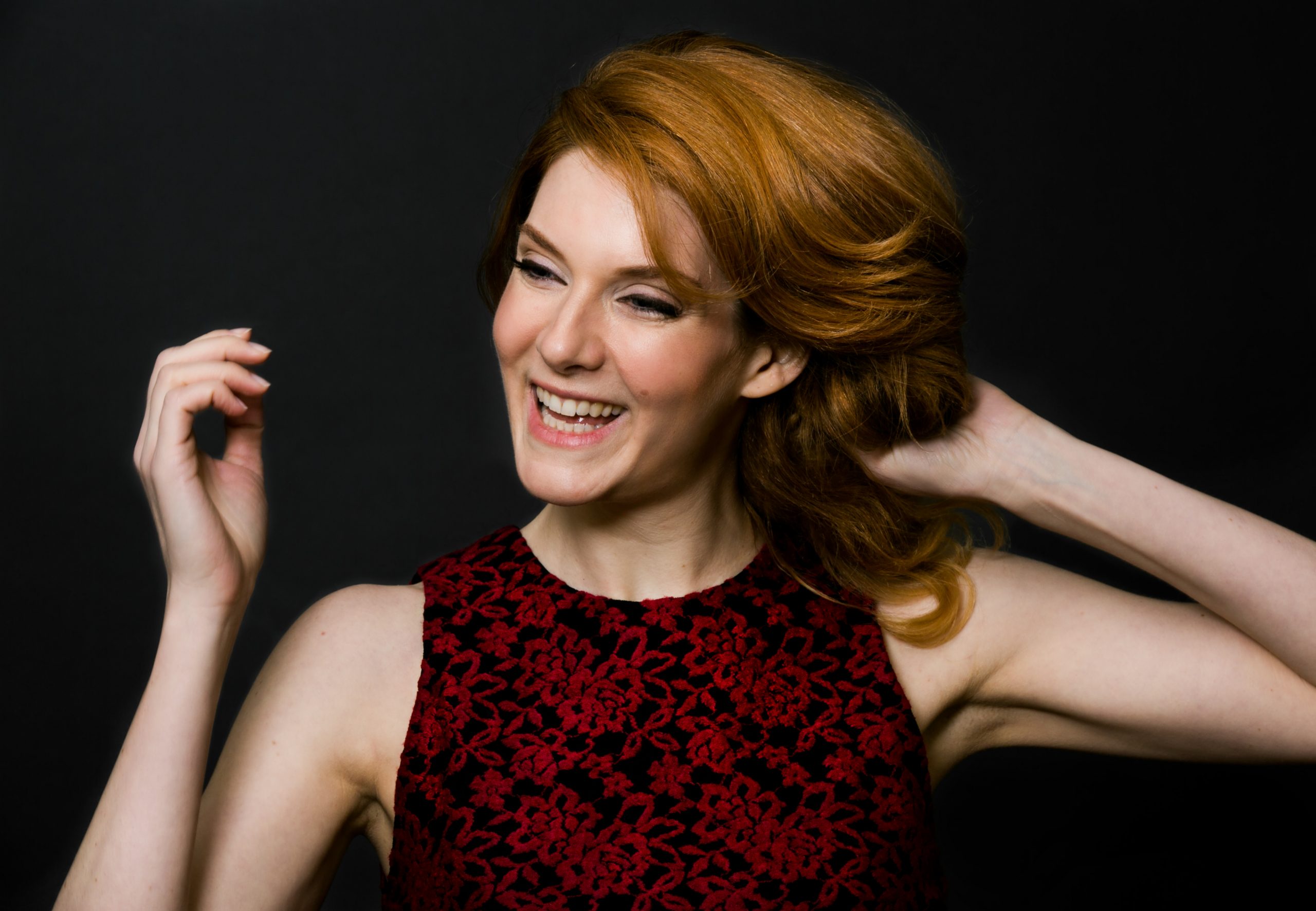
Mireille Lebel, mezzo-soprano
Canadian mezzo-soprano Mireille Lebel is originally from Vancouver and currently based in Berlin. She graduated with a Bachelor of Music from the University of Toronto and a Master of Music from the University of Montreal. She is the recipient of grants from the Canada Council and the Jacqueline Desmarais Foundation.
Following her tenure as a young arist at the Atelier Lyrique de l’Opéra de Montreal, a grant from the Jeunes Ambassadeurs Lyriques sent her on an audition tour to Germany. She was engaged at Theater Erfurt where she became a member of the ensemble for 5 years singing roles such as Sesto (Clemenza di Tito), Orlovsky (Die Fledermaus), Haensel (Haensel und Gretel), and Idamante (Idomeneo).
Following her time in Erfurt, she relocated to Berlin as a freelance artist and has since worked in opera and concert with theatres internationally including Opera Atelier, Narodni Divadlo Praha, Theater Basel, Opera Theatre de Metz, Opera de Nancy, Opera de Nice, Vancouver Opera, Schwetzingen SWR Festspiele, Aix-en-Provence Festival, Staatstheater Nuernberg, Les Violons du Roy, Collegium 1704, Houston Symphony, Ensemble Castor, and Early Music Vancouver. Her roles include Elle in La Voix Humaine (recorded for Vancouver Opera’s digital season 2020), Octavian in Der Rosenkavalier (recorded by BR-Klassik), Charlotte in Werther (recorded for Culture Box and French Television), the Ftle role in Carmen, Penelope in Il ritorno d’Ulisse in Patria, Nerone in L’incoronazione di Poppea, the title role in Gluck’s Orfeo, Nicklausse in Les contes d’Hoffmann, Siébel in Faust, and Cherubino in Le nozze di Figaro. She has worked as a soloist with conductors
Christoph Eschenbach, Bernard Labadie, Hervé Niquet, Jonathan Darlington, Jean-
Marie Zeitouni, Rodolfo Richter, Jacques Lacombe, Leslie Dala, Yannick Nezet-Seguin, and regularly performs the music of composer Samy Moussa. She has recorded 6 opera discs with the Boston Early Music Festival on the CPO label, including the 2015 Grammy Winner ‘La descente d’Orphée aux enfers’. Most recently she recorded Schoenberg’s String Quartet No. 2 with The Richter Ensemble.
In 2020 she co-founded the artistic collective Crown the Muse in Berlin with frequent collaborator, the soprano/pianist Rachel Fenlon. They were awarded a Canada Council Grant for their first collaboration, a staged two woman opera directed by Bruno Ravella.

Alexander Weimann | Sponsored by Bruce Munro Wright, O.B.C., fortepiano
The internationally renowned keyboard artist Alexander Weimann has spent his life enveloped by the therapeutic power and beauty of making music. Alex grew up in Munich. At age three he became fascinated by the intense magic of the church organ. He started piano at six, formal organ lessons at 12 and harpsichord at university (along with theatre theory, medieval Latin and jazz piano.) He is in huge demand as a director, soloist and chamber player, traveling the world with leading North American and European ensembles. He is Artistic Director of the Pacific Baroque Orchestra in Vancouver and teaches at the University of British Columbia where he directs the Baroque Orchestra Mentorship Programme.
Alex has appeared on more than 100 recordings, including the Juno-award-winning album “Prima Donna” with Karina Gauvin and Arion Baroque orchestra. His latest album series “The Art of Improvisation” (Volume 1: A Prayer for Peace; Volume 2: Ad libitum; and Volume 3: Canavian Variations, released on Redshift, 2024) unites his passions for both baroque music and improvisation on organ, harpsichord, and piano.