• My Account
  • Cart
  • About
    • Who is Early Music Vancouver
    • What is Early Music?
    • OUR INSTRUMENT COLLECTION
    • Employment Opportunities
    • Annual General Meeting 2025
    • 2024/25 Annual Report
  • Pacific Baroque Orchestra
    • Goldberg Variations Tour 2025
  • EVENTS
    • Summer Festival 2026: The Power of Music
    • EMV’s 2026-2027 Main Season
    • Digital Concert Hall
    • Free Events
    • Past Events
  • Learn
    • PROGRAMMES
    • Artist Interviews
    • Instrument Videos
  • Support Us
    • Donate Now
    • Corporate Opportunities
    • Volunteer
    • Host an EMV Musician
  • Ticketing Info
    • BOX OFFICE
    • Gift Vouchers
    • Venues
  • Press Centre
    • Media Releases
    • EMV PRESS KIT
    • EMV in the News
Early Music Vancouver
  • My Account
  • Cart
  • Donate
  • Buy Tickets
  • Gift Vouchers
  • Get our newsletter
Toggle Menu
  • About
    • Who is Early Music Vancouver
    • What is Early Music?
    • OUR INSTRUMENT COLLECTION
    • Employment Opportunities
    • Annual General Meeting 2025
    • 2024/25 Annual Report
  • Pacific Baroque Orchestra
    • Goldberg Variations Tour 2025
  • EVENTS
    • Summer Festival 2026: The Power of Music
    • EMV’s 2026-2027 Main Season
    • Digital Concert Hall
    • Free Events
    • Past Events
  • Learn
    • PROGRAMMES
    • Artist Interviews
    • Instrument Videos
  • Support Us
    • Donate Now
    • Corporate Opportunities
    • Volunteer
    • Host an EMV Musician
  • Ticketing Info
    • BOX OFFICE
    • Gift Vouchers
    • Venues
  • Press Centre
    • Media Releases
    • EMV PRESS KIT
    • EMV in the News
Home  >  Early Music Vancouver Past Events  >  Wondrous Machine – Organ Recital feat. Alexander Weimann | EMV DCH

Wondrous Machine – Organ Recital feat. Alexander Weimann | EMV DCH

Wednesday October 28, 2020 | 7:30PM

Alexander Weimann | Sponsored by Bruce Munro Wright, O.B.C., organ


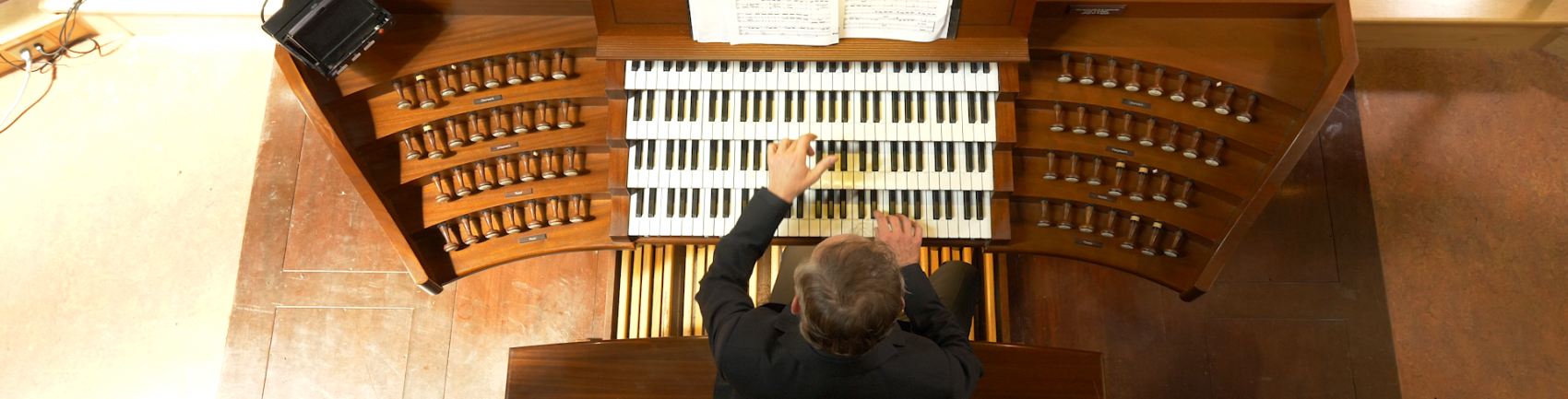
Join the Pacific Baroque Orchestra’s Music Director and one of Canada’s finest organists, Alexander Weimann, for an organ recital filmed on the magnificent instrument at Christ Church Cathedral in Victoria, BC. Built by Hellmuth Wolff & Associes Ltee of Montreal in 2005, all of the composers on this programme hail from a Southern German/Austrian tradition of organ composition and were chosen because they are a perfect fit for the design of this particular instrument.  Works by composers including Johann Kaspar Kerll (1627-1693), Hans Leo Hassler (1564-1612) , Georg Muffat (1653-1704), Johann Pachelbel (1653-1706), Johann Jakob Froberger (1616-1667), and ending with Wolfgang Amadeus Mozart’s (1756-1791)  Andante für eine Walze in eine kleine Orgel, KV 616.

To learn more about the organ, click here.

Access to the concert is free, but donations are greatly appreciated. Concert will remain online one year from premiere date.

This concert is generously supported by Dr. Katherine E. Paton


How to watch:

ONLINE: Watch the concert online by clicking here.
This concert is available to watch for free thanks to the generosity of donors. To support our programming by making a tax-deductible donation, click here.
Concert will remain online one year from premiere date.


Programme

Johann Kaspar Kerll (1627-1693)
Ricercata in Cylindrum phonotacticum transferenda – Passagaglia

Christian Erbach (1568-1635)
Introitus Secundi Toni

Hans Leo Hassler (1564-1612)
Responsorium “Isti sunt qui viventes in carne”

Georg Muffat (1653-1704)
Toccata XII from “Apparatus Musico-Organisticus”

Johann Pachelbel (1653-1706)
Ricercar in C

Johann Ulrich Steigleder (1593-1635)
40th Variation on “Vater unser im Himmelreich”

Johann Jakob Froberger (1616-1667)
Toccata da sonarsi alle Levatione

Johann Caspar Ferdinand Fischer (1656-1746)
Praeludium & Chaconne

Wolfgang Amadeus Mozart (1756-1791)
Andante für eine Walze in eine kleine Orgel, KV 616


Programme Notes

Writing in 1692, Nicholas Brady provided the text for one of Henry Purcell’s court odes celebrating St. Cecilia, Patron Saint of Music. In his poem, he suggests the divine origins of music and singles out organ music as the closest humans can come to recreating the sound of the music of heaven. He addresses Cecilia thus:

Thou tun’st this World below, the Spheres above,
Who in the Heavenly Round to their own Musick move.
With that sublime Celestial Lay,
Can any Earthly Sounds compare?
If any Earthly Musick dare,
The noble Organ may.
From Heav’n its wondrous Notes were giv’n,
(Cecilia oft convers’d with Heaven,)
Some Angel of the Sacred Choire
Did with his Breath the Pipes inspire;
And of their Notes the just Resemblance gave,
Brisk without Lightness, without Dulness [sic] Grave.
Wondrous Machine!

From this poem the current programme takes its title. The organ was a marvel of Early Modern engineering. Though we often take them for granted now, given their ubiquity, their invention was a staggering achievement of science melding with art. Nicholas Brady is far from alone in appreciating this great gesture of mankind’s achievement. Alex Weimann, soloist for this program, writes:

From when I was a really small boy, I was deeply fascinated by the pipe organs in churches, probably just by the apparatus, the size, volume, etc… and of course, that you could control it all from the console which looked and felt like a flight deck. So, as a working title, I picked “Wondrous Machine”. The first and the last piece in the programme are written for mechanical organs, some sort of cylinders the music was inscribed on and which would then trigger a mechanical system to play the composition which thus could extend what would be normally playable for one person. The last piece, by Mozart, is also one of the last compositions he ever wrote, only a few months before he died. It is strangely simple and reduced, like his “sonata facile”, but holds a universe of emotions and expression.

As the cylinders rotated in these miraculous self-playing organs, so does the sense of time rotate in the passacaglia that begins this program. Passacaglias and chaconnes have a wondrous balance of cyclical repetition and linear forward movement. They depend on a constantly repeating phrase structure and short harmonic pattern to weave out quite often monstrous compositions of mesmerizing, kaleidoscopic music. All of the composers on this programme hail from a Southern German/Austrian tradition of organ compositions that draw equally on French and Italian influences, though the passacaglias and chaconnes are much indebted to French models, such as those in the operas of Jean-Baptiste Lully. 

Additionally, as some of the music on this programme is from the early part of the seventeenth century, the earlier pieces use a harmonic language predating the crystallization of the modern major/minor key system, as evidenced in the “Introitus secondi toni” of Christian Erbach. The so-called “second tone” refers to a system whereby the final pitch of the piece in question is the note D, and the range of the melody runs from A to the A an octave higher, with the D forming the central sense of gravity. This music is based on the system of modes, rather than keys. With a sense of key comes a feeling of hierarchy between pitches greatly more complicated than the rules of modes, which really simply govern what melodies tend to do more than anything regarding harmony. Given the theme of directionality started by the passacaglia at the top of the programme, earlier music, such as that by Erbach, tends to float more than it drives, just by the nature of its harmonic language.

Notes by Justin Henderlight


Alexander Weimann | Sponsored by Bruce Munro Wright, O.B.C., organ

The internationally renowned keyboard artist Alexander Weimann has spent his life enveloped by the therapeutic power and beauty of making music. Alex grew up in Munich. At age three he became fascinated by the intense magic of the church organ. He started piano at six, formal organ lessons at 12 and harpsichord at university (along with theatre theory, medieval Latin and jazz piano.) He is in huge demand as a director, soloist and chamber player, traveling the world with leading North American and European ensembles. He is Artistic Director of the Pacific Baroque Orchestra in Vancouver and teaches at the University of British Columbia where he directs the Baroque Orchestra Mentorship Programme.

Alex has appeared on more than 100 recordings, including the Juno-award-winning album “Prima Donna” with Karina Gauvin and Arion Baroque orchestra. His latest album series “The Art of Improvisation” (Volume 1: A Prayer for Peace; Volume 2: Ad libitum; and Volume 3: Canavian Variations, released on Redshift, 2024) unites his passions for both baroque music and improvisation on organ, harpsichord, and piano.

read more...


Media

1254 W 7TH AVE
VANCOUVER, BC, V6H 1B6

(604) 732-1610
staff@earlymusic.bc.ca

  • About EMV
    • What is Early Music?
    • Staff
    • Partners
    • Board of Directors
    • Venues
  • Education & Community
    • BC Scholarship Programme – 2026/2027
    • OUR INSTRUMENT COLLECTION
  • Press Centre
  • Join Our Mailing List
Facebook URLTwitter URLYoutube URLInstagram URL

Copyright © 2026 EARLY MUSIC VANCOUVER | EMV | PHOTOS BY JESS MACALEESE, MARK MUSHET AND JAN GATES.
CONTACT EMV FOR INDIVIDUAL CREDITS. | site by DFS Digital Fusion Studios web designAND MEDIUM RARE Medium Rare Interactive

Een Romantische Johannes Passion

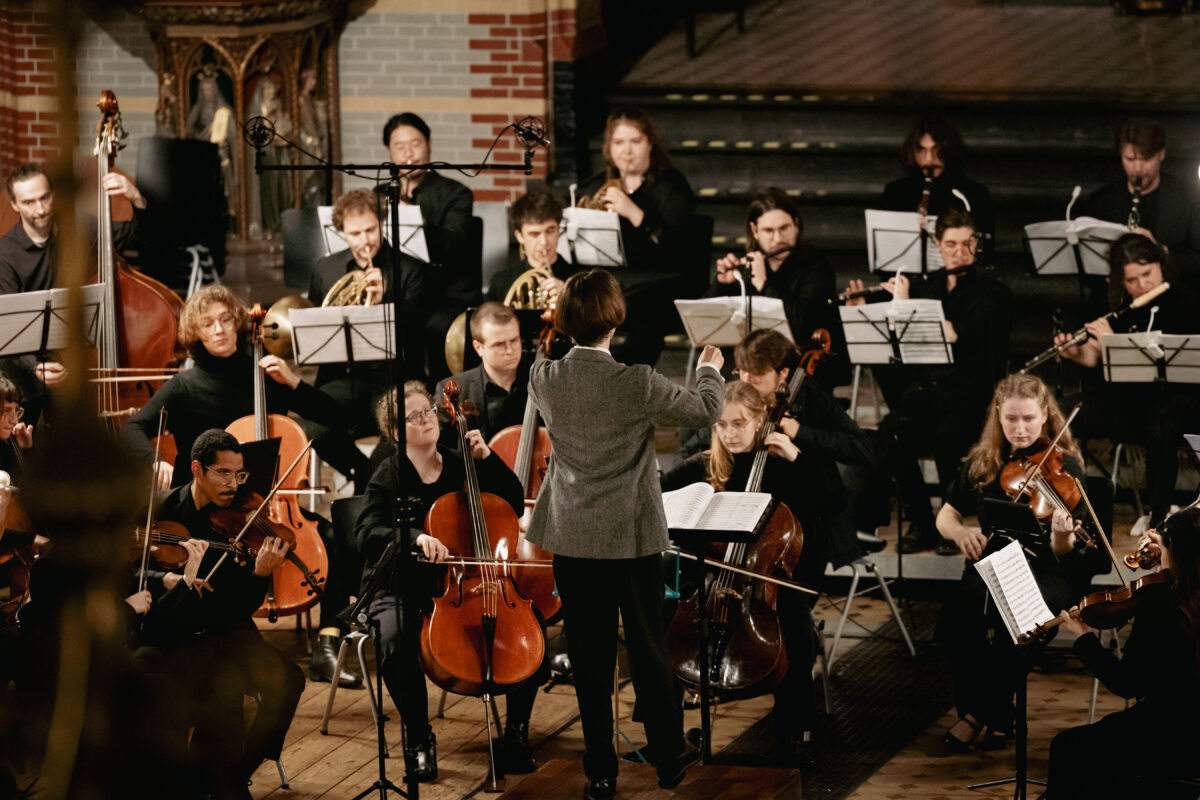
Historical Performance has been steadily looking toward the nineteenth-century as a source of inspiration, and Orchestra Lagrandt wants to lead the charge into Romantic orchestral performance practice. As an orchestra of ambitious musicians in their twenties from 25 different nations, we aspire to represent the voice of the new generation in Historical Performance.

Een Romantische Johannes Passion is an ongoing project to reimagine the Johannes Passion of J. S. Bach in a late nineteenth century style. The first Passion revivals in the Netherlands took place in Rotterdam in 1870, featuring large symphonic orchestrations, and a radically different musical language than that of the HP and modern classical worlds. In our initial performance with the Tangram Chamber Choir, we pushed the boundaries of what Romantic Bach might have sounded like: exploring changes in orchestration, stoic tempi, rubato, phrasing, nineteenth- century bowing practices, and even portamento. We plan to establish this project as an annual tradition every Easter season, reworking the arrangement each time in the spirit of Romantic spontaneity.


One of the wonderful things about the Historical Performance movement is that we are able to use forgotten practices, this time hailing from the nineteenth century, to present such a beloved and well known-work in a new light.

The world is familiar with stories of clever forgers whose life’s mission is to cunningly reproduce the light and shadows of historical masterworks, from Vermeer’s brushstrokes to Da Vinci’s proportional precision… but what if these crimes of craftsmanship were to extend beyond the visual arts? What if the pieces we know to be by Palestrina, Monteverdi or even Johann Sebastian Bach were in fact stylistic copies, artfully composed by a secret circle of music forgers and passed off as the work of the greats? What if those music forgers are at work as we speak? 

This premise inspires our original program The Music Forgery Workshop. Our early music comedy imagines the lives of such a circle of musical criminals, offering a fresh and lively presentation of historical compositions, not as museum artifacts but as living works in progress. The workshop itself is set up on the stage and its members carry forth the plot in music and words. A narrator in the role of a suspicious inspector lends the performance a theatrical flow. The listener is invited into a satire on high society’s art commerce, while the performers make fun of themselves for having devoted their lives to the niche subject of historical music performance. 

Violinist Elizabeth Sommers combines her skills and experience in traditional music with expertise in the performance and improvisation of medieval and Renaissance repertoires. Multi-instrumentalist Eliot X. Dios (keyboards, bagpipes and flutes) works wholeheartedly to employ storytelling techniques developed through the history of literature and cinema in his early music concerts. Composer Gunnar Haraldsson (violin, guitar) seeks to translate the forms and intentions of early composition for a modern audience. Halldór B. Arnarson (keyboards, voice) has devoted his career to bringing musical craftsmanship from the era of counterpoint to the attention of the public and comedy to the early music scene. Singer and storyteller Ásta S. Arnardóttir brings the storyline to the public with personal immediacy, and through her character work defines the different veins of the show, sometimes hilarious and sometimes serious. 

The story is narrated by the character of the Inspector, acted out by the members of the MFW, and told in rhyming Icelandic verse in one musical pillar of the show, a madrigal composed by our very own 

Halldór in the style of Monteverdi. The show has an entertaining educational dimension. The audience is exposed to a broad sweep of historical and musical information in a condensed form, necessary to understand the musical humour, while dramatic rhythm and scenographic effects prevent overwhelm. We also place particular emphasis on theatrical illusion and synchronisation. One example appears in the opening scene, in which the inspector is seen watching television. On stage, this becomes a complex exercise in coordination: each time the inspector presses a button on the remote control, the musicians instantly switch pieces, creating the impression of rapidly changing television channels. 

This opening scene establishes the tone of the entire show, comical and satirical in its storytelling and diverse in its musical language. It not only introduces the wide range of musical styles that appear throughout the performance, but also functions as the plot’s inciting incident, as the inspector hears a news report about the discovery of a previously unknown concerto by Vivaldi. 

Another important scene takes place when one forger is alone on stage in low light, perusing books on medieval music, while the musicians perform and sing offstage, sounding his audiation as he reads. This intimate moment evokes the sleepless nights spent studying facsimiles and learning historical compositional techniques, by which the forger acquires the inspiration and the expertise necessary to his art, and reveals a hidden side of musical performance: the immense amount of study and preparation that precedes the moment on stage. This setting also creates space for visual and musical comedy, as seen in the trailer video, where a 14th-century melody is played backwards because Halldór is unknowingly reading the facsimile upside-down, only realising the mistake when the music begins to sound absurd. 

Fun and friendship are at the heart of the whole project, though the link between music and crime is an important historical consideration. Classical music was often used as the demonstration of a monarch’s power, music teaching as a cover up for secret affairs, and pieces were published under another’s name for profit. Such examples of “inappropriate practices” carry an exciting and attractive element for the audience which the MFW seeks to exploit. Under this light-hearted surface lies a more serious layer of questions concerning our present-day existence, such as excessive materialism in high society and the threat posed on human craftsmanship and skill by the rise of artificial intelligence. 

Please Note:

The main applicant and creative/intellectual driver of the project must be 30 or under (on May 15th).

The average age of all musicians must not be older than 32, and the maximum age of supporting musicians must be no more than 35 (on May 15th.)