Christ Church Cathedral | Map
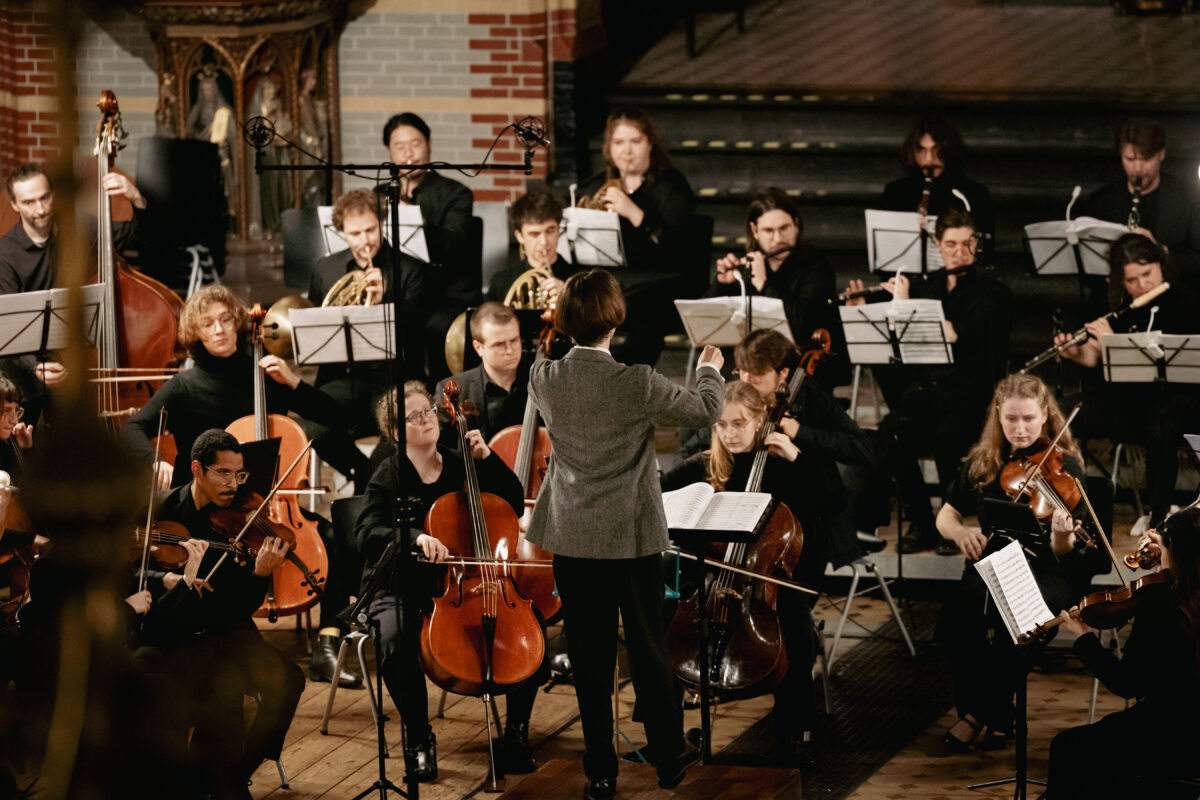
Enrico Onofri, Music Director; Pacific Baroque Orchestra
Antonio Vivaldi, master and model of invention, inspired over a half-century of European music with his first published set of concertos for one, two, and four violins: L’Estro Armonico. The Pacific Baroque Orchestra offer selections from this seminal work and from La Stravaganza led by the imaginative and wildy virtuosic Italian violinist Enrico Onofri. Born in Ravenna, Italy, Enrico’s career began when he was still a student when he was named first violin at the Capella Reial de Catalunya under Jordi Savall. He has since regularly collaborated with and led groups such as Il Giardino Armonico, Concentus Musicus Wien, Ensemble Mosaiques and Concerto Italiano. Enrico Onofri is professor of baroque violin and interpretation of baroque music at the Conservatorio Bellini in Palermo.
“Onofri has made a life’s work out of reviving the violin’s sound in its early days in 17th-century Italy. He holds his violin like a fiddler and turns the instrument into a wordless voice, pleading, cajoling, lamenting. Compared to the extrovert, brilliant modern violin, Onofri’s sound seems as delicate as a reed, and yet it’s always impassioned and enticingly strange.” – The Daily Telegraph
To download the concert programme, click here.
This concert is generously supported by Bruce Wright

Click here for information about parking around / transiting to Christ Church Cathedral
Programme
Concerto Op.3 no.1 in D major for four violins, cello, strings & continuo*
Soloists: Enrico Onofri, Chloe Meyers, Linda Melsted, Christi Meyers & Beiliang Zhu
Allegro
Largo e spiccato
Allegro
Concerto Op.4 no.4 in A minor for violin, strings & continuo**
Soloist: Enrico Onofri
Allegro
Grave
Allegro
Concerto Op.4 no.1 in B♭ major for violin, strings & continuo**
Soloist: Enrico Onofri
Allegro
Largo e cantabile
Allegro
Concerto Op.3 no.10 in B minor for four violins, strings & continuo*
Soloists: Enrico Onofri, Linda Melsted, Christi Meyers & Paul Luchkow
Allegro
Largo
Larghetto
Allegro
INTERVAL
Concerto Op.3 no.8 in A minor for two violins, strings & continuo*
Soloists: Enrico Onofri & Chloe Meyers
Allegro
Larghetto e spiritoso
Allegro
Concerto Op.3 no.9 in D major for violin, strings & continuo*
Soloist: Enrico Onofri
Allegro
Larghetto
Allegro
Concerto Op.3 no.11 in D minor for two violins, cello, strings & continuo*
Soloists: Enrico Onofri, Chloe Meyers & Beiliang Zhu
Allegro /Adagio e spiccato / Allegro
Largo e spiccato
Allegro
*from “L’estro armonico” (Op.3)
** from “La stravaganza” (Op.4)
Programme Notes
The Vivaldis were a family of multi-tasking entrepreneurs. Brother Francesco worked as a barber, paving contractor, and publisher. Father Giovanni Battista was a barber and a violinist at San Marco, involved himself in opera management, and closely collaborated with his son Antonio as his principle music copyist. Antonio Vivaldi studied violin, probably with his father for whom he sometimes substituted at San Marco, and trained for the priesthood. Not many years after his ordination, however, he stopped saying mass, likely because of his chronic asthma, and turned his attention increasingly to teaching, writing, and publishing his music. In 1703, the year of his ordination, he accepted his first position as maestro di violino at the Piéta, one of four famous Venetian intuitions that offered musical training to orphaned and abandoned girls. Vivaldi worked under the leadership of music director Francesco Gasparini, teaching violin and maintaining the school’s instrument collection. By 1709, however, his position had been discontinued probably due to financial constraints and perhaps because Vivaldi had so successfully trained the figlie privilegiate di coro, the most advanced instrumentalists, that they were able to train the younger students without his help. In 1711, he returned to his position at the Piéta, substituting for an ailing Gasparini. In the meantime, he had devoted some of his time to preparing a collection of concertos that would expand his reputation as a composer, his Opus 3, dedicated to the Grand Prince of Tuscany and the first of his music to be published outside Venice.
In 1711, the collection, L’estro armonico (The Harmonic Frenzy) was printed and financed by Estienne Roger in Amsterdam, a publisher whose distribution network included agents across northern Europe in Rotterdam, London, Cologne, Berlin, Liege, Leipzig, Halle, Paris, Brussels, and Hamburg. The concerti were soon pirated and reprinted by Roger’s rival, the English publisher John Walsh, who called them “Vivaldi’s Most Celebrated Concertos”, and a few years later by Charles-Nicholas Le Clerc in Paris. Vivaldi must have hoped for such a lively and wide-spread reception of his collection. He meticulously revised some of his earlier work that was already circulating in manuscript, compiling a collection designed to impress by careful construction and diversity of scoring and style, arranged with alternating major and minor concertos, and further ordered into four groups of three concertos, each group containing a concerto for one, for two, and for four violins. In the preface, Vivaldi apologizes for the printing quality of his earlier opuses and assures the reader of the superior quality of this print engraved by “the famous hand of Monsieur Estienne Roger.”
The concertos of L’estro armonico combine features of Bolognese and Roman concerto styles with special effects from Venetian opera. They synthesize virtuosic writing for solo instruments, rich scoring using two viola parts, and ritornello (refrain) form typical of the concertos of Giuseppe Torelli with concerto grosso-style dialogue between large and small groups within the orchestra from Archangelo Corelli’s concertos, and lyricism, rhythmic energy, and majestic unison themes borrowed from the operas of composers like Tomaso Albinoni. The Italian instrumental concerto had grown out of the smaller instrumental sonata genre and was uniquely suited to Vivaldi’s teaching situation at the Piéta, because it could accommodate players of different abilities, giving older, advanced players a challenge and chance to shine as soloists, and younger players less demanding but lively and engaging roles as orchestra members. Undoubtably, Vivaldi himself sometimes joined the orchestra as soloist, vigorously challenging the limits of violin technique. Johann Friedrich Armand von Uffenbach, a Frankfurt nobleman who heard Vivaldi perform in 1715, described in his diary a cadenza Vivaldi improvised as “a fantasy which really terrified me, for such has not been nor can ever be played; he came with his fingers within a mere grass-stalk’s breadth of the bridge, so that the bow had no room, and this on all four strings with imitations and at incredible speed.” In 1723, the directors of the Piéta commissioned Vivaldi to supply the school with two new concertos each month. He eventually composed more than 500 over the course of his life, and bragged to Charles de Brosses, a French magistrate who visited Venice in 1739, that he could compose a concerto faster than parts could be copied for it. De Brosses described Vivaldi as a shrewd businessman, who drove a hard bargain with foreigners, but admired what he called Vivaldi’s “furie de composition prodigieuse”.
Musicians all over Europe esteemed Vivaldi’s compositions. Johann Joachim Quantz, composer in the court of Frederick the Great, heard concertos from L’estro armonico for the first time in 1714, describing them as “musical pieces of a kind that was then entirely new; they made no small impression on me. I was eager to accumulate a good number of them, and Vivaldi’s splendid ritornelli served as good models for me in later days.” Telemann, though he claimed to dislike the genre, wrote close to 100 concertos in the style of Vivaldi’s. Nevertheless, Vivaldi’s concertos might have been completely forgotten had they not been rediscovered by Bach scholars in the nineteenth century. Bach transcribed several of the concertos from L’estro armonico as virtuosic keyboard solos. He probably received the idea from Prince Johann Ernst von Saxe-Weimar, the teenaged son of his employer. Himself an avid musician, composer, and music collector, the prince had studied in the Netherlands and likely heard the famous blind organist of the Niewe Kerk in Amsterdam, Johann Jacob de Graaf, perform organ arrangements of popular Italian concertos on the magnificent organ there. The Prince’s collection of Italian concertos had a major impact of Bach’s approach to composition, described by Bach’s biographer Johann Nikolaus Forkel, based on information received directly from Bach’s sons Wilhelm Friedemann and Carl Philipp Emanuel. Vivaldi’s concertos, Forkel asserts, taught the great Johann Sebastian Bach “how to think musically”.
Enrico Onofri, Music Director
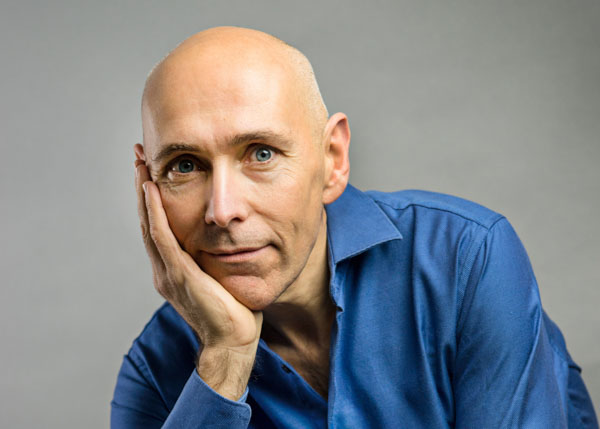
Enrico Onofri was born in Ravenna, Italy. His career began with an invitation from Jordi Savall to be the concertmaster of La Capella Real. Very soon he found himself working with groups such as Concentus Musicus Wien, Ensemble Mosaiques and Concerto Italiano. From 1987 to 2010 he was the concertmaster and soloist of Il Giardino Armonico.
In 2002 he entered upon a conductor’s career, which has brought him great critical acclaim and numerous invitations from orchestras, festivals and opera houses in Europe, Japan and America. From 2004 to 2013 he was the principal conductor of Divino Sospiro in Lisbon and since 2006 he has been a principal guest conductor with Orquesta Barroca de Sevilla. He has conducted ensembles such as Camerata Bern, Festival Strings Lucerne, Akademie für Alte Musik Berlin, Bochumer Symphoniker, Kammerorchester Basel, Orchestra Ensemble Kanazawa, Cipango Consort Tokyo, Real Orquesta de Sevilla, Orchestre de Clermont Ferrand, Orchestre de l’Opéra de Lyon, Orquesta Sinfonica de Galicia and more.
He founded the chamber group Imaginarium Ensemble to perform the Italian baroque repertoire.
Enrico Onofri has performed in the world’s most famous concert halls, alongside artists like Nikolaus Harnoncourt, Gustav Leonhardt, Christophe Coin, Cecilia Bartoli and Katia and Marielle Labèque, among others.
Many of Enrico Onofri’s recordings with Teldec, Decca, Astrée, Naive, Deutsche Harmonia Mundi/Sony, Passacaille, Nichion, Winter&Winter, Opus111, Virgin, Zig Zag Territoires etc., have been awarded prestigious international prizes, and his concerts have been broadcast by European, American, Asian and Australian networks. Enrico Onofri has been the professor of baroque violin and interpretation of baroque music at the Conservatorio Bellini in Palermo since 1999. He has been invited to give master classes throughout Europe, Canada and Japan. He has been tutor and invited conductor with the EUBO, European Union Baroque Orchestra. In 2011 he’s been invited to give a master class at the Juilliard School in New York. https://www.facebook.com/onofri.enrico/

Pacific Baroque Orchestra
Learn more about the PBO by clicking here.
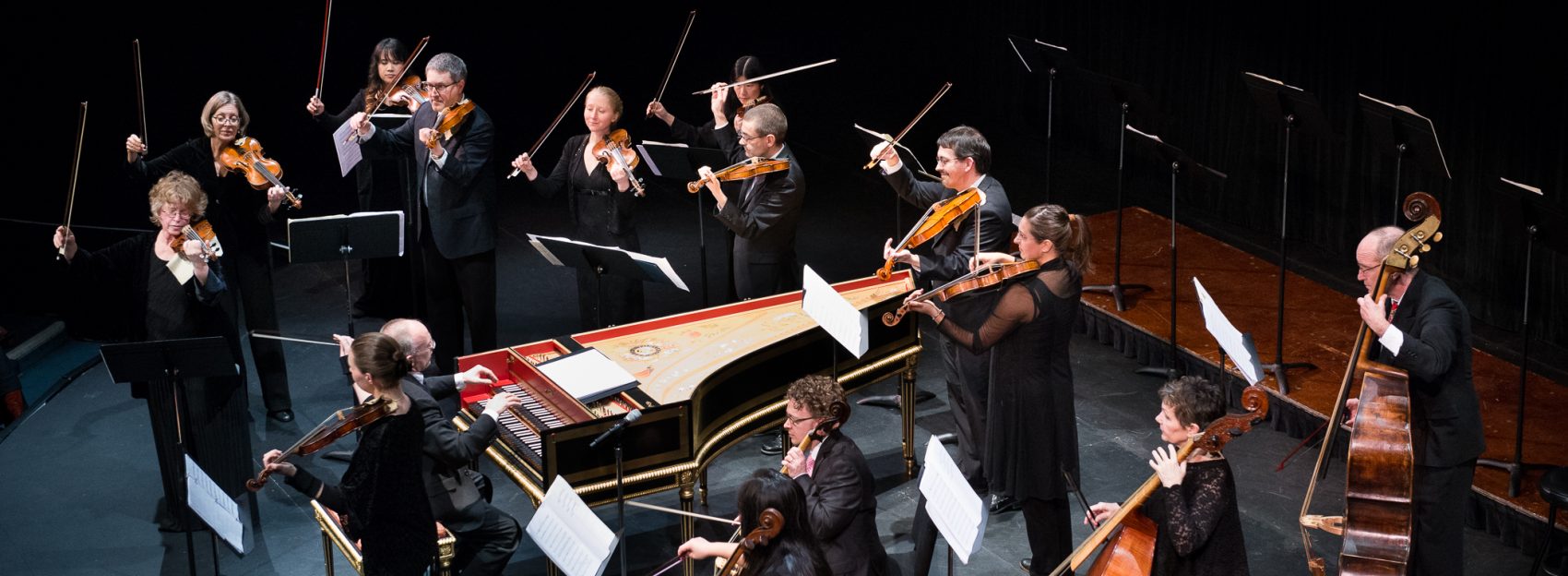
The ‘house band’ of Early Music Vancouver, The Pacific Baroque Orchestra (PBO) is recognized as one of Canada’s most exciting and innovative ensembles performing “early music for modern ears.” Formed in 1990, the orchestra quickly established itself as a force in Vancouver’s burgeoning music scene with the ongoing support of Early Music Vancouver. In 2009, PBO welcomed Alexander Weimann as Director. His imaginative programming, creativity and engaging musicianship have carved out a unique and vital place in the cultural landscape of Vancouver.
PBO regularly joins forces with internationally-celebrated Canadian guest artists, providing performance opportunities for Canadian musicians while exposing West Coast audiences to a spectacular variety of talent. The Orchestra has also toured throughout BC, the northern United States, and across Canada. Their 2019 East Coast Canadian tour with Canadian soprano Karina Gauvin culminated in a critically acclaimed album, Nuit Blanches, released by Atma Classique.