Christ Church Cathedral | Map
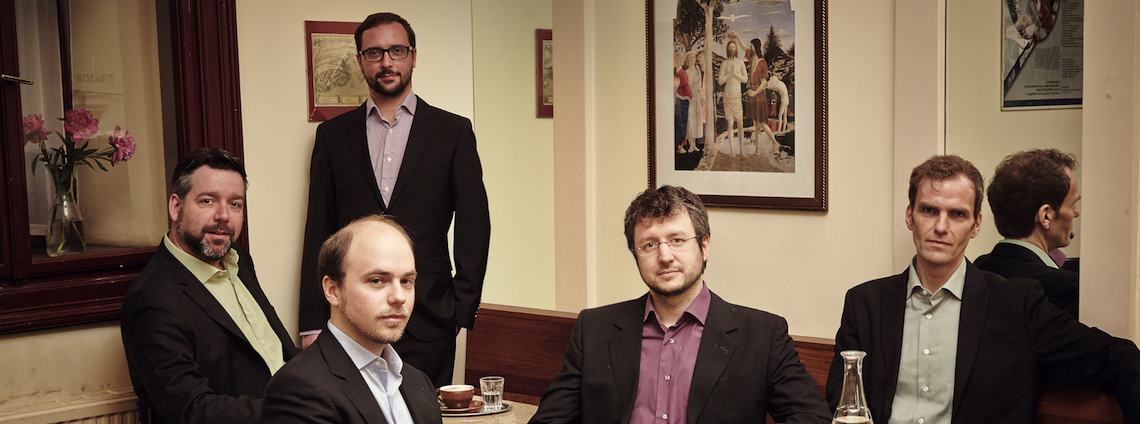
Acclaimed European ensemble Cinquecento focuses on the emotionally charged and harmonically rich Latin Church music of William Byrd, his teacher Thomas Tallis, and Christopher Tye during the height of the English Reformation – a time of conflict and religious upheaval. The programme includes Tallis’ incomparable “Lamentations of Jeremiah.”
Comprising five professional singers from five European countries, Cinquecento takes its name from the Italian term for the sixteenth century. The pan-European structure of the ensemble (its members are from Austria, Belgium, England, Germany and Switzerland) harks back to the imperial chapel choirs of the sixteenth century, whose members would have been chosen for their musicianship from Europe’s most prized musical establishments. Since 2006, Cinquecento has been recording for Hyperion. They are one of the world’s finest vocalist ensembles specializing in Renaissance polyphony.
This concert will be preceded by a free screening of Playing Elizabeth’s Tune at 4pm. In this 65 minute documentary by the BBC, Charles Hazlewood explores the life and music of William Byrd, Catholic Composer for a Protestant Queen, and the troubled times that produced some of the most intimate and passionate sacred music ever written.
Supported by Adèle Lafleur

Click here for information about parking around / transiting to Christ Church Cathedral
Programme
Thomas Tallis (1505-1585): Salvator mundi I à 5
Christopher Tye (1505 – 1572): The Mean Mass: Gloria à 5
Thomas Tallis: In ieiunio et fletu à 5
Thomas Tallis: If ye love me à 4
Christopher Tye: The Mean Mass: Credo à 5
Thomas Tallis: Te lucis ante terminum I (alternatim) à 5
Thomas Tallis: Lamentations of Jeremiah I
INTERVAL
Thomas Tallis: Honor, virtus et potestas (alternatim) à 5
Christopher Tye: The Mean Mass: Sanctus à 5
Thomas Tallis: O Lord, give thy Holy Spirit
Thomas Tallis: Te lucis ante terminum II (alternatim) à 5
Christopher Tye: The Mean Mass: Agnus Dei à 5
William Byrd (c.1540 – 1623): Ne irascaris Domine
Programme Notes
In 1527, the second Tudor monarch of England, Henry VIII, requested of Pope Clement VII that he might annul his first marriage to Catherine of Aragon. When Rome refused his request Henry renounced papal authority and Catholic rule, initiating a period of political and religious upheaval that would prove to be the most turbulent in the country’s history. The reign of Henry’s son, Edward VI, saw more thorough Protestant reforms introduced, before Mary I plunged her subjects back into Catholicism with the bloody murders of Protestants for which she is now remembered. It was to be under the rule of the last Tudor monarch, Elizabeth I, that England would finally find relative religious stability. A more moderate Protestant approach would lead to the establishment of the Church of England, which would incorporate elements of the Catholic tradition.
Tonight’s program contrasts an early Catholic mass setting from Henry VIII’s reign, The Mean Mass by Christopher Tye (c.1505 – 1572), with works in Latin and English from the Edwardian and Elizabethan periods by Thomas Tallis (c.1505 – 1585). The last word, however, is given to Tallis’ pupil, colleague and friend William Byrd (c.1540 – 1623), through his poignant Ne irascaris Domine.
Christopher Tye served as organist, composer and singer at King’s College, Cambridge, Ely Cathedral and the Chapel Royal. Preserved in partbooks at Peterhouse, Cambridge, The Mean Mass for 5 voices dates from before 1540 and lacks a tenor part, which has been reconstructed for the purposes of modern performance. The young Tye displays mastery of harmonic imagination and poise, with liberal use of sevenths and dissonance often culminating in the most beautifully unexpected cadences.
No musician could have felt the shifts of reform more than the man who worked under all four aforementioned monarchs: Thomas Tallis. Born around 1505 Tallis’ early career was marred by Henry’s dissolution of the monasteries. Jobs that the composer held at Dover Priory and Waltham Abbey between 1530 and 1540 did not last more than two years each as the foundations were shut down. Preferment came relatively quickly for Tallis though, as his name starts appearing in the sovereign’s Chapel Royal records in the early 1540s.
His younger works display loyalty to the musical fashions of early sixteenth century Catholic England – in particular the grand scale votive antiphon. These were highly melismatic works in Latin for five or six voices (including a high treble) lasting up to twenty minutes, with one syllable regularly set to long stretches of music. However, the decree of Archbishop Thomas Cranmer, that every syllable should have one note, together with the staunchly Protestant advisers to the young King Edward VI meant Tallis was now forced to compose in English, with text clarity of the utmost importance.
Dating from 1547/48, If ye love me is one of the first surviving examples we have of Tallis’ vernacular style. Setting verses from John:14 this deft miniature expresses the English text without sacrificing musical ingenuity. O Lord, give thy Holy Spirit, a prayer dating from 1566, belongs to the reign of Elizabeth I. Like If ye love me, the final section of text here is repeated giving the work an ABB structure.
In 1575 Thomas Tallis and William Byrd published – under an exclusive patent from Elizabeth I – a selection of 34 Latin motets (17 each) entitled Cantiones quae ab argumento sacrae vocantur. The works by Tallis display the extraordinary rhetorical style and musical imagination of an older composer at the height of his powers. The collection opens with Salvator mundi I, an antiphon for the Exaltation of the Cross. A canon at the octave between the superius and contratenor soon flourishes into free moving polyphony in this heartfelt plea for redemption. The chant-based respond Honor, virtus et potestas alternates between plainchant and polyphony. The tenor of the polyphony retains the chant, but this time in longer note values acting as a melodic pillar around which the other voices can weave. Also featured in the collection are two settings of the compline hymn Te lucis ante terminum, with only the middle of the three verses set to polyphony. In both cases Tallis handles the simple harmonization of the chant delicately to create a fitting nocturnal atmosphere. Elizabeth I’s support of this endeavour suggests that the monarch was not averse to Latin church music being performed in her private chapel.
Both In ieiunio et fletu and the setting of Lamentations of Jeremiah I are considered to be two of Tallis’ latest and finest works. There has been disagreement as to what Tallis’ religious allegiances were, yet it is hard not to hear a cry for England to return to Catholicism both as the priests weep and beg to save their heritage from destruction, and in the final phrase of the Lamentations: “Jerusalem, Jerusalem return unto the Lord thy God”. The harmonic invention and chromaticisms of In ieiunio are adventurous, to say the least, with a tonal centre only finally clear in the last few bars.
William Byrd became a member of the Chapel Royal in 1572. In the early 1590s he left London to lead a more private life among like-minded Catholic recusants in Essex, but before doing so he published a collection of motets in 1589 entitled Cantiones Sacrae. Contained in this collection is the elaborate, penitential motet Ne irascaris Domine, setting verses from Isaiah:64. The prophet’s plea to God is set to the sweetest music before stark homophony at the words “Sion deserta facta est”. The final phrase lamenting Jerusalem – again, a metaphor for Catholic England – “desolata est” is heard no fewer than 54 times. At a time when Catholics were still being executed for their beliefs Byrd’s “propaganda” could not have gone unnoticed. It can only be assumed that the beauty of his music, and protection by the Crown ensured his survival.
Tim Scott Whiteley, 30.iv.2017
Texts and Translations
Click here to view or download the texts and translations for this concert
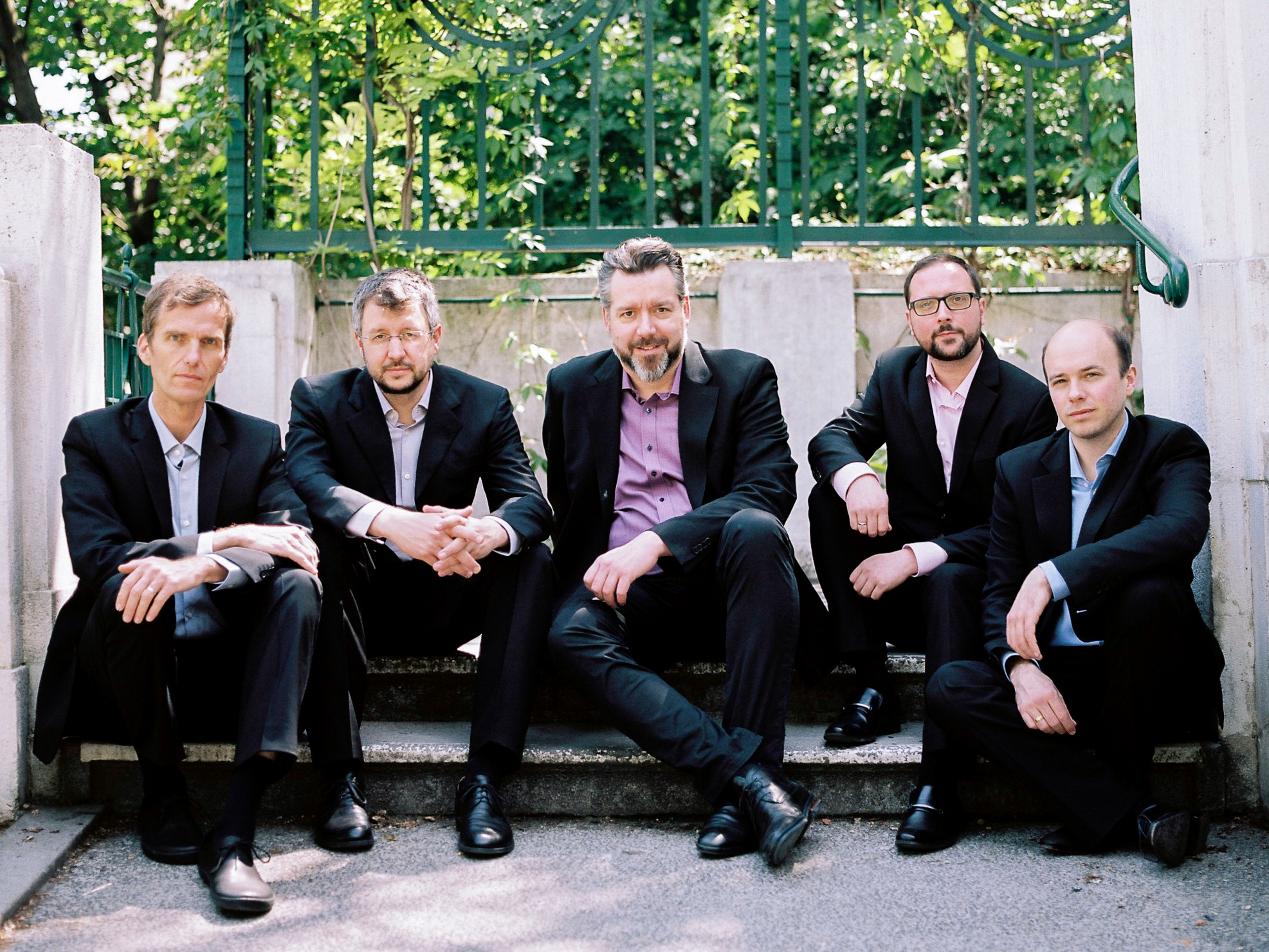
Ensemble Cinquecento
Comprising five professional singers from five European countries, Cinquecento takes its name from the Italian term for the sixteenth century. The pan-European structure of the ensemble (its members are from Austria, Belgium, England, Germany and Switzerland) harks back to the imperial chapel choirs of the 16th century, whose members would have been chosen for their musicianship from Europe’s most prized musical establishments.
Formed in Vienna in October 2004 the ensemble has now established itself as one of Europe’s premier vocal sextets. The ensemble aims to bring the lesser known sixteenth-century choral repertoire from the courts of imperial Austria to a wider public, as well as performing a varied range of Renaissance polyphony with a view to illuminating to audiences the kaleidoscopic diversity of compositional styles operating within Europe over the period. Recent interest from modern composers has also seen the ensemble add a variety of contemporary works to its repertoire.
Aside from numerous performances in Austria an increasingly heavy touring schedule abroad has already taken the ensemble to Germany, France, Holland, Belgium, Italy, Switzerland, Poland, Portugal, Slovakia, Czech Republic, Slovenia and South Korea. Since September 2005 Cinquecento has been ‘Ensemble in Residence’ at the church of St Rochus and Sebastian, Vienna performing a polyphonic mass setting each week.
In 2009 Cinquecento was awarded the “Förderpreis Deutschlandfunk” (Award for Outstanding Promise) by the Musikfest Bremen in conjunction with German Radio.
Since 2006 Cinquecento has been recording for the British label Hyperion, focusing on Habsburg court composers from the sixteenth century. Having attracted high praise from the international media, as well as Gramophone Magazine Editor’s Choice and a prestigious Gramophone Award nomination, these recordings have variously been awarded: the ORF Pasticcio Preis, International CD Compact “Renaissance” Award, as well as the Deutsche Schallplatten Kritik Preis. Their 8th CD, which will focus on secular works by composers at the 16th century Habsburg court, is due for release in early 2014.
…at the very forefront of modern-day specialists in the performance of Renaissance vocal music. (International Record Review)