
Christ Church Cathedral | Map
Alexander Weimann | Sponsored by Bruce Munro Wright, O.B.C.; Pacific Baroque Orchestra; Alan Matheson; Alan Matheson Septet
A collaboration with VIM House, Coastal Jazz, and the Pacific Baroque Orchestra
Alan Matheson Septet
Alan Matheson (cornet, flugelhorn, piano)
Rob McKenzie (trombone)
Julia Nolan (soprano and alto saxophones)
David Branter (clarinet, soprano and tenor saxophones)
Jon Roper (guitar)
Laurence Mollerup (bass)
Craig Scott (drums)
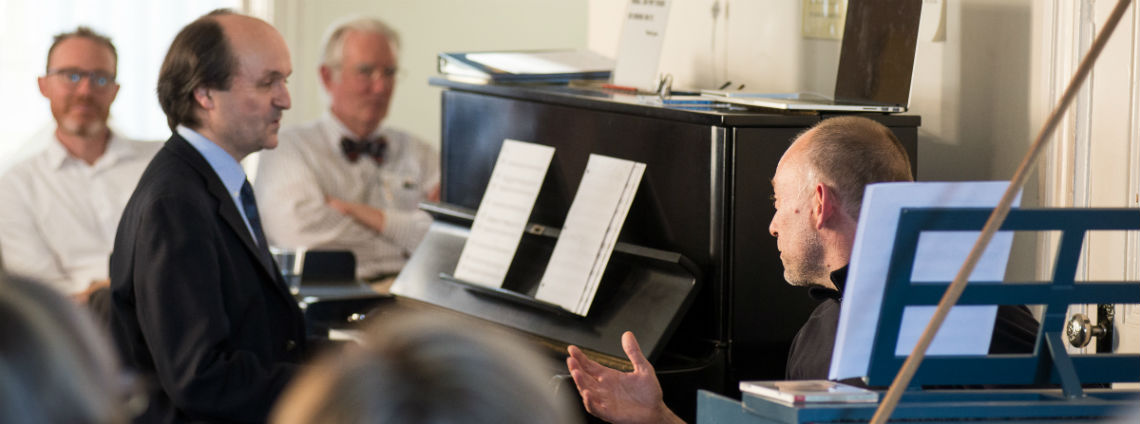
Two ensembles. Two starkly different genres. In this remarkable project, a Baroque ensemble led by JUNO Award-winning harpsichordist/chamber organist Alexander Weimann and a brilliant jazz septet led by trumpeter/composer Alan Matheson explore threads running from the 1600s through today’s creative jazz scene. Bringing together disparate musical communities, the two groups will perform works from their respective fields as well as pieces written for the “common ground” of both. In this timeless meeting place, the long melodic lines of Ellington and Strayhorn echo Handel and Bach, while the endlessly creative practice of “theme and variation” is a keystone of jazz improvisation, of the Baroque and, one could argue, of life.
Supported by the Koerner Foundation, BC Arts Council, City of Vancouver






Click here for information about parking around / transiting to Christ Church Cathedral
Programme
Jazz
Alan Matheson
Intrada
Billy Strayhorn (1915-1967)
Johnny Come Lately (arr. Alan Matheson)
Alan Matheson
Jackson Square
Baroque
Givanni Battista Vitali (1632 – 1692)
Ciacona (tutti)
Francesco Corbetta (ca. 1615 – 1681)
Passachaglia (guitar solo)
Improvisation
Follia (trombone solo)
Jazz
Alan Matheson/Riina Tamm
Open Land (“Avamaa”)
Alan Matheson
Invention
‘Trane To Leipzig
Baroque
Improvisation (timpani solo)
Francesco Rognoni (1570 – 1626)
Diminutions on Pulchra es (Palestrina) (cornetto solo)
Andrea Falconieri (1585[6] – 1656)
Passacalle (tutti)
INTERVAL
Baroque
Salamone Rossi (ca. 1570 – 1630)
Sonata IV sopra Ruggiero (tutti)
Giovanni Picchi (1571[2] – 1643)
Padoana la Ongara (harpsichord solo)
Johann Heinrich Schmelzer (1623 – 1680)
Sonata IV (violin solo)
Jazz
Alan Matheson
White Nights
Jazz/Baroque – joint piece
Alan Matheson
Chaconne (world premiere)
Programme Notes
Instrumental music of all times, types and characters has often been built on a sequence of chords which had to be repeated many times, much like a harmonic and/or melodic theme and its variations; something one could improvise upon, or elaborate on paper; an essential source for composers and players, from the late Medieval era up to our period where we find it mainly in improvised music, particularly in Jazz.
One of the most common of these chord progressions, or grounds, as we call them, is the Passacaglia, or Passacaille. The name comes from the Spanish words pasar and calle, so it means something like “strolling down the street”. And that’s quite accurately what it feels like to play those pieces: like a walk (or sometimes a hike, or a run, or any other kind of journey).
Closely related to the Passacaglia is the Ciacona, or Chaconne, usually in major keys (opposed to the Passacaglia which appears mostly in minor) and a little more up-beat. It is probably older than its sibling, can already be found in Spanish sources of the 16th century, and with some likelihood, it had been exported from the New World to Europe, alongside other very useful products like avocado, corn, potato and tomato, the squash family, various peppers and spices, not to forget cacao and (for some of us) tobacco.
All these grounds were immensely popular in the 17th and 18th centuries, and they still are: Besides the Passacaglia and the Ciacona or Chaconne, the most widespread were probably the Follia, Romanesca, Bergamasca, Monica, Passamezzo, Pavana and the Ruggiero.
A cousin to the practice of playing over a succession of harmonies was the skill of “diminutions”, also known as “divisions”, which essentially means ornamenting, embellishing a tune, mainly through replacing a long note by a melodic figure with notes of shorter value, hence the name. Those pieces were frequently based on evergreen madrigals (like “Anchor che col partire”), canzonas (like “Vestiva i colli”) or motets (like “Pulchra es amica mea”).
We are exited to explore the common grounds of some older and newer music, its texture and polyphony, its structure and its improvisatory freedom, the wide range of its emotions and pace, and we embrace the opportunity to be performing with our colleagues from the Alan Matheson septet.
– Alexander Weimann
*****
Jazz and the music of the Baroque era share many common features, including the use of improvisation, polyphony, theme and variation, and the idea of the “ground bass”. In jazz, the “walking bass” functions similarly to that of the “ground bass” in baroque music: outlining the fundamentals of the harmony and indicating (and maintaining) the basic pulse. Most tonal jazz improvisation is a form of theme and variation technique with many soloists using (or sometimes, abandoning) the structure of the opening theme or melody as an improvisatory “jumping off point”. Certainly, in the Baroque era (and afterwards) there was an abundance of improvisation and perhaps the greatest of all Baroque composers, J.S. Bach, was renowned for his skills as a keyboard improviser. Jazz musicians have greatly appreciated and been influenced by the music of the Baroque, especially for its long, sinuous melody lines and sophisticated use of motivic development. While various “jazz meets Baroque” recordings and performances are well known (such as the work of the Modern Jazz Quartet and Jacques Loussier, along with Benny Goodman’s pioneering recording “Bach Goes To Town”) one of the greatest of all jazz soloists, tenor saxophonist Coleman Hawkins, revered the work of J.S. Bach, playing his music on saxophone as well as on his first instrument, the ‘cello.
For our part of the programme, we have chosen to play compositions that make use of jazz-influenced “ground bass”, polyphony, and theme and variation (both written and improvised). We hope that they will create an interesting dialogue with the music performed by the baroque ensemble.
– Alan Matheson

Alexander Weimann | Sponsored by Bruce Munro Wright, O.B.C.
The internationally renowned keyboard artist Alexander Weimann has spent his life enveloped by the therapeutic power and beauty of making music. Alex grew up in Munich. At age three he became fascinated by the intense magic of the church organ. He started piano at six, formal organ lessons at 12 and harpsichord at university (along with theatre theory, medieval Latin and jazz piano.) He is in huge demand as a director, soloist and chamber player, traveling the world with leading North American and European ensembles. He is Artistic Director of the Pacific Baroque Orchestra in Vancouver and teaches at the University of British Columbia where he directs the Baroque Orchestra Mentorship Programme.
Alex has appeared on more than 100 recordings, including the Juno-award-winning album “Prima Donna” with Karina Gauvin and Arion Baroque orchestra. His latest album series “The Art of Improvisation” (Volume 1: A Prayer for Peace; Volume 2: Ad libitum; and Volume 3: Canavian Variations, released on Redshift, 2024) unites his passions for both baroque music and improvisation on organ, harpsichord, and piano.

Pacific Baroque Orchestra
The ‘house band’ of Early Music Vancouver, The Pacific Baroque Orchestra (PBO) is recognized as one of Canada’s most exciting and innovative ensembles performing “early music for modern ears.” Formed in 1990, the orchestra quickly established itself as a force in Vancouver’s burgeoning music scene with the ongoing support of Early Music Vancouver. In 2009, PBO welcomed Alexander Weimann as Director. His imaginative programming, creativity and engaging musicianship have carved out a unique and vital place in the cultural landscape of Vancouver.
PBO regularly joins forces with internationally-celebrated Canadian guest artists, providing performance opportunities for Canadian musicians while exposing West Coast audiences to a spectacular variety of talent. The Orchestra has also toured throughout BC, the northern United States, and across Canada. Their 2019 East Coast Canadian tour with Canadian soprano Karina Gauvin culminated in a critically acclaimed album, Nuit Blanches, released by Atma Classique.
Alan Matheson
Alan Matheson is a Vancouver-based pianist, trumpeter, composer and arranger. He teaches at the music departments of the University of British Columbia, Vancouver Community College and Capilano University where he is an instructor in jazz piano and trumpet. He is a graduate of Northwestern University in Evanston, Illinois and studied with Vincent Cichowicz. Alan has also studied with Barbara Butler, Joe Newman and Clark Terry.
Alan also leads his own big band, nonet, septet and trio and has written arrangements for jazz legends Clark Terry and Bud Shank. As well, Alan has conducted his big band tributes to Duke Ellington, Paul Whiteman and Louis Armstrong. He has also performed with the Vancouver Symphony Orchestra, Louis Bellson and Phil Woods. Alan’s compositions have been performed by Julia Nolan (saxophone), Sal Ferreras (percussion) David Palmer (pipe organ) and Martin Hackelman (horn). His arrangements for big band have been performed by the Tulane University Jazz Ensemble and the Northwestern University Jazz Ensemble. Alan’s first CD “Intrada” was released in 2004 and his newest CDs “Duetti” and “Summer Evening” (recorded in Finland with bassist Wade Mikkola) were released in 2013 and 2015 respectively.
Alan Matheson Septet
The Alan Matheson Septet has been an important part of the Vancouver jazz scene for over twenty years. Their first CD release, “Intrada”, features original compositions by Alan Matheson that reflect a wide range of musical influences, from Ellington to Woody Shaw. The septet also plays compositions by band members Rob McKenzie, Dave Branter, and Craig Scott, as well as jazz classics by Billy Strayhorn, Fletcher Henderson, and Stan Kenton.
Their “little big band” sound has impressed audiences at the Vancouver International Jazz Festival, the Pender Harbour Jazz Festival, and on the air via CBC Radio’s “Hot Air” and “Tonic” programs. The personnel of both groups is made up of some of Vancouver’s most versatile musicians, all equally at home in jazz, classical, and popular music.