Chan Shun Concert Hall at the Chan Centre for the Performing Arts | Map
Queen Elizabeth I may not have wanted “to make windows into men’s souls”, but faced with threats at home and abroad, her regime dealt increasingly harshly with supporters of the old Catholic religion. Torn between obedience and conscience, several of England’s most talented musicians “Philips, Dering, and Dowland” chose a life of exile abroad. Those Catholic composers who remained in England – chief amongst them William Byrd and Robert White “expressed their spiritual exile in music of astonishing intensity and emotional impact.”
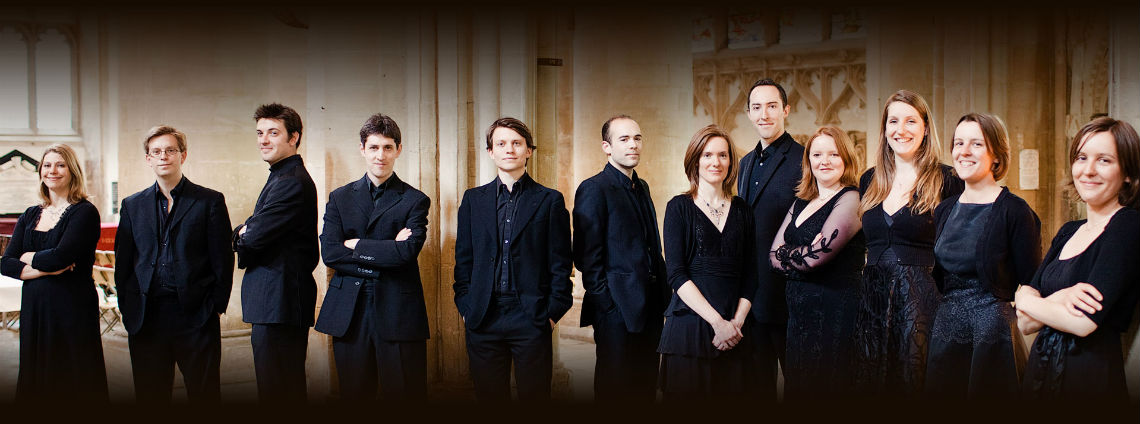
Stile Antico is a British ensemble now established as one of the most original and exciting new voices in its field and has an extensive and award-winning discography on the Harmonia Mundi label.
“Anything but antique…their sound has the urgency and freshness you get from young voices, and an amazing rhythmic vitality.” – The Daily Telegraph
Supported by Elaine Adair
Programme
John Dowland – Flow my tears
Philip de Monte – Super Flumina Babylonis
William Byrd – Quomodo cantabimus
Richard Dering – Sancta et immaculata virginitas
Thomas Tallis – In ieiunio et fletu
Peter Philips – Regina caeli laetare
William Byrd – Tristitia et anxietas
INTERVAL
William Byrd – Haec Dies
Peter Philips Gaude – Maria / Virgo prudentissima
John Dowland – In this trembling shadow cast
Richard Dering – Factum est silentium
Robert White – Lamentations a5
Click here to view the texts and translations.
Programme Notes
‘How shall we sing the Lord’s song in a strange land?’
Henry VIII’s infamous break with Rome in 1534 and subsequent destruction of religious institutions did comparatively little to change the appearance or content of church services, which continued to be carried out according to the centuries-old Sarum rite. When his Protestant young son Edward VI came to the throne, however, church worship in England was turned upside-down within a space of months. The backlash was equally violent at the accession of Mary I, who restored papal authority and the Sarum rite between 1553 and 1558. By the time Elizabeth I came to the throne, English churchgoers might have been forgiven for feeling disillusioned. The new queen’s task was to unify her subjects behind her rule, and, although her convictions were essentially Protestant she did not in fact wish to alienate those who held more traditional Catholic beliefs – which may explain her softening of one or two more distinctly Protestant corners of Edward’s Book of Common Prayer. While many may have disliked the newly-imposed English services, few seem to have absented themselves from public worship in the early Elizabethan years.
Although by the late 1560s there were notable Papist stirrings (echoes of which can perhaps be detected in a work like White’s Lamentations), the real turning point came in late February 1570, when Pope Pius V issued a bull asserting Elizabeth to be a heretic and pretender, prohibiting her subjects from obeying ‘her orders, mandates and laws’ and declaring any who did so excommunicated. Thus, to be an obedient Catholic now entailed rejecting Elizabeth’s authority and (by implication) desiring her overthrow. Furthermore, for those whose conscience now prevented them from attending the ‘impious rites’ of the English Prayer Book, recusancy was the only option, against which laws were enforced from the late 1570s. So began the years of persecution which saw influential Roman Catholics martyred for treason, and many more imprisoned and persecuted. A ‘clarification’ from Rome in 1580 permitting Catholics to be loyal citizens in civil matters until an ‘opportunity for liberation’ helped little (nor, to be fair, did many want England to be ‘liberated’ by the Spaniards). Yet, while it is well documented that Elizabeth personally favoured greater religious tolerance than Parliament permitted her, the foiling of numerous plots and assassination attempts against her during the 1570s and 80s demonstrated that concerns about her safety were well-founded. Meanwhile, behind the walls of Roman Catholic houses, of the scriptures to which believers most often turned for comfort and encouragement during these troubled times, Old Testament texts concerning the Babylonian captivity proved particularly popular, and provided much inspiration for composers. This is the context out of which sprang the works in the present programme. All but one of the composers represented here were English Catholics, either in the metaphorical ‘strange land’ of Protestant England, or living abroad.
John Dowland (1563-1626) turned to Rome while a teenager in Paris, but he had returned to England by the time he was first turned down for a post at court. An Italian journey to study with Marenzio got him accidentally mixed up in a plot against Elizabeth from which he hurriedly escaped, but, upon his return, failed again to win the royal patronage he so desperately craved. To describe his travels as ‘exile’ is far-fetched, but, from what we know of his character he wouldn’t have minded in the least. He self-pityingly wrote that his religion was the reason for his failure to win Elizabeth’s favour – though in reality it hadn’t stopped others, and, if anything, she probably just didn’t warm to such a self-absorbed sycophant. He clearly therefore ‘had no choice’ but to take a very well-paid position at the Danish court in 1598, from which he was dismissed in 1606 after spending too long on visits home. Finally, James I took him on as a lutenist in 1612. Dowland’s music is famed for its melancholy; this seems to have been rather true of his personality, too (though such affectations were somewhat in vogue amongst artistic types at that time). His famous lute song Flow my tears, with its striking descending lacrimae motif, must be considered his signature tune, and appears here in a consort arrangement – a not uncommon practice in Dowland’s time. Indeed, the song In this trembling shadow is one of many of Dowland’s songs published in such a way as to permit just that type of performance: the solo melody and lute tablature are printed on one side of the page, and three voice (or viol) parts – in ‘table’ format, with each different part facing outwards in a different direction so that the music can be gathered-around – on the facing page. Here, Dowland casts his melancholia in rather chromatic musical material.
William Byrd (c.1540-1623), by contrast, stayed in England and was the most admired composer of his generation. His connections in Catholic circles are well-documented, but it was through his music that he most openly served the recusant community (while his friendship with Elizabeth ensured impunity): his Cantiones sacrae of 1589 and 1591 included numerous works with overtly subversive texts, while the Gradualia of 1605 and 1607 provided short liturgical motets for the year-round celebration of the mass. His three famous mass settings, composed in the mid-1590s, were considered dangerous enough that the printer dared not include his own name, although Byrd’s appears on each page. The extraordinary 8-part motet Quomodo cantabimus, appears to have had a particularly memorable genesis: the eighteenth-century antiquarian John Alcock records that Philippe de Monte, kappelmeister to the Holy Roman Emperor, sent Byrd a copy of his motet Super flumina Babylonis, a setting of the opening verses of that most memorable exile text, psalm 136 (137 in English translations). Byrd ‘replied’ with Quomodo cantabimus – a setting of verses 4-7 – the motet itself providing an answer to the question posed in the opening line of the text. That three of its eight voice parts formed an ingenious canon by inversion doubtless assured the rest of the world that music was alive and well amongst England’s persecuted Catholics. Tristitia et anxietas (from the 1589 Cantiones sacrae) is without doubt one of his great tours de force – a musical setting which uses expressive semitonal melodic inflections (perhaps a nod to Clemens’ setting of the same text) and a strikingly broad sense of scale to lend great heaviness to the lament of the first half of the text, while lending the more hopeful second a sense of profound yearning. The much-loved Haec dies, on the other hand, has little of this gravitas; here the joy of this psalm text (one closely associated with Easter day, when it is used as a Gradual) calls forth a more economical, madrigalian response.
Richard Dering (c.1580-1630) spent the first years of his career in England, but probably converted to Rome on a trip to Italy in the early 1610s and spent most of the rest of his life in the Low Countries. Only in 1625 did he return, taking the position of organist to Charles I’s Catholic wife Henrietta Maria. Sancta et immaculata virginitas finds him in a distinctly modern, Italianate voice, writing for two solo voices with basso continuo (not to mention setting a text which would hardly be countenanced in the English church). The same can be said of perhaps his best-known motet, Factum est silentium – a setting of a dramatic passage from the Revelation of St John – in which he draws upon considerable variation in note durations, vividly contrasting textures and insistent, stylised rhythms in order to convey the text; the style is not at all unlike that seen in many of the madrigals of the day.
Thomas Tallis (c.1505-1585) – a close friend and teacher to Byrd – represents the generation who experienced all the mid-century upheavals first-hand – which, as a composer, meant a constant reinventing of his craft to suit the religious tastes of the moment. Although many of his works cannot be precisely dated, the bold, expressive harmonies of In ieiunio et fletu suggest a late date of composition not long before the motet’s publication in 1575. Indeed, its emotive power lies in some extraordinary progressions of seemingly barely-related chords, which present to us, as if dumbstruck, the scene of priests lamenting their desecrated heritage. At the words of the priests themselves, the voices reach the highest point in their tessitura as if to echo the impassioned cries for mercy. Although the worst persecution was yet to come, it is hard not to see this piece as in some way a metaphor for the grief of many at the perceived desecration of the church by the Protestant regime.
The most-published English composer of his generation after Byrd, Peter Philips (1560/1-1628) spent much of his working life in the Low Countries, having fled England in 1582 on account of his Catholicism. His travels took him via Douai to Rome, where he stayed for three years, before another 5 years’ travel in the employment of Lord Thomas Paget, another prominent English refugee. He settled in Antwerp around 1590, enjoying a quiet seven years, save for a visit to Amsterdam (probably to see Sweelinck) during which he was accused of complicity in a plot against Elizabeth and briefly imprisoned – a stark reminder of the perils of being an English Catholic, home or abroad. When the matter came to court, Philips was released without charge. In 1597 he joined the household of the Archduke Albert VII, Hapsburg governer of the Low Countries and was to remain in Brussels until his death. Like many continental composers of his generation, Philips’s extensive output of sacred and secular music spans the join between the Renaissance and Baroque styles. The fine five-voice setting of Regina caeli performed here is a good example – its various metrical and textural changes, and its reliance upon ‘modern’ cadential patters, are not unreminiscent of the sacred music of Monteverdi or Gabrieli (as would be especially the case if the voice parts were to be doubled by instruments) but its strong roots in the prima pratica are also evident. By contrast, his two-part motet Gaude Maria virgo seems more archaic; imitative counterpoint prevails, and, at its conclusion, Philips employs one of the oldest gags in the book: the words ‘ut sol’ (‘as the sun’) set to a rising fifth interval – a reference to the note names in the Guidonian hexachord.
Robert White (1538-1574) is one of the several very fine sixteenth-century English composers eclipsed by Tallis and Byrd, primarily on account of the monopoly they had been given by the queen over the printing of music. Nonetheless, White’s music is highly imaginative, individual and masterful, and his Lamentations setting is one of his finest works. It is one of several superb settings of that text which seem to have been written during the 1560s (Tallis’s being the most famous) – yet more evidence that, even before 1570, not everybody was happy with the religious status quo. The fact is particularly striking when one considers the way in which the Babylonians’ sacking of Jerusalem (the historical impetus for the Lamentations of Jeremiah) was to become such a notorious metaphor for the plight of English Catholics over the ensuing decades. On the other hand, it needn’t go unnoticed that, on the facing page in each of the Dow partbooks (the work’s principal source) is a Latin inscription which reads ‘wine and music make the heart glad’. Perhaps, even amidst the turmoil of the 1580s, this extraordinary setting was appreciated as much for its musical merit and affective power as for its devotional message. The original Hebrew text is an acrostic poem (each short section begins with a new letter of the Hebrew alphabet) and White’s Latin text contains the Hebrew letter names at the beginning of each section, which he sets as a musical equivalent of ‘illuminated letters’.
Stile Antico
Stile Antico is firmly established as one of the world’s most accomplished and innovative vocal ensembles. Working without a conductor, its twelve members have thrilled audiences throughout Europe and North America with their fresh, vibrant and moving performances of Renaissance polyphony. Its bestselling recordings on the Harmonia Mundi label have earned accolades including the Gramophone Award for Early Music, the Diapason d’or de l’année, the Edison Klassiek Award and the Preis der deutschen Schallplattenkritik, and have twice received Grammy® nominations.
Based in London, Stile Antico has performed at many of the world’s most prestigious venues and festivals. The group enjoys a particularly close association with the Wigmore Hall, and has appeared at the BBC Proms, Buckingham Palace, the Amsterdam Concertgebouw, the Cité de la Musique, the Palais des Beaux-Arts and the Luxembourg Philharmonie. Stile Antico is frequently invited to perform at Europe’s leading festivals: highlights include the Lucerne Easter Festival, the Rheingau, Schleswig-Holstein and Wrocław Festivals and the Antwerp, Barcelona, Bruges, Granada, Utrecht and York Early Music Festivals.
Since making its critically acclaimed North American debut at the Boston Early Music Festival in 2009, Stile Antico has returned frequently to the US and Canada, performing regularly in Boston and in New York’s Music Before 1800 and Miller Theatre series. Further appearances include Washington’s Library of Congress, the Chan Centre in Vancouver, the Quebec Festival of Sacred Music, at Duke, Michigan and Yale Universities, and in concert series across nineteen US states. In 2010 Stile Antico made its debut at the Cervantino festival in Mexico.
Stile Antico is renowned for the committed and expressive performances that arise from its uniquely collaborative style of working: its members rehearse and perform as chamber musicians, each contributing artistically to the musical results. The group is also noted for its intelligent programming, drawing out thematic connections between works to shine new light on Renaissance music. In addition to its core repertoire, Stile Antico has given world premieres of works by John McCabe and Huw Watkins, and recently juxtaposed the music of William Byrd and James MacMillan to great acclaim. Its diverse range of collaborations has included performances with viol consort Fretwork, pianist Marino Fomenti, orchestra B’Rock, and Sting.
Alongside its concert and recording work, Stile Antico is passionate about sharing its repertoire and working style with the widest possible audience, and its masterclasses and workshops are much in demand. The group regularly leads courses at the Dartington International Summer School, is often invited to work alongside ensembles at universities, festivals and early music forums, and is preparing to expand its education work in schools under the auspices of the newly-created charitable Stile Antico Foundation.
Stile Antico marks its tenth anniversary with celebratory projects and performances throughout the 2015-6 season. Highlights include a birthday concert at the Wigmore Hall, where the group premieres a new work by Nico Muhly, landmark European appearances at the BBC Proms and the Antwerp, Bruges, and Utrecht Early Music Festivals, a collaboration with the Folger Ensemble in Washington DC and New York, and a bursary for young singers in association with the Stile Antico Foundation and the University of York. Harmonia Mundi honours this milestone with the launch of a tenth-anniversary compilation album, Sing with the Voice of Melody, the reissue of the group’s debut, Music for Compline, and the release of its tenth disc, A Wondrous Mystery.