
Chan Shun Concert Hall at the Chan Centre for the Performing Arts | Map
Alexander Weimann | Sponsored by Bruce Munro Wright, O.B.C.; Pacific Baroque Orchestra; UBC Baroque Mentorship Orchestra
The members of the Pacific Baroque Orchestra join forces with the UBC Baroque Mentorship Orchestra to perform Handel’s suite for wind band written for the fireworks celebration commemorating the end of the War of Austrian Succession in April of 1749. Fittingly, the festively-sized orchestra of students and professional players will perform a re-scoring of this famous suite for full orchestra that Handel composed to benefit the student residents of the Foundling Hospital in London.
PROGRAMME
Georg Philipp Telemann:
Concerto for 3 trumpets, timpani, 2 oboes and strings (TWV 54:D3) in D major
Intrada Adagio, Allegro, Largo, Vivace
Johann Sebastian Bach:
Brandenburg Concerto 1 (BWV 1046) in F major
No indication, Adagio, Allegro, Menuetto-Trio-Polacca-Trio
INTERVAL
Georg Frideric Handel:
Music for the Royal Fireworks (HWV 351) in D major
Ouverture, Bourée, La Paix, La Rejouissance, Menuet I & II
PROGRAMME NOTES
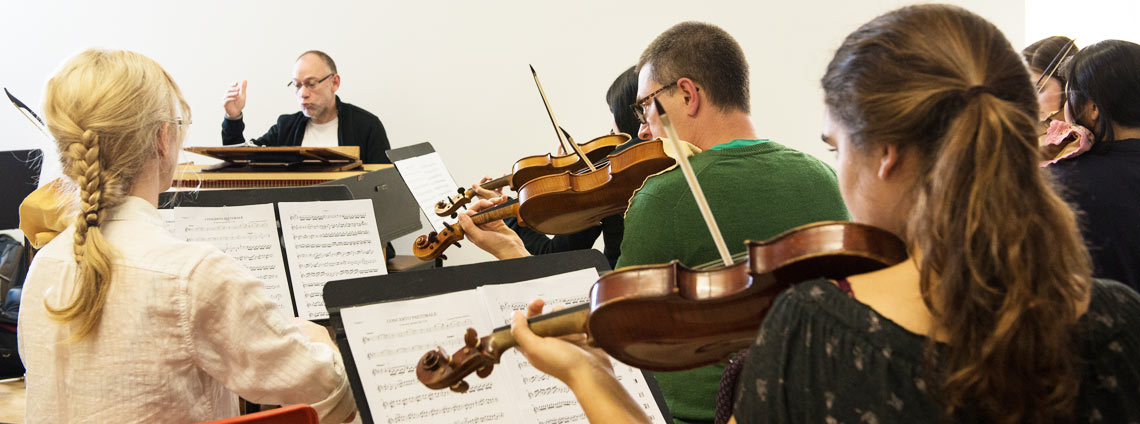
This afternoon’s programme is exuberantly festive. Not only have Handel’s Music for the Royal Fireworks and Bach’s Brandenburg concertos elevated the spirits of generations of music lovers, today’s performance celebrates the accomplishments of students and young professionals, members of the UBC Baroque Mentorship Orchestra, who have spent the academic year studying under Alexander Weimann, Chloe Meyers, Natalie Mackie, and special guests including Nicholas McGegan. The Baroque Mentorship Orchestra Programme, a collaboration between Early Music Vancouver, Pacific Baroque Orchestra, and the UBC School of Music, provides an extraordinary opportunity for students to intuitively learn period performance practice and professional skills, sitting beside the very best historical instrument players in weekly rehearsals and in the professional rehearsals that preceded this concert, when the Mentorship Orchestra joined the Pacific Baroque Orchestra to create a lavish ensemble of more than 40 musicians. Triumphs are made sweeter by trials. For the students of the Baroque Mentorship Orchestra, the relatively minor tribulations included adapting to violins without chin or shoulder rests, cellos without endpins, woodwinds without keys, differently balanced bows, and gut strings more sensitive to climate changes than their modern counterparts. The pieces on the programme survived much hotter crucibles to delight us today.
The 1721 autograph manuscript of Johann Sebastian Bach’s Brandenburg Concertos languished unopened on a shelf in the library of Christian Ludwig, Margrave of Brandenburg, until his death, when it was sold for the equivalent of $25. Bach gave the concertos the understated title, Concerts avec plusieurs instruments. In fact, they feature unprecedented and daring combinations of instruments. Concerto No. 1 foregrounds a solo group of two horns, three oboes, bassoon, and violin piccolo, a miniature violin tuned a third or fourth higher than the standard violin. In the Brandenburgs, he explores the endless adaptability of the concerto principle, in which a solo group, or concertino, is pitted against the rest of the orchestra. He likely composed them during his time as organist and director of music in Weimar, when he was introduced to the concertos of Antonio Vivaldi. His biographer, Johann Nikolaus Forkel, asserts that these “taught [Bach] how to think musically,” explaining that through them Bach achieved his astounding mastery of musical order, coherence, and proportion.
Georg Philipp Telemann’s Concerto in D Major for Three Trumpets and Timpani celebrated the birth of Leopold Johann of Hapsburg, heir to the imperial throne. The opening Intrada exuberantly heralds the entrance of the tiny royal. Tragically, the prince died in infancy, the only son of Charles VI. His sister Maria Theresa was born the following year. On the grounds of ancient Salic law that prohibited royal inheritance by a woman, France and Prussia challenged her right to the Hapsburg dynasty. Great Britain and the Dutch Republic, long enemies of France, sided with Austria. The War of Austrian Succession broke out in 1739, finally ending in 1748 with the Treaty of Aix-la-Chapelle and Maria Theresa’s crowning as empress.
Peace was celebrated in London with a grand fireworks display accompanied by a new orchestral suite commissioned from George Frideric Handel. Perhaps in an attempt to popularize the expensive war and controversial treaty, George II demanded that Handel perform his Music for the Royal Fireworks not only during the official celebrations at London’s Green Park, but also in an open rehearsal at the Vauxhall Gardens. London newspapers and magazines contributed to the propaganda, claiming that 8,000 to 12,000 people attended the public rehearsal, though Vauxhall Gardens only have accommodated about 3,000 people. The official performance on April 27, 1749 failed dismally. All the brass and winds of Handel’s 100-member band could not compete with the noise of the fireworks, and rainy weather damped the atmosphere, but did not prevent the pavilion in which Handel and his musicians performed from catching fire! Neither did Handel escape vicious criticism. A 1749 caricature by Joseph Goupy depicts Handel, an extravagantly-dressed pig seated at a chamber organ surrounded by food and military instruments, with a wine cask for an organ bench.
However this royal commission and his delight in sensual pleasures may have harmed his public image, Handel’s friends knew a different man. James Smyth reports that “he died as he lived … in perfect charity with all the world.” Handel established and donated generously to the Society for the Support of Decay’d Musicians, and served as a governor of the Foundling Hospital for vulnerable and abandoned children. On May 27, 1749, Handel presented a re-orchestrated indoor version of his Music for the Royal Fireworks in a charitable concert for the hospital. The event generated so much excitement that women were asked not to wear hooped skirts and men told not to bring swords to make room for the large audience. Handel continued his popular fundraising concerts until his death, performing Messiah at the Foundling Hospital every year. He raised the equivalent of more than a million dollars for the care and education of children.
– Christina Hutten

Alexander Weimann | Sponsored by Bruce Munro Wright, O.B.C.
The internationally renowned keyboard artist Alexander Weimann has spent his life enveloped by the therapeutic power and beauty of making music. Alex grew up in Munich. At age three he became fascinated by the intense magic of the church organ. He started piano at six, formal organ lessons at 12 and harpsichord at university (along with theatre theory, medieval Latin and jazz piano.) He is in huge demand as a director, soloist and chamber player, traveling the world with leading North American and European ensembles. He is Artistic Director of the Pacific Baroque Orchestra in Vancouver and teaches at the University of British Columbia where he directs the Baroque Orchestra Mentorship Programme.
Alex has appeared on more than 100 recordings, including the Juno-award-winning album “Prima Donna” with Karina Gauvin and Arion Baroque orchestra. His latest album series “The Art of Improvisation” (Volume 1: A Prayer for Peace; Volume 2: Ad libitum; and Volume 3: Canavian Variations, released on Redshift, 2024) unites his passions for both baroque music and improvisation on organ, harpsichord, and piano.

Pacific Baroque Orchestra
The ‘house band’ of Early Music Vancouver, The Pacific Baroque Orchestra (PBO) is recognized as one of Canada’s most exciting and innovative ensembles performing “early music for modern ears.” Formed in 1990, the orchestra quickly established itself as a force in Vancouver’s burgeoning music scene with the ongoing support of Early Music Vancouver. In 2009, PBO welcomed Alexander Weimann as Director. His imaginative programming, creativity and engaging musicianship have carved out a unique and vital place in the cultural landscape of Vancouver.
PBO regularly joins forces with internationally-celebrated Canadian guest artists, providing performance opportunities for Canadian musicians while exposing West Coast audiences to a spectacular variety of talent. The Orchestra has also toured throughout BC, the northern United States, and across Canada. Their 2019 East Coast Canadian tour with Canadian soprano Karina Gauvin culminated in a critically acclaimed album, Nuit Blanches, released by Atma Classique.
UBC Baroque Mentorship Orchestra
In 2014/2015, the UBC School of Music, the Pacific Baroque Orchestra, and Early Music Vancouver established a Baroque Orchestra Mentorship Programme that is open to selected students and members of the professional community wishing to learn about period performance practice. This new initiative is aimed at increasing the long-term sustainability of the local period instrument scene.