Chan Centre for the Performing Arts
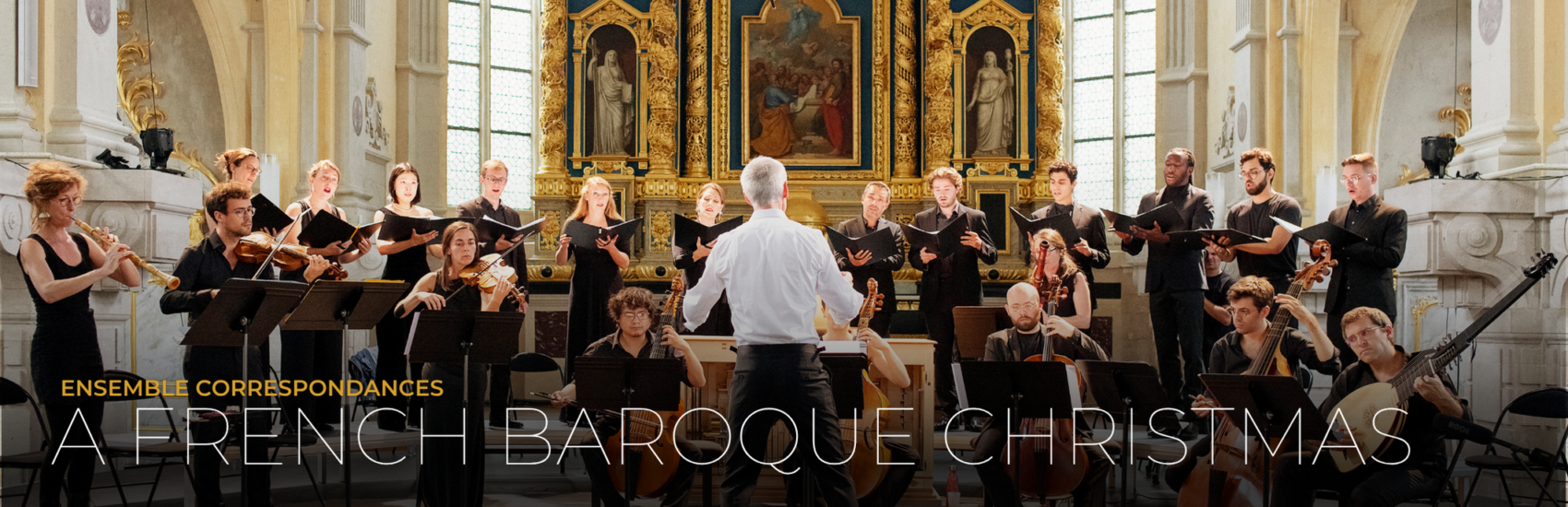
A French Baroque Christmas with Ensemble Correspondances
“Messe de minuit pour Noël” by Marc-Antoine Charpentier
Artists: Ensemble Correspondances directed by Sébastien Daucé; with Caroline Weynants, Soprano; Lucile Richardot, Alto; Richard Pittsinger, Tenor; and Lysandre Châlon, Basse.
Pre-concert Chat: TBA
Runtime: approximately 80 minutes plus interval
Written for the holy night of Christmas, Charpentier’s Midnight Mass has travelled the world. Based on traditional French Noëls, this music offers pleasure to everyone: be it through the joy of hearing a familiar tune, or of marveling at its extraordinary craftsmanship. The very simplicity of the original songs lends the entire Mass a cheerful character and a transparency that is anything but shallow, speaking instead in a language that was once profoundly universal.
“…the path followed by Sébastien Daucé and Correspondances represents the culmination of a practice deeply nourished by the French repertoire, a familiarity reinforced by a true ensemble spirit that privileges the blending of timbres, mutual listening, and a harmonic culture that brings to the surface details otherwise buried: Italian reminiscences, verbal rhetoric, the rare grain of the continuo, and the absolute primacy of the text.
– Jérémie Rousseau (Radio-France)
Generously sponsored by José Verstappen
PROGRAMME:
Marc-Antoine Charpentier (1643 – 1704)
Sub tuum praesidium H.28
Quam gloriosa dicta sunt de te H.400 (extract)
In nativitatem Domini canticum H.416
Interval
Marc-Antoine Charpentier
Nuit H.420
Sébastien de Brossard (1655 – 1730)
O Miraculum
Marc-Antoine Charpentier
Messe de minuit H.9 Kyrie
Messe de minuit H.9 Christe
Messe de minuit H.9 Kyrie
Joseph est bien marié H.534
Messe de minuit H.9 Gloria
O sacramentum pietatis H.274
Messe de minuit H.9 Credo
Or nous dites Marie H.534
In Nativitate Domini Canticum H. 421
Messe de minuit H.9 Sanctus
Messe de minuit H.9 Agnus
Caroline Weynants, Soprano
Caroline Weynants is a Belgian soprano specializing in Baroque music. She is distinguished by her extensive collaborations with high-quality international ensembles and by a rich discography. Trained at the Royal Conservatory of Liège (Belgium), where she obtained her advanced diploma in singing (2003) as well as a first prize in chamber music, she worked there on all repertoires, from early music to contemporary music.
In 1998, she joined the Chamber Choir of Namur (Centre d’Art Vocal & de Musique Ancienne – CAV&MA), where she built her career as a choral singer and soloist under the direction of renowned conductors such as M. Minkowski, S. Kuijken, J. Tubéry, J-C. Malgloire, G. Van Waas, F. Bernius, P. Dombrecht, P. Davin, Ph. Pierlot, and L. García Alarcón. She has performed with some of the best European Baroque ensembles: La Fenice (J. Tubéry), Les Agrémens (G. Van Waas), Il Fondamento (P. Dombrecht), Il Gardellino (M. Ponseele, Jan de Winne), Cappella Mediterranea (L. García Alarcón), Lauda Musica, La Grande Chapelle (A. Recasens), Les Muffatti, Correspondances (S. Daucé), and Vox Luminis (L. Meunier).
These collaborations have resulted in several recordings, including, for example, C.P.E. Bach: *Lukas Passion* with Il Fondamento, or Grétry: Céphale et Procris with Les Agrémens; Bach: Desire – Cantatas 32, 49 & 154 with Il Gardellino, as well as Falvetti: Il diluvio Universale or Nabucco with L. García Alarcón. Histoires Sacrées by Charpentier with Correspondances, Handel’s Dixit Dominus with Vox Luminis, and many others.
Caroline Weynants has sung at numerous festivals across Europe—the Ambronay Festival, the Beaune Baroque Opera Festival, the Centre de Musique Baroque de Versailles, the Bourg-en-Bresse Festival, Lyon, Lessay, Sablé, La Chaise-Dieu, and Périgueux. In Belgium, she has performed at the Flanders and Wallonia festivals; she has also appeared in festivals and major venues in Spain, Italy, Germany, England, Canada, and the United States.
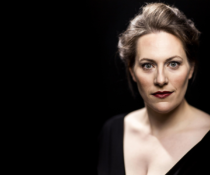
Lucile Richardot, Alto
Equally at home in madrigals as in solo repertoire, as well as being a committed Early Music champion, Lucile Richardot discovered singing as a child in her hometown of Épinal and initially pursued a career in journalism.
Having subsequently trained with the Maîtrise de Notre-Dame de Paris, then in Early Music at the Conservatoire à Rayonnement Régional in Paris, she embraces all eras and musical styles, on the concert platform as on the operatic stage. She has notably sung with Il Seminario Musicale, Le Poème Harmonique, Les Paladins, Solistes XXI, the Ensemble Intercontemporain, Collegium 1704, Het Collectief, Il Giardino Armonico, The English Concert, Le Concert de la Loge, Les Accents, Les Surprises, Faenza, the Orchestre National de France, and she performs regularly with Correspondances, Pygmalion, Les Arts Florissants, Pulcinella, Les Musiciens de Saint-Julien, and Acte 6...
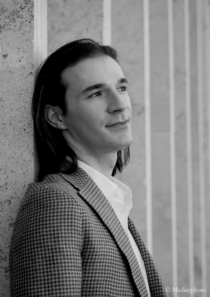
Richard Pittsinger, Tenor
Praised by Anthony Tomassini of The New York Times for his “winning singing and youthful bearing,” American tenor Richard Pittsinger is quickly establishing himself as a leading performer of both early and modern repertoire. An artist of rare versatility whose performance experience spans music across four centuries, Pittsinger’s principal operatic roles to date include Céphale in Élisabeth Jacquet de La Guerre’s Céphale et Procris with the Boston Early Music Festival, Aminta in Handel’s Atalanta with Juilliard Opera, Polinesso in Jonathan Dawe’s Being Ariodante at the Italian Academy, Orfeo in Luigi Rossi’s L’Orfeo with Juilliard Opera, Lysander in Britten’s A Midsummer Night’s Dream with Juilliard Opera, and “The Rocket” in Laura Karpman’s Wilde Tales at the Glimmerglass Festival. Additional stage credits include Verdi’s Falstaff at the Aspen Music Festival (Dr. Caius), Handel’s Acis & Galatea (Damon & Corydon), Virgil Thomson’s The Mother of Us All (Andrew Johnson), and Offenbach’s Orpheus in the Underworld (Mercury). Recent stage credits also include excerpts from the title role in Rameau’s Platée and the ensemble of Verdi’s Un giorno di regno at the Garsington Opera Festival, where he subsequently won the esteemed Helen Clark Award. In addition, at the 2023 International Baroque Singing Competition of Normandy, Richard was awarded both the Young Artist Award and Audience Award. Equally comfortable on the concert stage, Pittsinger has additionally served as tenor soloist with Musica Sacra, ARTEK, Central City Chorus, The Cecilia Chorus of New York, The Co-Cathedral at St. Joseph’s, as well as Julliard415. He has collaborated with, or appeared under the direction of, such musicians as Paul Agnew, Louisa Muller, Christopher Alden, Mary Birnbaum, Avi Stein, Gilbert Blin, William Christie, Richard Egarr, Stephen Stubbs, Patrick Summers, Stephen Wadsworth, and Gary Wedow.
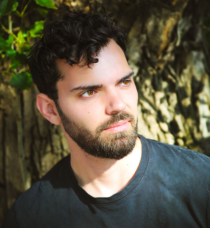
Lysandre Châlon, Basse
Lysandre Châlon began his vocal training at the Conservatoire de Meaux before continuing his studies at the Conservatoire National Supérieur de Musique et de Danse de Paris.
Lysandre’s upcoming engagements in the 2025–2026 season include multiple collaborations with Les Talens Lyriques and a series of concert projects with Ensemble Correspondances. Highlights include the recording of Lully’s Cadmus et Hermione and a performance of Berlioz’s L’Enfance du Christ (as Joseph) at the Müpa concert hall in Budapest. The season will conclude with his house debut at the Opéra national du Rhin, where he will appear in the title role of a new production of Le nozze di Figaro.
Lysandre Châlon has performed with esteemed conductors and ensembles across a diverse repertoire. In baroque music, he has sung roles in Armide, Dido and Aeneas, and David et Jonathas, collaborating with Christophe Rousset, Leonardo García Alarcón, and Ensemble Correspondances. He has also appeared at the Théâtre des Champs-Élysées and regularly works under the baton of conductors such as Emmanuelle Haïm.
In the Mozart repertoire, he has performed Figaro, Papageno, Guglielmo, Leporello, and the Count in Le nozze di Figaro with companies including Opéra Éclaté. He has also appeared as Belcore in L’elisir d’amore, Franck in Die Fledermaus, and the Baker in Bernstein’s Wonderful Town.
As a concert soloist, Lysandre has interpreted major works such as Mozart’s Requiem, Rossini’s Petite Messe Solennelle, and Dvořák’s Stabat Mater and Requiem.
Lysandre completed a master’s degree at the Conservatoire National Supérieur de Musique et de Danse de Paris, where he studied with Frédéric Gindraux, Morgane Fauchois-Prado, and Mary Olivon. He has also participated in masterclasses with renowned artists such as Véronique Gens, Iñaki Encina Oyon, Irène Kudela, and Alain Buet.
A passionate interpreter of art song and lieder, he regularly performs works by Ropartz, Ibert, Fauré, Duparc, Schubert, Brahms, Wolf, Vaughan Williams, and Gerald Finzi, and has received guidance from Anne Le Bozec, Philippe Biros, Susan Manoff, and Jeff Cohen.
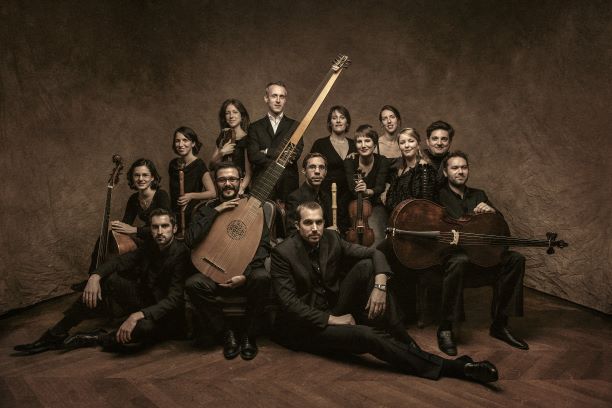
Ensemble Correspondances
Founded in Lyon in 2009, Correspondances brings together under the direction of the harpsichordist and organist Sébastien Daucé a group of singers and instrumentalists, all of whom are specialists in the music of the Grand Siècle. In a few short years of existence, Correspondances has become a benchmark ensemble in the seventeenth-century French repertory. Placing itself under the auspices of Baudelaire’s notion of correspondences between the arts, it performs music whose sonorities can still directly touch today’s listeners while presenting staged productions of rarer and more original forms such as the oratorio and the ballet de cour.
The exceptional reconstruction of the score of Le Ballet Royal de la Nuit, the result of three years of research, allowed modern audiences to discover a major musical event of the seventeenth century, the unprecedented moment that inaugurated the reign of the Sun King. After the public and critical success of the CD-book released on harmonia mundi (Le Concert Royal de la Nuit, 2015), the ensemble returned to this extraordinary spectacle in 2017 with the théâtre de Caen, in a contemporary production by Francesca Lattuada combining elements of the circus and the dance, also given at the Opéra Royal de Versailles and at the Opéra de Dijon. This staged version has been published recently: an exceptional box set gathering the full music (27 additional dances) and the recording of the show.
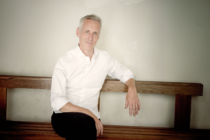
Sébastien Daucé , Director
Sébastien Daucé is a French conductor and musicologist, born in France on 4 June 1980. He is artistic director and founder of Ensemble Correspondances, formed from alumni of the Conservatoire National Supérieur de Musique de Lyon.
It was during his training at the Conservatoire National Supérieur de Musique de Lyon that he met the future members of Correspondances. Key influences among his teachers there were Françoise Lengellé and Yves Rechsteiner. Initially, in demand as a continuo player and vocal répétiteur (with the Pygmalion ensemble, the Festival d’Aix en Provence, and the Maîtrise and Orchestre Philharmonique de Radio France among others), he formed the Correspondances ensemble in Lyon in 2009, assembling around him singers and instrumentalists with a passion for the French sacred repertory of the Grand Siècle.
With this ensemble, which he directs from the harpsichord or the organ, he now travels throughout France and around the world, and frequently broadcasts on radio. Sébastien Daucé and Correspondances are in residence at the Théâtre de Caen, where they developed their first staged projects (Trois Femmes directed by Vincent Huguet in 2016, Le Ballet Royal de la Nuit directed by Francesca Lattuada in November 2017), and are associate artists at the Centre Culturel de Rencontre d’Ambronay, at the Opéra and Chapelle of the Château de Versailles, and at La Chapelle de la Trinité with the support of the Ville de Lyon.
Significant stages in the ensemble’s career have been tours to Japan, Colombia, the United States and China, alongside regular appearances in Europe (the United Kingdom, Germany, Benelux, Italy, Poland). Its exploration of a little-performed and often unpublished repertory has led, with the support of the harmonia mundi label, a pioneer of the Baroque repertory in many respects, to a discography of eleven recordings that have attracted considerable press attention and have received such distinctions as the Diapason d’Or of the Year, ffff de Télérama, Editor’s Choice in Gramophone, ‘Choc’ of the Year in Classica, German Record Critics’ Award and IRR Outstanding.
Correspondances now enjoys international recognition: at the ECHO Preis ceremony in the Berlin Konzerthaus in 2016, it won the award categories of Best World Premiere Recording (for Le Concert Royal de la Nuit) and Best Young Conductor of the Year, while the Australian Limelight magazine named it Operatic Recording of 2016 for Le Concert Royal de la Nuit.
Alongside his activities as a performing musician, Sébastien Daucé works with the leading scholars of seventeenth-century music, publishing regular articles and taking part in important performance practice projects. Passionately interested in questions of musical style, he edits the music that makes up the ensemble’s repertory, going so far as to recompose complete pieces when necessary, as was the case in Le Ballet Royal de la Nuit. He has taught at the Pôle Supérieur de Paris since 2012. In 2018 he is guest artistic director of the London Festival of Baroque Music. Sébastien Daucé is also an associate artist of the Fondation Royaumont.