• My Account
  • Cart
  • About
    • Who is Early Music Vancouver
    • What is Early Music?
    • OUR INSTRUMENT COLLECTION
    • Employment Opportunities
    • Annual General Meeting 2025
    • 2024/25 Annual Report
  • Pacific Baroque Orchestra
    • Goldberg Variations Tour 2025
  • EVENTS
    • Summer Festival 2026: The Power of Music
    • EMV’s 2026-2027 Main Season
    • Digital Concert Hall
    • Free Events
    • Past Events
  • Learn
    • PROGRAMMES
    • Artist Interviews
    • Instrument Videos
  • Support Us
    • Donate Now
    • Corporate Opportunities
    • Volunteer
    • Host an EMV Musician
  • Ticketing Info
    • BOX OFFICE
    • Gift Vouchers
    • Venues
  • Press Centre
    • Media Releases
    • EMV PRESS KIT
    • EMV in the News
Early Music Vancouver
  • My Account
  • Cart
  • Donate
  • Buy Tickets
  • Gift Vouchers
  • Get our newsletter
Toggle Menu
  • About
    • Who is Early Music Vancouver
    • What is Early Music?
    • OUR INSTRUMENT COLLECTION
    • Employment Opportunities
    • Annual General Meeting 2025
    • 2024/25 Annual Report
  • Pacific Baroque Orchestra
    • Goldberg Variations Tour 2025
  • EVENTS
    • Summer Festival 2026: The Power of Music
    • EMV’s 2026-2027 Main Season
    • Digital Concert Hall
    • Free Events
    • Past Events
  • Learn
    • PROGRAMMES
    • Artist Interviews
    • Instrument Videos
  • Support Us
    • Donate Now
    • Corporate Opportunities
    • Volunteer
    • Host an EMV Musician
  • Ticketing Info
    • BOX OFFICE
    • Gift Vouchers
    • Venues
  • Press Centre
    • Media Releases
    • EMV PRESS KIT
    • EMV in the News
Home  >  Early Music Vancouver Past Events  >  Blessed Echoes: Elizabethan Lute Songs

Thursday, December 5, 2024 | 7:30 p.m.Christ Chuch Cathedral, Vancouver


Blessed Echoes: Elizabethan Lute Songs

Works by: Dowland, Jones, Ferrabosco, & Cavendish

Artists: Ensemble “Près de votre oreille” directed by Robin Pharo

Pre-Concert Chat: 7pm with Robin Pharo hosted by David Gordon Duke

GENERAL ADMISSION SEATS STILL AVAILABLE

Robin Pharo and the Ensemble Près de votre oreille (“Close to your ear”) offer a fascinating dive into the English lute song during the reign of Queen Elizabeth I.

“Blessed Echoes” brings to light other treasures of Elizabethan and Jacobean song in one, two, three or four voices, which still remain unknown or poorly known, composed by famous poets and composers like Thomas Campion or Philipp Rosseter. The intimate setting of eight musicians and a typical instrumentarium of late 16th century England (lyra-viols, cittern, renaissance lute, virginal and four vocalists) allows us to savor the poetry of these works.

Generously sponsored by the RPC Family Foundation.

Click here to read the programme notes by Robin Pharo.


PROGRAMME

Alfonso Ferrabosco II (c. 1575-1628) – Ayres (1609)

Like Hermit poore

Robert Jones (1577-1617) – A Musicall Dreame (1609) 

Lie down poor heart

Thomas Ford (1580-16478) – Musicke of Sundrie Kindes (1607)

A Pavin, Sir Richard Westons delight

Robert Jones (1577-1617) – A Musicall Dreame (1609) 

If in this Flesh

Michael Cavendish (c. 1565-1628) – Ayres in Tabletorie to the lute (1598) 

Wandring in this place

John Dowland (1563-1626) – The First booke of songes or Ayres (1597)

Go Crystal teares

Alfonso Ferrabosco II (c. 1575-1628)

Almain II

Thomas Ford (1580-16478) – Musicke of Sundrie Kindes (1607)

How shall I then discribe my love

John Dowland

Farewell fantaisie

Alfonso Ferrabosco II (c. 1575-1628)

Coranto I

Philipp Rosseter – A book of ayres (1601)

When Laura Smiles

Robert Jones (1577-1617) – The first booke of Songes (1600) 

What if I seeke for love

Thomas Ford (1580-16478) – Musicke of Sundrie Kindes (1607)

Not full twelve yeeres twice tolde

John Dowland (1563-1626) – The First booke of songes or Ayres (1597)

Can she excuse my wrongs

Robert Jones (1577-1617) – A Musicall Dreame (1609) 

Once did I serve a cruel heart

Thomas Ford (1580-16478) – Musicke of Sundrie Kindes (1607)

A Pavin, M Maines Choice

Thomas Campion (1567- 1620) – The first booke of airs (1613)

Never wether-beaten saile

Robin Pharo 

Réversibilité 

Chanson pour 4 voix et guitare sur un poème de Charles Baudelaire


Click here to read the programme notes by Robin Pharo.
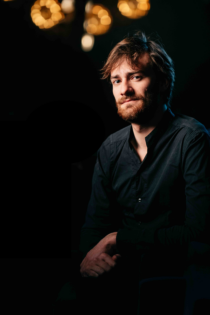
Robin Pharo, viola da gamba & direction

Robin Pharo studied the viola da gamba with Jean-Louis Charbonnier, Caroline Howald, Ariane Maurette and Christophe Coin, at the Music and Dance’s National Conservatory of Paris. He is a founder member of the Quartet Nevermind with whom he won the third prize and the special festival prize at the Van Wassenaer competition in Utrecht. In 2017, Nevermind has been invited to play all over Europe, in Russia, in Iceland, Australia, Asia and USA and has recorded tree discs, Conversations (2016), Quatuors Parisiens (2017) and Carl Philipp Emanuel Bach (2021) with Alpha Classic Label.

He works presently with contemporary composers such as Fabien Touchard or Philippe Hersant, wich who he creatd Hypnos and La Harpe de David as well as Rika Suzuki, Yassen Vodenitcharov and Jean-Marc Chouvel (with whom he creates Les Trois ailes du papillon). He had been playing at the Hyperweekend festival at France Radio and created the project Phonographie, imaginated by the group Code (Jérémie Arcache and Léonardo Ortega), together with the electronic musician Superpoze, with who he created a new piece in tribute to Marin Marais.
read more...

Ensemble Près de votre orielle

In 2017, Robin Pharo officially created the ensemble Près de votre oreille on the occasion of the Festival of Early Music in Timisoara, Romania, around a program devoted to the work for two viols by Marin Marais and Descent of Orpheus to the Underworld by Marc-Antoine Charpentier.

Près de votre oreille – Close to your ear – is a concept that is particularly close to his heart. By its strangeness and its poetry, it has imposed itself as the singular identity of a young ensemble which wishes to share the curiosity of unusual antique jewellery. Following an original passion, the ensemble strives to create projects related to the history of the viola da gamba, which allows its artistic director to share both his love of the solo repertoire and that of chamber music. Since its creation, the activities of the ensemble focus on contemporary music and the exploration of European vocal and instrumental repertoires of the Renaissance and the Baroque period (especially those of the golden age of the Tudors, which offers an incredible field of discovery). The musical aesthetic of the Renaissance, in which the ensemble Près de votre oreille draws part of its identity and an inexhaustible source of beauty, as well as the passion to rediscover a niche repertoire in order to arouse the curiosity of uncommon jewels, represent a wonderful challenge for an ensemble immersed in a contemporary society in which the research for splendors and sweetness can only be providential.

In 2023, Près de votre oreille had been in residence at La Cité de la Voix in Vézelay for the creation of a chamber opera, Les vies ordinaires d’Anaïs, based on an original text by author Milena Scergo and composed by Fabien Touchard. In 2024, the Près de votre oreille ensemble will record for Scala Music Label his album Lighten mine eies, and will be structured in Nouvelle-Aquitaine, in the Limousin, in order to lead cultural actions and a residence at the Villefavard farm in Limousin for the creation of the project Mes amours durent en tout temps, dedicated to the art of Renaissance song and the Franco-Flemish school.

The association Près de votre oreille has produced five discs, L’Anonyme Parisien (Paraty, 2016), Come Sorrow (Paraty, 2019), Suite d’un Goût Etranger (Château de Versailles Spectacles, 2021), Blessed Echoes (Paraty, 2023) and The Waves (Scala Music, 2023), in duet with Anaïs Bertrand, devoted to a cycle for viola da gamba and voice entitled composed by Fabien Touchard, works by Philippe Hersant and Robin Pharo as well as new arrangements of melodies composed by Claude Debussy, Gabriel Fauré and Nadia Boulanger.

read more...


Media

1254 W 7TH AVE
VANCOUVER, BC, V6H 1B6

(604) 732-1610
staff@earlymusic.bc.ca

  • About EMV
    • What is Early Music?
    • Staff
    • Partners
    • Board of Directors
    • Venues
  • Education & Community
    • BC Scholarship Programme – 2026/2027
    • OUR INSTRUMENT COLLECTION
  • Press Centre
  • Join Our Mailing List
Facebook URLTwitter URLYoutube URLInstagram URL

Copyright © 2026 EARLY MUSIC VANCOUVER | EMV | PHOTOS BY JESS MACALEESE, MARK MUSHET AND JAN GATES.
CONTACT EMV FOR INDIVIDUAL CREDITS. | site by DFS Digital Fusion Studios web designAND MEDIUM RARE Medium Rare Interactive

Een Romantische Johannes Passion

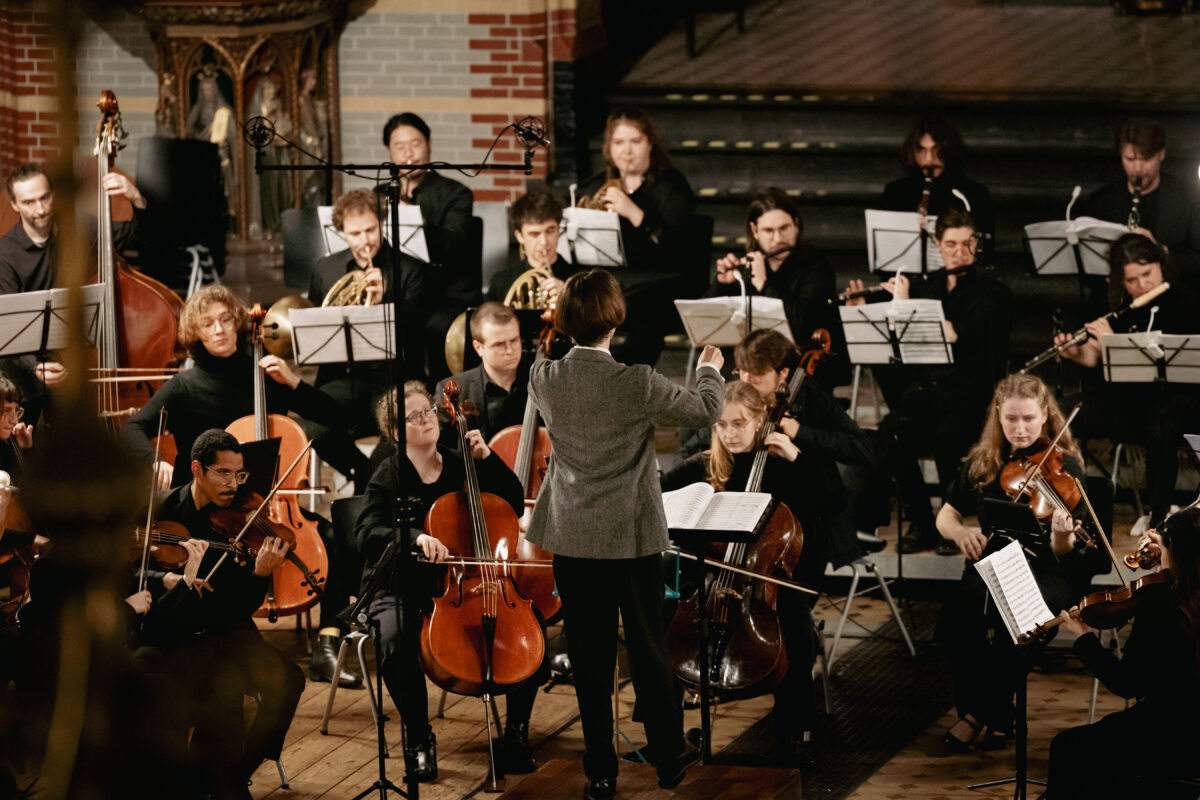
Historical Performance has been steadily looking toward the nineteenth-century as a source of inspiration, and Orchestra Lagrandt wants to lead the charge into Romantic orchestral performance practice. As an orchestra of ambitious musicians in their twenties from 25 different nations, we aspire to represent the voice of the new generation in Historical Performance.

Een Romantische Johannes Passion is an ongoing project to reimagine the Johannes Passion of J. S. Bach in a late nineteenth century style. The first Passion revivals in the Netherlands took place in Rotterdam in 1870, featuring large symphonic orchestrations, and a radically different musical language than that of the HP and modern classical worlds. In our initial performance with the Tangram Chamber Choir, we pushed the boundaries of what Romantic Bach might have sounded like: exploring changes in orchestration, stoic tempi, rubato, phrasing, nineteenth- century bowing practices, and even portamento. We plan to establish this project as an annual tradition every Easter season, reworking the arrangement each time in the spirit of Romantic spontaneity.


One of the wonderful things about the Historical Performance movement is that we are able to use forgotten practices, this time hailing from the nineteenth century, to present such a beloved and well known-work in a new light.

The world is familiar with stories of clever forgers whose life’s mission is to cunningly reproduce the light and shadows of historical masterworks, from Vermeer’s brushstrokes to Da Vinci’s proportional precision… but what if these crimes of craftsmanship were to extend beyond the visual arts? What if the pieces we know to be by Palestrina, Monteverdi or even Johann Sebastian Bach were in fact stylistic copies, artfully composed by a secret circle of music forgers and passed off as the work of the greats? What if those music forgers are at work as we speak? 

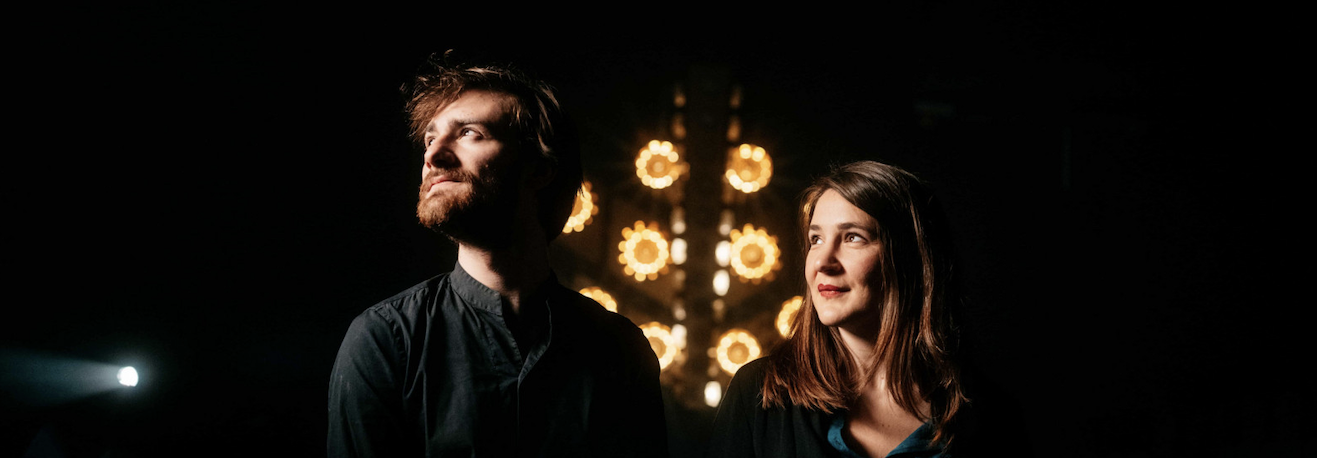
This premise inspires our original program The Music Forgery Workshop. Our early music comedy imagines the lives of such a circle of musical criminals, offering a fresh and lively presentation of historical compositions, not as museum artifacts but as living works in progress. The workshop itself is set up on the stage and its members carry forth the plot in music and words. A narrator in the role of a suspicious inspector lends the performance a theatrical flow. The listener is invited into a satire on high society’s art commerce, while the performers make fun of themselves for having devoted their lives to the niche subject of historical music performance. 

Violinist Elizabeth Sommers combines her skills and experience in traditional music with expertise in the performance and improvisation of medieval and Renaissance repertoires. Multi-instrumentalist Eliot X. Dios (keyboards, bagpipes and flutes) works wholeheartedly to employ storytelling techniques developed through the history of literature and cinema in his early music concerts. Composer Gunnar Haraldsson (violin, guitar) seeks to translate the forms and intentions of early composition for a modern audience. Halldór B. Arnarson (keyboards, voice) has devoted his career to bringing musical craftsmanship from the era of counterpoint to the attention of the public and comedy to the early music scene. Singer and storyteller Ásta S. Arnardóttir brings the storyline to the public with personal immediacy, and through her character work defines the different veins of the show, sometimes hilarious and sometimes serious. 

The story is narrated by the character of the Inspector, acted out by the members of the MFW, and told in rhyming Icelandic verse in one musical pillar of the show, a madrigal composed by our very own 

Halldór in the style of Monteverdi. The show has an entertaining educational dimension. The audience is exposed to a broad sweep of historical and musical information in a condensed form, necessary to understand the musical humour, while dramatic rhythm and scenographic effects prevent overwhelm. We also place particular emphasis on theatrical illusion and synchronisation. One example appears in the opening scene, in which the inspector is seen watching television. On stage, this becomes a complex exercise in coordination: each time the inspector presses a button on the remote control, the musicians instantly switch pieces, creating the impression of rapidly changing television channels. 

This opening scene establishes the tone of the entire show, comical and satirical in its storytelling and diverse in its musical language. It not only introduces the wide range of musical styles that appear throughout the performance, but also functions as the plot’s inciting incident, as the inspector hears a news report about the discovery of a previously unknown concerto by Vivaldi. 

Another important scene takes place when one forger is alone on stage in low light, perusing books on medieval music, while the musicians perform and sing offstage, sounding his audiation as he reads. This intimate moment evokes the sleepless nights spent studying facsimiles and learning historical compositional techniques, by which the forger acquires the inspiration and the expertise necessary to his art, and reveals a hidden side of musical performance: the immense amount of study and preparation that precedes the moment on stage. This setting also creates space for visual and musical comedy, as seen in the trailer video, where a 14th-century melody is played backwards because Halldór is unknowingly reading the facsimile upside-down, only realising the mistake when the music begins to sound absurd. 

Fun and friendship are at the heart of the whole project, though the link between music and crime is an important historical consideration. Classical music was often used as the demonstration of a monarch’s power, music teaching as a cover up for secret affairs, and pieces were published under another’s name for profit. Such examples of “inappropriate practices” carry an exciting and attractive element for the audience which the MFW seeks to exploit. Under this light-hearted surface lies a more serious layer of questions concerning our present-day existence, such as excessive materialism in high society and the threat posed on human craftsmanship and skill by the rise of artificial intelligence. 

Please Note:

The main applicant and creative/intellectual driver of the project must be 30 or under (on May 15th).

The average age of all musicians must not be older than 32, and the maximum age of supporting musicians must be no more than 35 (on May 15th.)