
Christ Church Cathedral, Vancouver
A Tribute to Giovanni Gabrieli
“Immortal Gods, How Great a Man!”
Works by: Gabrieli, Usper, Schütz, Schein, & Scheidt
Artists: Hana Blažíková, soprano; Charles Daniels, tenor; Chloe Meyers, violin; Catherine Motuz & Maximilien Brisson, trombones; Alon Sariel, theorbo; Alexander Weimann, keyboard; Bruce Dickey, cornetto and direction.
Pre-Concert Chat: 7pm with Bruce Dickey hosted by Christina Hutten
A rare tribute to one of the foremost composers of the early Baroque, the Venetian Giovanni Gabrieli. Gabrieli’s works for the ornate Basilica di San Marco were the pinnacle of the magnificent polychoral style, where two groups of musicians echo one another in ‘call and response’.
Instrumental to the development of Italian musical culture, Gabrieli’s monumental legacy lived on in his student Heinrich Schütz and other German contemporaries. “Immortal Gods, How Great a man!” is a quote from the Preface to one of Schütz’ printed collections and refers to his beloved teacher.
Concert generously sponsored by Vincent and Zelie Tan & David McMurtry; Artist-in-Residence sponsored by Birgit Westergaard and Norman Gladstone
Runtime: 75 min + intermission
PROGRAMME
Giovanni Gabrieli (1557-1612)
Exaudi Domine a 6 (Venice, 1597)
Andrea Gabrieli (1533-1585)
Sancta Maria succurre miseris a 6 (Venice, 1587)
Heinrich Schütz (1585-1672)
Exultavit cor meum (SWV 258)
Paratum cor meum (SWV 257)
G. Gabrieli
Canzon seconda a 4 (Venice, 1608)
H. Schütz
Bone Jesu, verbum Patris (SWV 313)
Domine labia mea aperies (SWV 271)
Francesco Usper (1561-1641)
Vulnerasti cor meum a 6 (Venice, 1614)
Interval
Johann Hermann Schein (1586-1630)
Christ lag in Todesbanden
Christ unser Herr zum Jordan kam
Gelobet seist Du Jesu Christ
Opella nova I (Leipzig 1618)
Johann Grabbe (1585-1655)
Canzon a 4 (Hamburg, 1621)
Samuel Scheidt (1587-1654)
Herr, lehre uns bedenken a 2 (Leipzig, 1631)
Ist nicht Ephraim a 3 (Halle, 1634)
J.H. Schein
Warum betrübst du dich, mein Herz (Leipzig, 1627)
Gehet hin in alle Welt (Leipzig, 1626)
Nu danket alle Gott (Leipzig, 1627)

Hana Blažíková, soprano
Hana Blažíková was born in Prague. As a child she sang in the children’s choir Radost Praha and played the violin. Later she turned to solo singing, graduating in 2002 from the Prague Conservatory in the class of Jiří Kotouč and undertook further study with Poppy Holden, Peter Kooij, Monika Mauch and Howard Crook.
Today Hana has achieved high acclaim as a leading specialist in the interpretation of Baroque, Renaissance and medieval music, performing with ensembles and orchestras around the world, including the Collegium Vocale Gent, the Bach Collegium Japan, Sette Voci, the Amsterdam Baroque Orchestra, L’Arpeggiata, Gli Angeli Genève, La Fenice, Nederlandse Bachvereniging, Tafelmusik, Collegium 1704, Collegium Marianum, Musica Florea, L’Armonia Sonora and others.
In 2010 and 2013 she took part in a highly praised world tour of the St. Matthew Passion under the direction of Philippe Herreweghe and in 2011 she made her debut in Carnegie Hall with Masaaki Suzuki´s Bach Collegium Japan. In 2017 she appeared in major venues all over Europe and North America in the trilogy of Monteverdi operas mounted by John Eliot Gardiner for the composer’s 450th birthday. In the three operas she sang six roles including the title role in Poppea.
Hana appears on more than thirty CDs, including the well-known series of Bach cantatas with the Bach Collegium Japan. She also plays gothic and romanesque harp and presents concerts in which she accompanies herself on this instrument. In addition she is a member of the Tiburtina Ensemble, which specializes in Gregorian chant and early medieval polyphony.
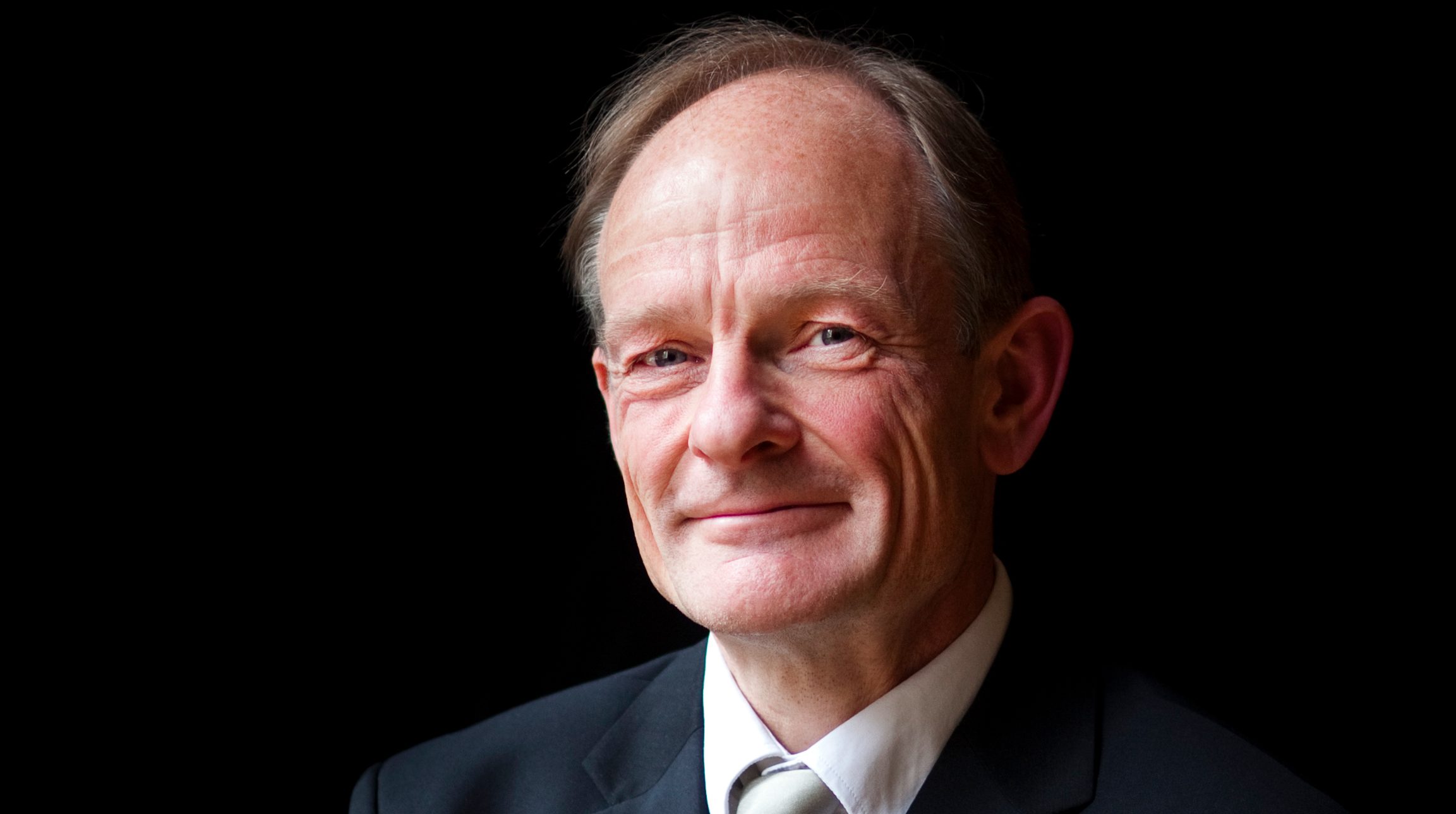
Charles Daniels, tenor
Charles Daniels is a noted interpreter of Baroque music, though his narrative gifts are praised for music as diverse as Machaut Virelais and Graham Treacher’s Visions (2016). His recordings include Monteverdi’s L’Orfeo with Andrew Parrott, Bach’s Matthäus Passion with the Bach-Stiftung; Schütz Weihnachtshistorie, Monteverdi’s Vespers and Purcell’s Fairy-Queen with the Gabrieli Consort; Heracleitus with the Bridge Quartet and Lambert airs with Fred Jacobs; Kilar’s Missa Pro Pace with the Warsaw Philharmonic; much Bach and recent Purcell releases with the King’s Consort.
He created the dual role of Ulisse and John Gregory Dunne to critical acclaim in last year’s Bayerische Staatsoper production of Il Ritorno d’Ulisse/Jahr des magisches Denken His concert appearances span the intimate and the grand, from BBC Radio 3 recitals with lutenist Elizabeth Kenny, domestic music of Bach for Nederlandse Bach Vereniging and Handel Chandos Anthems in their original setting of the Canons Estate church, to performances of Britten’s War Requiem (Canterbury, Lille) and Elgar’s Dream of Gerontius (Cardiff, Wroclaw). Recent concerts include Dowland in Japan with Les Voix Humaines, Viadana in Verona and Switzerland with Bruce Dickey, a Weckmann programme in Vienna’s Konzerthaus and the 50th birthday celebration in Oxford of Andrew Parrott’s Taverner Consort.
Charles’ reconstructions of Gesualdo’s Sacrae Cantiones à6 have been premiered by the Gesualdo Consort of Amsterdam and his completion of Purcell’s court Ode Arise my Muse was broadcast on Radio-Canada during the Montréal Baroque Festival. He is delighted to return to EMV for this summer’s Festival.
Chloe Meyers | Sponsored by Jill Bodkin, violin
Violinist Chloe Meyers performs with early music ensembles across North America as leader, orchestra member, and chamber musician. She is the concertmaster of the Pacific Baroque Orchestra in Vancouver and co-concertmaster of Arion Baroque Orchestra in Montreal. She has led or appeared as soloist with groups including the Victoria Baroque Players, Pacific MusicWorks, Ensemble Les Boréades, the Theatre of Early Music, Ensemble Masques, and Les Voix Baroques, of which she was a founding member. She has had the pleasure of sharing the stage with international violin stars, performing double concerti with Stefano Montanari, Enrico Onofri, Amandine Beyer, and Cecilia Bernardini. Chloe’s playing may be heard on many award-winning disks, including the 2022 Juno award winning recording “Solfeggio”… in which she leads the orchestra L’Harmonie des Saisons as concertmaster. In 2023 she was nominated as Best Musical Director for her work in Pergolesi’s Stabat Mater with the Edmonton Opera.
Alongside Chloe’s passion for performance and directing, is her love of teaching. As adjunct professor at the University of British Columbia, she trains young artists in the Baroque Orchestra Mentorship Program, chamber music and solo lessons. She has years of teaching children, university and students of all ages and levels! She is an active teacher in the summer Victoria Conservatory teaching programs, as well the UVic Collegium orchestral program.
Chloe lives in Ladner, BC, with her ever growing family and dog.
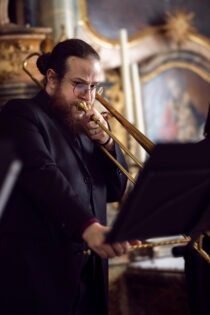
Maximilien Brisson, trombone
An alumnus of the Université de Montréal, McGill University, the Royal Conservatoire The Hague and the Schola Cantorum Basiliensis, where he studied with Catherine Motuz and Charles Toet, Maximilien Brisson quickly established himself as a leading specialist of historical trombones. He is a member of I Fedeli and ¡Sacabuche!, and has also performed with the Freiburger Barockorchester, Akamus, Concerto Palatino, Collegium Vocale Gent, Les Cornets Noirs, I Gemelli, The Toronto Consort and the Zürich Opera, among others. He was, with the Consort laurentien, finalist at the prestigious YorkComp in 2019. His debut solo album with Christophe Gauthier and Luc Beauséjour is scheduled for release in 2024.
Maximilien is lecturer for baroque trombone at the University of the Arts Bremen, the leading conservatory in Germany for early music, and has taught in masterclasses and workshops at the University of Toronto, MentiParti, the San Francisco Early Music Society and the Madison Early Music Festival. Also active as a scholar and editor, he presented his research on Lodovico Viadana’s solo motets at the MedRen conference in Basel in 2019, as well as on a forgotten, early Italian trombone method at the Romantic Brass Symposium in Bern in 2023. His edition of the complete works of Andreas Oswald is pending publication.
An accomplished leader, Maximilien received critical acclaim for his 2013 interpretation of Mahler’s Sixth symphony: “What he heard is comparable to the best Mahler there is, both live and on disc. […] This reviewer even had tears in his eyes. Because this Mahler’s Sixth […] was rendered in its full and terrifying dimension by this astonishing young conductor” (Claude Gingras, La Presse). He is Artistic Director of the Viadana Collective and co-director of canticum trombonorum.
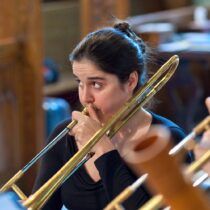
Catherine Motuz, trombone
Catherine Motuz enjoys an active career as a performer, teacher, and researcher. A founding member of I Ensemble Fedeli, she has played and recorded with ensembles including Concerto Palatino, the Amsterdam and Freiburg Baroque Orchestras, Bach Collegium Japan, Abendmusiken Basel, The English Cornett & Sackbut Ensemble, His Majesty’s Sagbutts & Cornetts, and ¡Sacabuche!. As a soloist, she has performed across Canada, at the Midsomer Barock Festival in Copenhagen, and in Austria and Switzerland with countertenor Alex Potter.
Catherine studied historical trombone with Charles Toet at the Schola Cantorum, Basel and with Dominique Lortie at McGill University. She has taught at McGill University, the Université de Montréal, the Royal Conservatoire of the Hague, the Royal Academy in London, and currently at the Schola Cantorum in Basel. She also teaches specialised workshops for early career musicians at LAMP in Nova Scotia, the Neuburger Sommerakademie für Alte Musik and at Alte Musik in Hof.
Catherine’s research activities focus on two related fields in Renaissance music: improvisation pedagogy and emotional expression in music. She has published on the role of memorisation in improvisation, and given workshops on improvised counterpoint at the Universities of Oxford, Birmingham, and Glasgow, the Royal Conservatory of the Hague, CESR (Tours), and at the Alamire Foundation (Leuven). In February 2021, she gave a Keynote presentation at The Hague Royal Early Music Conference: Edition 2021, Historical Music Pedagogy.
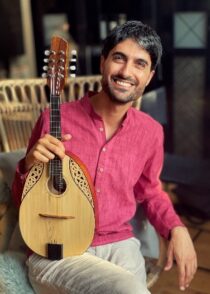
Alon Sariel | Sponsored by Birgit Westergaard and Norman Gladstone, theorbo
Philharmonic hall, not jazz podium; Mozart festival not cult TV rock programme – back then, Alon Sariel had not foreseen how things would develop: back then, in 1994, when his music teacher told the eight-year-old that the mandolin and the electric guitar were “basically the same thing”. This was a momentous deception that was to deliver to the world of music one of the most versatile mandolin players, lutenists and ensemble directors of the present day. In his concert programmes, Alon uses the lute, Baroque guitar, oud and other plucked instruments to give his audiences the most diverse musical experiences. The mandolin, which has survived the centuries and found its place in the most varied of music styles and cultures, occupies a very special place in his heart.
His many acclaimed recordings of Renaissance and Baroque works – his album “Telemandolin” was recognised in 2018 with an OPUS Klassik award – have firmly established him in the public eye as a specialist for early music. His work with international soloists and ensembles such as Maurice Steger, Andreas Scholl, Lautten Compagney, Norway’s Barokksolistene and many others attests to his reputation. That said, Alon’s guiding principle is a changing perspective. In other words: giving new life to existing material, as well as creating completely new works.
That is why Alon, as soloist and conductor, frequently brings contemporary compositions both to the stage and into the studio. He conducted the Munich Chamber Orchester in Markus Stockhausen’s “Symbiosis”, premiered as soloist with the Deutsches Kammerorchester Berlin Gilad Hochman’s “Nedudim”, and commissioned two new works for mandolin from Uri Caine for the Beethoven anniversary year in 2020. His album and PENTATONE debut “Plucked Bach” is a journey through Bach’s Cello Suites on six of his different plucked instruments, with a follow-up “Plucked Bach II” released in 2023.
Looking beyond the scope of a professional musician, Alon is an active member of Rhapsody in School, introducing classical music to schoolchildren of all ages. Furthermore, he supported the Live Music Now Foundation and has played in Daniel Barenboim’s West-Eastern Divan Orchestra. Animal protection is also an important issue for Alon; he has been an ambassador for the Pro Animale charity since 2021.

Alexander Weimann | Sponsored by Bruce Munro Wright, O.B.C., keyboard
The internationally renowned keyboard artist Alexander Weimann has spent his life enveloped by the therapeutic power and beauty of making music. Alex grew up in Munich. At age three he became fascinated by the intense magic of the church organ. He started piano at six, formal organ lessons at 12 and harpsichord at university (along with theatre theory, medieval Latin and jazz piano.) He is in huge demand as a director, soloist and chamber player, traveling the world with leading North American and European ensembles. He is Artistic Director of the Pacific Baroque Orchestra in Vancouver and teaches at the University of British Columbia where he directs the Baroque Orchestra Mentorship Programme.
Alex has appeared on more than 100 recordings, including the Juno-award-winning album “Prima Donna” with Karina Gauvin and Arion Baroque orchestra. His latest album series “The Art of Improvisation” (Volume 1: A Prayer for Peace; Volume 2: Ad libitum; and Volume 3: Canavian Variations, released on Redshift, 2024) unites his passions for both baroque music and improvisation on organ, harpsichord, and piano.
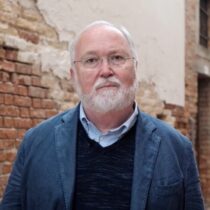
Bruce Dickey, cornetto & direction
Bruce Dickey is one of a handful of musicians worldwide who have dedicated themselves to reviving the cornetto – once an instrument of great virtuosi, but which lamentably fell into disuse in the 19th century. The revival began in the 1950s, but it was largely Bruce Dickey, who, from the late 1970s, created a new renaissance of the instrument, allowing the agility and expressive power of the cornetto to be heard once again. His many students, over more than 30 years of teaching at the Schola Cantorum Basiliensis, have helped to consolidate and elevate the status of this once forgotten instrument. For his achievements the Historic Brass Society awarded him in 2000 the prestigious Christopher Monk Award for “his monumental work in cornetto performance, historical performance practice and musicological scholarship.” In 2007 he was honored by British conductor and musicologist Andrew Parrott with a “Taverner Award” as one of 14 musicians whose “significant contributions to musical understanding have been motivated by neither commerce nor ego.”
In the course of his long career as a performer and recording artist he has worked with most of the leading figures in the field of early music, including the legendary pioneers of historically informed perfomance, Gustav Leonhardt, Frans Brüggen and Nikolaus Harnoncourt. He was a member for over ten years of Jordi Savall’s Hesperion XX , and has frequently and repeatedly collaborated wth Ton Koopman, Monica Huggett, Philippe Herreweghe and many others. Of special importance has been his long-time friendship and collaboration with Andrew Parrott, and in more recent years with Konrad Junghänel.
Bruce Dickey can be heard on countless recordings. His solo CD (“Quel lascivissimo cornetto…”) on Accent with the ensemble Tragicomedia was awarded the Diapason d’or and was chosen in 2017 by Diapason Magazine as one of the 100 best CDs of Baroque Music of the past half century. His second solo CD, entitled “La Bella Minuta”, was released on the Passacaille label in 2011, and was described as, “simply a brilliant recording”.
In addition to performing, Bruce Dickey is much in demand as a teacher, both of the cornetto and of seventeenth-century performance practice. In addition to his regular class at the Schola Cantorum he has taught at the Royal Conservatory in The Hague, the Accademia Chigiana in Siena, and the Early Music Institute at Indiana University, as well as master classes in the United States, Canada, Europe and Japan. He is also active in research on performance practice, and has published, together with Michael Collver, a catalog of the surviving cornetto repertoire, and, together with trumpeter Edward Tarr, a book on historical wind articulation. In 1997, together with his wife Candace Smith, he founded Artemisia Editions, a small publishing house which produces editions of music from17th-century Italian convents.
For more information, please visit brucedickey.com.