
First Church of Christ Scientist, Victoria
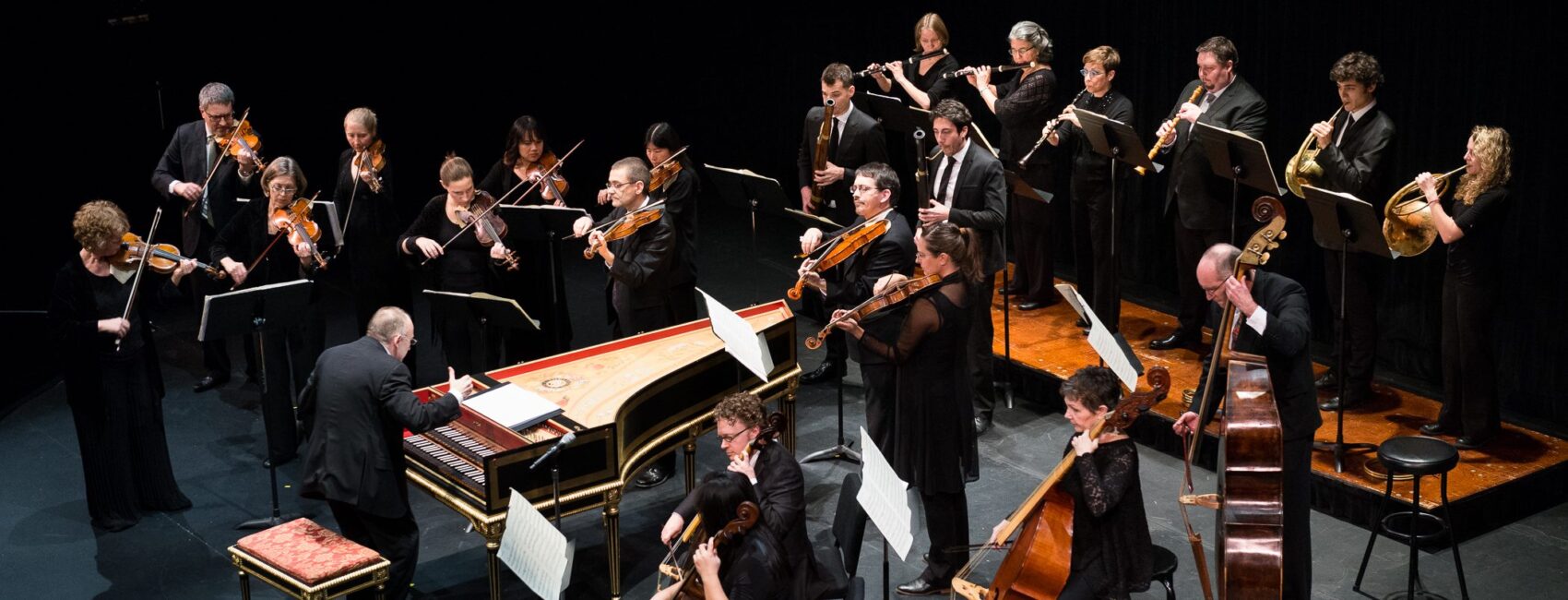
The Pacific Baroque Orchestra, directed by Alexander Weimann
Time: 80 minutes with 20 minute intermission
Alexander Weimann and the Pacific Baroque Orchestra invite you to celebrate the holiday season with a festive selection of works from the Italian Baroque. It was an Italian tradition to compose music for Christmas Eve, and this programme of instrumental works written specifically for Christmas celebrations paints a rich and colourful musical landscape.
J.S. Bach’s enchanting Pastorale in F Major for organ was likely written for Christmas services in Leipzig, where Bach worked. Arcangelo Corelli’s Christmas concerto, written for Christmas night and arguably his most famous work, has been a holiday tradition for over 300 years. These popular selections are paired with lesser-known masters of the Italian Baroque to create an afternoon of festive celebration.
PROGRAMME
Giuseppe Torelli (1685-1709)
Concerto grosso à Quattro in forma di Pastorale, op. 8/6, Per il Santo Natale
Grave-Vivace, Largo, Vivace
Francesco Manfredini (1688-1748?)
Sinfonia Pastorale, op. 2/12
Largo, Adagio, Largo
Giuseppe Valentini (1695-1764)
Sinfonia à Tre, op. 1/12, Per il Santissimo Natale
Largo – Andante e Forte – Allegro, Largo – Presto
Pietro Antonio Locatelli (1695-1764)
Concerto grosso à Cinque, op. 1/8
Largo-Grave-Vivace, Grave-Largo/Andante-Andante, Pastorale
INTERVAL
Antonio Vivaldi (1695-1764)
Concerto per Violino & Archi, RV 270 Il Riposo per il Santo Natale
Allegro, Adagio, Allegro
Johann Sebastian Bach (1685-1750)
Pastorale, BWV 590
Pastorale, Andante, Adagio, Allegro
Arcangelo Corelli (1685-1750)
Concerto grosso, op. 6/8 Fatto per la Notte di Natale
Vivace-Grave, Allegro, Adagio-Allegro-Adagio, Vivace, Allegro, Pastorale
PROGRAMME NTOES
It is said that, in thirteenth-century Italy, St. Francis of Assisi began the still thriving tradition of the presepe vivente: the living manger scene, or crèche. Francis hoped to bring the significance of Christmas home to people by recreating its central scene, the Nativity, complete with manger (“presepium,” in Latin), animals, and live actors for the various roles. I’d like to see Francis’s presepe as a (very) distant ancestor to the early (or “historically informed”) music movement of the past several decades: the basic idea in common is that there’s no better way of understanding the spirit of something than by reenacting it as well as we can.
It is a peculiarity of the Christmas season, viewed historically, that it has always encouraged local traditions and devotions within and alongside the standard liturgy. One Italian outgrowth of the presepe is the crib-rocking ceremony; in 1691, an observer of this devotion (“still every Year practis’d in Italy and Germany at Christmass”) described the practice of making “a Representation of the stable at Bethlehem”: “there are many great Ribbands or Cords, ty’d to the cradle of the Child Jesus, which the Spectators that are there present, (and upon their Knees) do pull towards them very devoutly, to rock the cradle . . . and sing what in Italian they call their Nà, Nà, which are Songs commonly sung, to Rock Children asleep.” Christmas plays and similar spectacles were to be found throughout Europe.
The roots of this programme’s music—eighteenth-century concerti described as pastorale, per il Santo Natale, or per la Notte di Natale—may have been in such devotional practices. The idea of the “pastoral” in music was nothing new around 1700, but it was around this time and in the previous few decades that it coalesced (thanks especially to Arcangelo Corelli and his Italian followers) in an internationally recognizable repertoire of musical gestures and styles that was, as these titles indicate, closely linked with the celebration of Christmas.
Pastoral art and music is concerned—like the Eclogues of the Roman poet Virgil—with shepherds and rural life. Such topics were already in vogue in madrigals of the late sixteenth century, and over time became associated with distinctive musical motifs: lilting rhythms, drones, horn calls, rustic-sounding melodies and close, sweet harmonies in thirds and sixths. These musical hints evoked the idyllic Arcadia of Classical poetry with its piping shepherds, but also reflected contemporary folk music, particularly the pifferari (shawms) and zampogne (bagpipes) heard in Italian towns during the Christmas season. Like the presepe, pastoral music brought together the old and the new, the mysterious and the familiar.
Corelli (1653-1713), the period’s most influential composer for instruments, deserves much of the credit for creating and spreading the phenomenon of the Christmas concerto. His famous concerto “Fatto per la Notte di Natale”—published posthumously in 1714 among the concerti grossi of his op. 6 but possibly composed and performed as early as 1690—inspired countless imitations. Especially in the concluding “pastorale,” Corelli established for his followers a sound language indicative of the world of shepherds and nighttime expectation: 12/8 time with rocking melodies and drone basses. This idiom found its way into some of the best-loved works of Bach (the Christmas Oratorio) and Handel (the instrumental “Pifa” and “He shall feed His flock” from Messiah). However familiar Corelli’s Christmas concerto may be to us—whether through its offspring or in its own right—it is still able to surprise us with passages of what one can only call immortal beauty: the serene third movement, for instance, and the quiet conclusion.
Giuseppe Torelli (1658-1709), a younger contemporary of Corelli, likely took his cue from the elder composer. His Christmas concerto shares the same key (G minor) as Corelli’s although it evolves quite differently: the 12/8 movement that follows the opening Grave, although mysterious, is brisk, almost jig-like; so is the last movement, which similarly makes extensive use of drones under the agile, and fairly soloistic, fiddles. In his day, Torelli was famous as a violinist, and he spent much of his career in Bologna, where he prepared his op. 8 (including this concerto) for publication.
This music, unlike most modern-day holiday fare, is not uniformly cheerful. There is plenty of rustic fun, but also a suggestion of awesome mystery: the hush of midnight, the tension of some momentous and transformative event. Pietro Antonio Locatelli (1695-1764), this programme’s youngest composer, spends most of his concerto grosso (op. 1, no. 8) exploring serious counterpoint and an intense development of dissonance in the extreme key of F minor. Only in the finale does the sun (or moon) shine out with the customary 12/8 time and dronish passages in the major.
Francesco Manfredini (1684-1762) and Giuseppe Valentini (1681-1753) were both prominent composers of the post-Corelli generation. Manfredini may have spent time in Bologna studying the violin with Torelli; Valentini (who appears in official records, rather endearingly, under the nickname “Straccioncino”: “little ragamuffin”) worked in Rome, the centre of Corelli’s influence. Both adopt the trademarks of the pastoral idiom, as well as the gorgeous chains of suspensions over steadily walking basses that were one of Corelli’s gifts to the musical language of the high Baroque.
The two most famous names on this programme, Antonio Vivaldi (1678-1741) and Johann Sebastian Bach (1685-1750), are in a way the outliers of the group: Vivaldi is the only Venetian and a wildly idiosyncratic musical personality; Bach is neither Italian nor Catholic, and his contribution to tonight’s concert is written not for string ensemble but rather for organ. Vivaldi’s bucolic take on the Christmas concerto, with its drones, birdcalls, and typical violin virtuosity, seems to almost foreshadow the spring depicted in his La Primavera. Bach’s “Pastorale” (or “Pastorella”) is an odd mixture of influences and genres. The first movement is unmistakeably a pastorale in the Italian style, with the addition of tongue-in-cheek chromatic lines that may (like the chromatic ascents in Vivaldi’s concerto) be intended to evoke the tuning peccadilloes of bagpipe players. Lovers of Bach’s more well-known keyboard music may recognize in the last movement one of those contrapuntal gigues that serve so often as the brilliant conclusions of his dance suites. The origins of this piece are uncertain, but it may well have been intended for Christmas services in Leipzig, where Bach spent the last decades of his life: a breath of fragrant air from the Italian (or is it Arcadian? or Judean?) countryside for listeners north of the Alps.
- Notes by Connor Page

Pacific Baroque Orchestra
The ‘house band’ of Early Music Vancouver, The Pacific Baroque Orchestra (PBO) is recognized as one of Canada’s most exciting and innovative ensembles performing “early music for modern ears.” Formed in 1990, the orchestra quickly established itself as a force in Vancouver’s burgeoning music scene with the ongoing support of Early Music Vancouver. In 2009, PBO welcomed Alexander Weimann as Director. His imaginative programming, creativity and engaging musicianship have carved out a unique and vital place in the cultural landscape of Vancouver.
PBO regularly joins forces with internationally-celebrated Canadian guest artists, providing performance opportunities for Canadian musicians while exposing West Coast audiences to a spectacular variety of talent. The Orchestra has also toured throughout BC, the northern United States, and across Canada. Their 2019 East Coast Canadian tour with Canadian soprano Karina Gauvin culminated in a critically acclaimed album, Nuit Blanches, released by Atma Classique.

Alexander Weimann | Sponsored by Bruce Munro Wright, O.B.C., music director
The internationally renowned keyboard artist Alexander Weimann has spent his life enveloped by the therapeutic power and beauty of making music. Alex grew up in Munich. At age three he became fascinated by the intense magic of the church organ. He started piano at six, formal organ lessons at 12 and harpsichord at university (along with theatre theory, medieval Latin and jazz piano.) He is in huge demand as a director, soloist and chamber player, traveling the world with leading North American and European ensembles. He is Artistic Director of the Pacific Baroque Orchestra in Vancouver and teaches at the University of British Columbia where he directs the Baroque Orchestra Mentorship Programme.
Alex has appeared on more than 100 recordings, including the Juno-award-winning album “Prima Donna” with Karina Gauvin and Arion Baroque orchestra. His latest album series “The Art of Improvisation” (Volume 1: A Prayer for Peace; Volume 2: Ad libitum; and Volume 3: Canavian Variations, released on Redshift, 2024) unites his passions for both baroque music and improvisation on organ, harpsichord, and piano.