Chan Centre for the Performing Arts
CHORAL LOFT SEATS AVAILABLE
The Choral Loft is located behind and above the stage on the Dress Level.
To book, click ‘Dress Level,’ then ‘Choral Loft’ for General Admission tickets.
ASSIGNED SEATS SOLD OUT
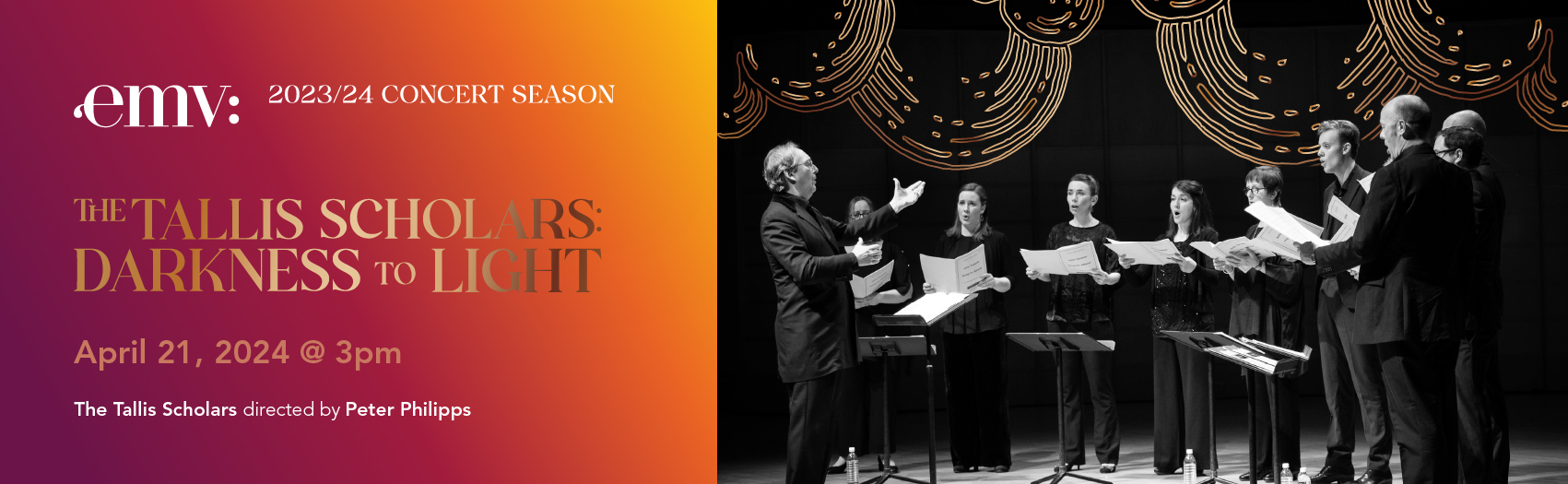
Artists: The Tallis Scholars, directed by Peter Phillips
Pre-Concert Chat: 2:30 p.m. | Peter Phillips, hosted by Suzie LeBlanc | RBC Cinema
Run time: 100 min + 20 min intermission.
“”…ethereal and yet full-blooded, uplifting and yet grounded in the very human emotions the words express.” (The Guardian)
Fresh off the heels of their 50th birthday, the legendary singers of The Tallis Scholars under director Peter Phillips – known worldwide as the “rockstars of Renaissance vocal music” (The New York Times) for their performances and recordings of unparalleled purity and clarity – return to Vancouver with a new programme.
The two halves of this Easter program are linked by the idea of the earthquake, which traditionally occurred in the story of the Crucifixion. David Lang originally wrote sun-centered to accompany Antoine Brumel’s Earthquake Mass. He decided to focus on Galileo’s battle with the church authorities over whether the earth revolves around the sun, or vice versa, carrying into this narrative the fragility of human existence. In his Easter Propers, sung at the end of the second half of our concert, Byrd homes in on this fragility, taking up the reality of an earthquake in the motet Terra tremuit where, in no more than a minute, he depicts in music the terror of it. Lang’s music is divided into five movements, as are the Byrd Propers.
Around these two sets the story of Lent unfolds, partly with extracts from the Lamentations (by Robert White and Nico Muhly), and partly with Whitacre’s beautiful vision of an angel in the Sainte Chapelle in Paris, hinting at the resurrection. Then Byrd presents the Easter story in all its hope, ending each movement with ringing ‘Alleluias’.
Generously Sponsored by The Graham and Gayle Cooke Foundation
Run time: 100 min + 20 min intermission.
PROGRAMME
Robert White (1538 – 1574)
Lamentations II
David Lang (b. 1957)
sun-centered
Interval
Nico Muhly (b. 1981)
Recordare
Eric Whitacre (b. 1970)
Sainte Chapelle
Robert Parsons (1535–1572)
Ave Maria
William Byrd (1540 – 1623)
All Saints Propers
Gaudeamus omnes
Timete Dominum
Justorum animae
Beati mundo corde
PROGRAMME NOTES
‘Weeping may endure for a night’, says the Psalmist, ‘but joy cometh in the morning’. This age-old consolation sums up our programme, one which considers darkness and light, and their sacred analogues of penitence and joy. Alongside the emotionally-charged and exquisitely-crafted sacred music of Tudor England, sits music commissioned by The Tallis Scholars from three of the most celebrated American composers of our age, casting new light (and shadows) on this theme.
The biblical Lamentations of Jeremiah were written in response to a defining event in the history of the Judean people: the sacking of Jerusalem and the destruction of the Temple in about 586 BC, presaging the exile of the Jews into captivity in Babylon. Like other contemporary literature, including perhaps the Book of Job, Lamentations at once bemoans and rationalises the suffering of the people. According to the author, the city was destroyed because its people were sinful; for things to be made right, they must ‘return to the Lord their God’.
In the time of Elizabeth I, and perhaps because of the ‘fashionable melancholy’ which pervaded late-Tudor culture, settings of the Lamentations were very popular. Though liturgically these lessons were appointed to be read in Holy Week, settings such as Robert White’s were more likely intended for private devotional performances in the home.
Composers were drawn to the particular character of the text, which in the original Hebrew takes the form of an acrostic poem. It was customary in polyphonic musical settings to retain the Hebrew letters with which each verse begins. The setting of these letters, quite meaningless on their own, enabled composers to indulge in a sort of ‘pure polyphony’ which has been described as ‘ritualised weeping in music’. White’s setting must have been very popular at the time; it is included in multiple contemporary partbook collections, including those of Robert Dow, who praises White in the following encomium:
Greatest glory of our muses, White,
You perish, but your muse remains for ever.
sun-centered was commissioned by The Tallis Scholars, and first performed by them in 2022. In this piece, the American composer David Lang explores the idea of light; both the physical light of the Sun, and the light of knowledge, always under threat by those who are resistant to ideas which challenge received wisdom. He does this through the story of Galileo, who, accused of blasphemy for showing that the Earth orbits the Sun and not the other way around, was famously said to utter the phrase ‘e pur si muove’ (‘and yet it moves’).
Lang’s typically thorough approach has him disassemble, atomise and recombine existing texts, then set the fragments within a musical framework that is open, minimal, and often bracingly direct. His paraphrases move beyond Galileo to encompass Francis Bacon, the Psalms, and Plato’s Republic, all in the service of a central question: ‘Why is it that we are so resistant to new ideas that challenge the ones we already know?’ Though the work begins and ends with Galileo, voiced by a baritone soloist, the inner movements connect his efforts to a universal theme: the struggle of truth-tellers against dogmatic authority.
Nico Muhly’s Recordare, Domine was commissioned by The Tallis Scholars in 2013. Sixteenth-century composers have long been a source of inspiration for Muhly, who here adopts one of their favourite texts: the Lamentations. Over long, held notes, spare harmonies arise, reminiscent of Arvo Pärt. Insistent repetitions of recordare underpin a more mobile section in which vocal lines overlap and rub against each other. A long, held tritone provides unsettling accompaniment to the words ‘cervicibus nostris’. Finally, the upper voices divide, singing the refrain ‘Jerusalem’ one after another, before the piece quietly retreats, as if worn out by grief.
The name Sainte-Chapelle immediately signals a concern with light – a reference to the stunning 13th-century, stained-glass-dominated chapel of the French kings. Eric Whitacre sets a Latin text by long-term collaborator Charles Anthony Silvestri, in which the protagonist is an ‘innocent girl’ – perhaps the Virgin Mary – who encounters God with awe and wonder. Her singing mingles with that of angels singing out of the windows of the chapel, until eventually ‘her voice becomes light’. Plainchant is an obvious inspiration for the meandering vocal lines, evoking a sense of timelessness that marries well with Whitacre’s love of rich choral sonority.
Ave Maria is Parsons’ most famous composition, not only today but probably in his own lifetime too; the collector Robert Dow, having copied it into his partbooks, was moved to write Musica laetificat corda at the end: ‘music rejoices the heart’. Its gently unfolding texture, in which the simple treble line rises with each new entry, concludes movingly with wave upon wave of imitative Amens.
The conclusion of our exploration of light and dark finds us among the Saints, who many Christians believe enjoy eternal bliss in the light of heaven, with Christ and his mother. The four motets given here are those assigned to be sung for the Feast of All Saints on 1 November. Their author is William Byrd, whose Gradualia represents a complete cycle of music for the feast days of the Catholic year. Set for five voices, they offer great stylistic variety, from the exuberance of the introit Gaudeamus omnes and the Gradual Timete Dominum, to the reflective and penitential Justorum animae, and the cumulative blessings, each one adding a further voice, of the Communion Beati mundo corde.
- Notes by James M. Potter
The Tallis Scholars
Founded in 1973 by their director, Peter Phillips, the Tallis Scholars have established themselves as the leading exponents of Renaissance sacred music throughout the world. The ensemble is renowned for its purity and clarity of sound in its presentation of the Renaissance repertoire. The Tallis Scholars give around 80 concerts each year. In 2013 they celebrated their 40th anniversary with a World Tour, and now look ahead to their 50th anniversary in 2023.
Upcoming highlights include performances in Australia, New York and Boston, Amsterdam, Zurich, Paris, tours of Italy, a number of appearances in London as well as their usual touring schedule around the USA, Europe and the UK. In July 2022, to mark Josquin des Prez’ 500th anniversary celebrations The Tallis Scholars sang all eighteen of the composer’s masses over the course of 4 days at the Boulez Saal in Berlin.Recordings by The Tallis Scholars have attracted many awards throughout the world. The latest recording of Josquin masses including Missa Hercules Dux Ferrarie was released in November 2020 and was winner of the BBC Music Magazine’s much coveted ‘Recording of the Year Award’ in 2021 and the ‘2021 Gramophone Early Music Award.’ This disc was the last of nine albums in The Tallis Scholars’ project to record and release all Josquin’s masses before the 500th anniversary of the composer’s death.
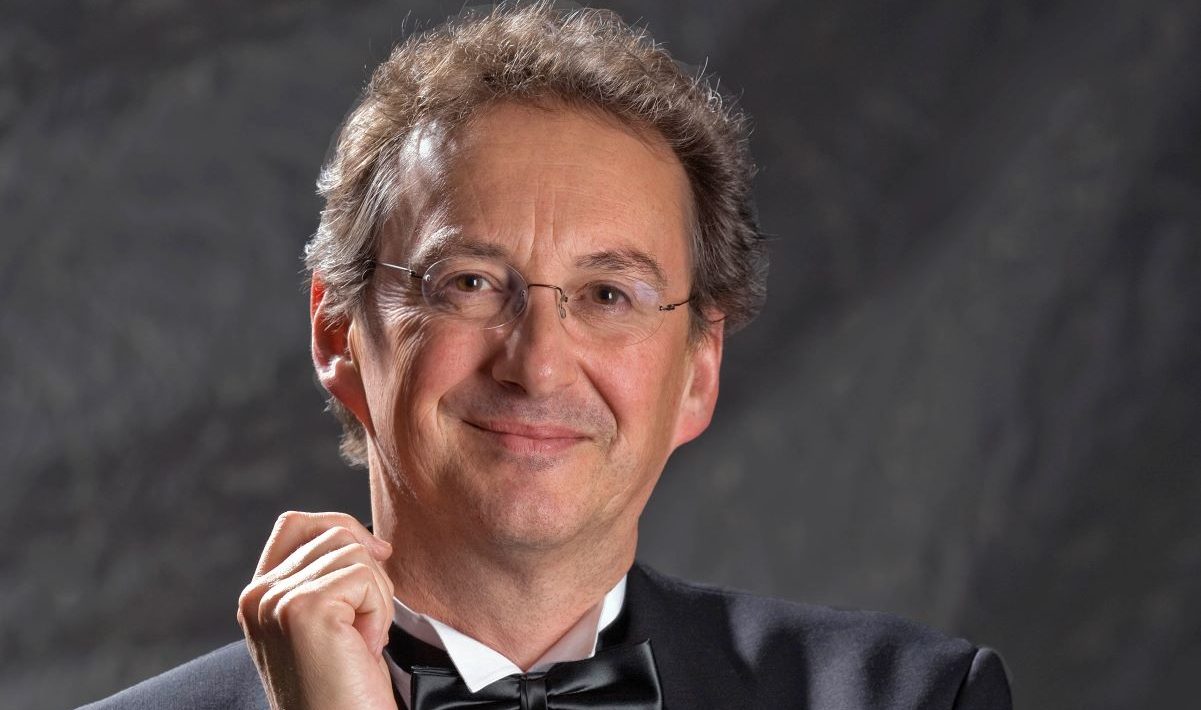
Peter Phillips, music director
‘‘I got the polyphony bug when an undergraduate at Oxford in 1973. An ideal choral sound got fixed in my head at that time, and I’ve spent all the years since then trying to recapture it. Hence The Tallis Scholars. I haven’t done much else of creative importance – no novels or films – just a lot of concerts and recordings, and endless travelling. This in turn has piqued an interest in exploring the cuisines of the world, and even some of the languages, though rarely the right ones. A thorough grasp of Latin would have been good; Arabic has proved of limited value as a tool for promoting Christian sacred music. Other daft things I’ve done include: starting a choral foundation in Oxford’s oldest and most beautiful college chapel; writing a music column in the London Spectator for more than 33 years, planning a choir trip to the Antarctic so that the penguins may get to hear some decent music; and visiting a restaurant near my house so often that I now have my own table there. The best thing I’ve done is marry Caroline Trevor and help to bring up three children who, to my lasting relief and delight, have grown into very civilised people.’’
“Speaking of birds, it was also wonderful to glimpse Peter Phillips’s conducting: hands opening as if setting free a dove, or closing to punctuate with dotting-the-i’s exactitude. I found myself wishing I could get a choir’s-eye view to witness Phillips’ complete – lifelong – inhabiting of this music.” The Observer, September 2015