• My Account
  • Cart
  • About
    • Who is Early Music Vancouver
    • What is Early Music?
    • OUR INSTRUMENT COLLECTION
    • Employment Opportunities
    • Annual General Meeting 2025
    • 2024/25 Annual Report
  • Pacific Baroque Orchestra
    • Goldberg Variations Tour 2025
  • EVENTS
    • Summer Festival 2026: The Power of Music
    • EMV’s 2026-2027 Main Season
    • Digital Concert Hall
    • Free Events
    • Past Events
  • Learn
    • PROGRAMMES
    • Artist Interviews
    • Instrument Videos
  • Support Us
    • Donate Now
    • Corporate Opportunities
    • Volunteer
    • Host an EMV Musician
  • Ticketing Info
    • BOX OFFICE
    • Gift Vouchers
    • Venues
  • Press Centre
    • Media Releases
    • EMV PRESS KIT
    • EMV in the News
Early Music Vancouver
  • My Account
  • Cart
  • Donate
  • Buy Tickets
  • Gift Vouchers
  • Get our newsletter
Toggle Menu
  • About
    • Who is Early Music Vancouver
    • What is Early Music?
    • OUR INSTRUMENT COLLECTION
    • Employment Opportunities
    • Annual General Meeting 2025
    • 2024/25 Annual Report
  • Pacific Baroque Orchestra
    • Goldberg Variations Tour 2025
  • EVENTS
    • Summer Festival 2026: The Power of Music
    • EMV’s 2026-2027 Main Season
    • Digital Concert Hall
    • Free Events
    • Past Events
  • Learn
    • PROGRAMMES
    • Artist Interviews
    • Instrument Videos
  • Support Us
    • Donate Now
    • Corporate Opportunities
    • Volunteer
    • Host an EMV Musician
  • Ticketing Info
    • BOX OFFICE
    • Gift Vouchers
    • Venues
  • Press Centre
    • Media Releases
    • EMV PRESS KIT
    • EMV in the News
Home  >  Early Music Vancouver Past Events  >  July 29 Alexander Weimann – The Well-Tempered Organ!

July 29 Alexander Weimann – The Well-Tempered Organ!

Saturday, July 29, 2023 | 2 p.m.West Vancouver United Church


Artist: Alexander Weimann, organ

The “well” temperaments of Bach’s day were tuning systems carefully designed to let keyboardists play in every key without re-tuning their instruments. Inspired by Bach’s famous Well-Tempered Clavier, Alexander Weimann has assembled a new collection of pieces spanning the whole harmonic spectrum. This concert showcases the extraordinary range of Bach’s organ writing, seen through the lens of Alex’s profound artistry and musical knowledge.

This concert is generously sponsored by David McMurty


PROGRAMME

Johann Sebastian Bach (1685-1750)

Pièce d’Orgue in G major, BWV 572

Fantasia in C minor, BWV 1121

Aria in F major (“after Couperin”), BWV 587

Ach bleib bei uns, Herr Jesu Christ, BWV 649

O Mensch, bewein dein Sünde gross, BWV 622

Ich ruf zu dir, Herr Jesu Christ, BWV 639

Toccata and Fugue in E major BWV 566

Allein Gott in der Höh’ sei Ehr’, BWV 662

Fugue in B minor (“on a Theme of Corelli”), BWV 579

Vater unser in Himmelreich, BWV 682

Praeludium in A minor, BWV 569

Toccata and Fugue in D minor, BWV 565

Fugue in G major, BWV 577


PROGRAMME NOTES

Johann Sebastian Bach’s relationship to the organ was lifelong and multifaceted; it was as an organist that he first embarked on his professional career, and some of his last published works (the Canonic Variations and so-called “Schübler” Chorales) were devoted to the instrument. The organ was central to Bach’s activities as a teacher, a legendary performer and improviser, and an exacting composer, and it shaped both his professional identity and his legacy. Bach’s obituary of 1754 remembered him as the “most prodigious organist and keyboard player that has ever been,” but his reputation did not rest on virtuosity alone. Throughout his life, Bach took an interest in organ building and design, and he was one of the technical masters of central Germany called upon to examine and inaugurate new instruments.

Organ building was a monumental enterprise, involving architectural design, church governance, civic planning and pride, and the latest mechanical, mathematical, aesthetic and acoustic understandings of the day. While some of these organs can still be played and heard today, one of the factors that Bach may have been evaluating is difficult to recapture—how the instruments were tuned. Music historians have argued that Bach lived through part of a shift in musical aesthetics away from the “meantone” tunings of previous centuries—which favoured pure euphonious thirds at the cost of some irredeemably bad intervals in keys that were therefore unusable—toward more modern “well” temperaments allowing for a greater range of keys that were acceptably in tune. The work of theorists such as Andreas Werckmeister (1645-1706) helped to promote the notion of a closed circle of fifths (C-G-D-A-E-B-F♯/G♭-C♯/D♭-G♯/A♭-D♯/E♭-A♯/B♭-F-C) in which enharmonic notes like G♯ and A♭ are equivalent. (By contrast, some earlier keyboards built for meantone tunings had split keys that allowed for G♯ and A♭ to be played as different pitches—woe to the player who attempted a fifth between, for instance, G♯ and E♭!) The solutions that Werckmeister and his colleagues proposed could thus be thought of as “circular” or “circulating” temperaments, permitting the player to move freely around the whole circle of keys.

The prospect of playing the pieces of Bach’s famous Well-Tempered Clavier collections in a single sitting without retuning the instrument requires such a tuning, as do keyboard works that move a long way chromatically from the home key (as Bach no doubt liked to do when he was improvising). Interestingly, the theorists of Bach’s day were aware of the equal temperament that has become the norm today—where each fifth in the circle, and thus each semitone in the octave, is the same size—as an abstract possibility, but few of them found it at all appealing. At least until the end of the eighteenth century, close listeners seem to have cherished the subtle variations between keys produced by unequal, well temperaments. Johann Mattheson, for instance, writes that F♯ minor, “although it leads to great sadness, is somewhat languid and amorous rather than lethal,” whereas B♭ major “is very diverting and showy, however, somewhat modest.” Part of the great interest of collections like the Well-Tempered Clavier—and the new “collection” formed by this programme—is the way they invite us to notice how the composer’s approach to each key might be unique. 

It is difficult to tell how quickly such temperaments caught on in German organ building. Unlike the tuning of stringed keyboard instruments, organ tuning was a relatively permanent affair, considering the time, labour, and materials needed to adjust it. (Bach, according to his son Carl Philipp Emmanuel, could tune a harpsichord to his satisfaction in fifteen minutes.) A given organ’s pitch and temperament would quite possibly have influenced the way music was generally performed in the surrounding area—a kind of acoustic centre of gravity. What seems clear is that Bach’s music frequently makes demands that it would take a well-tempered instrument to satisfy.

We can easily imagine that Bach might have often composed with an individual organ particularly (though not exclusively) in mind. The chorale preludes contained in the Orgelbüchlein (“Little Organ Book”) may have been conceived for the newly rebuilt organ in Weimar or for the Liebfrauenkirche’s larger instrument in Halle, which was noted as having a “tolerably good temperament.” “O Mensch, bewein dein Sünde gross” (BWV 622) and “Ich ruf zu dir, Herr Jesu Christ” (BWV 639) are both part of this collection, whose title page professes an intention to show “an inquiring organist . . . how to implement a chorale in all kinds of ways.” These settings of traditional Lutheran hymns are unique and endlessly inventive, and several of them push the harmonic envelope: “Ich ruf zu dir” is in the highly unusual key of F minor, which it traces out with an innovative broken-chord accompaniment in the left hand. “O Mensch, bewein” is also very close to the “flat” extreme of the tonal spectrum, perhaps to reflect the poignant Passion text. The decorated melodic line is spun out over some astonishing harmonic turns; most surprising (and notorious) is the introduction of a C♭ major triad right before the end of the piece.

The other chorale settings in this programme are also drawn from printed or manuscript collections: “Ach bleib bei uns, Herr Jesu Christ (BWV 649) from the “Schübler” Chorales, a late publication of organ transcriptions of movements from Bach’s own cantatas; “Allein Gott in der Höh’ sei Ehr’” (BWV 662) from a series of chorales copied and revised during Bach’s Leipzig years; and the complex “Vater unser in Himmelreich” (BWV 682), a rendition of Martin Luther’s versification of the Lord’s Prayer, from the third volume of Bach’s Clavierübung (“Keyboard Practice”). The selections that make up the rest of this programme are diverse in style and genre, from the iconic Toccata and Fugue in D minor (BWV 565) to the Aria in F major (BWV 587)—an almost exact transcription for organ of a movement from François Couperin’s Les Nations. These pieces are mostly “homeless,” surviving in rare and sometimes rather mysterious manuscript copies. Perhaps Bach would have smiled to see these scattered offspring gathered together again in a celebration of the musical language—and the musical instrument—he was so intent on exploring throughout his life.

  • Connor Page

Alexander Weimann | Sponsored by Bruce Munro Wright, O.B.C., organ

The internationally renowned keyboard artist Alexander Weimann has spent his life enveloped by the therapeutic power and beauty of making music. Alex grew up in Munich. At age three he became fascinated by the intense magic of the church organ. He started piano at six, formal organ lessons at 12 and harpsichord at university (along with theatre theory, medieval Latin and jazz piano.) He is in huge demand as a director, soloist and chamber player, traveling the world with leading North American and European ensembles. He is Artistic Director of the Pacific Baroque Orchestra in Vancouver and teaches at the University of British Columbia where he directs the Baroque Orchestra Mentorship Programme.

Alex has appeared on more than 100 recordings, including the Juno-award-winning album “Prima Donna” with Karina Gauvin and Arion Baroque orchestra. His latest album series “The Art of Improvisation” (Volume 1: A Prayer for Peace; Volume 2: Ad libitum; and Volume 3: Canavian Variations, released on Redshift, 2024) unites his passions for both baroque music and improvisation on organ, harpsichord, and piano.

read more...


Media

1254 W 7TH AVE
VANCOUVER, BC, V6H 1B6

(604) 732-1610
staff@earlymusic.bc.ca

  • About EMV
    • What is Early Music?
    • Staff
    • Partners
    • Board of Directors
    • Venues
  • Education & Community
    • BC Scholarship Programme – 2026/2027
    • OUR INSTRUMENT COLLECTION
  • Press Centre
  • Join Our Mailing List
Facebook URLTwitter URLYoutube URLInstagram URL

Copyright © 2026 EARLY MUSIC VANCOUVER | EMV | PHOTOS BY JESS MACALEESE, MARK MUSHET AND JAN GATES.
CONTACT EMV FOR INDIVIDUAL CREDITS. | site by DFS Digital Fusion Studios web designAND MEDIUM RARE Medium Rare Interactive

Een Romantische Johannes Passion

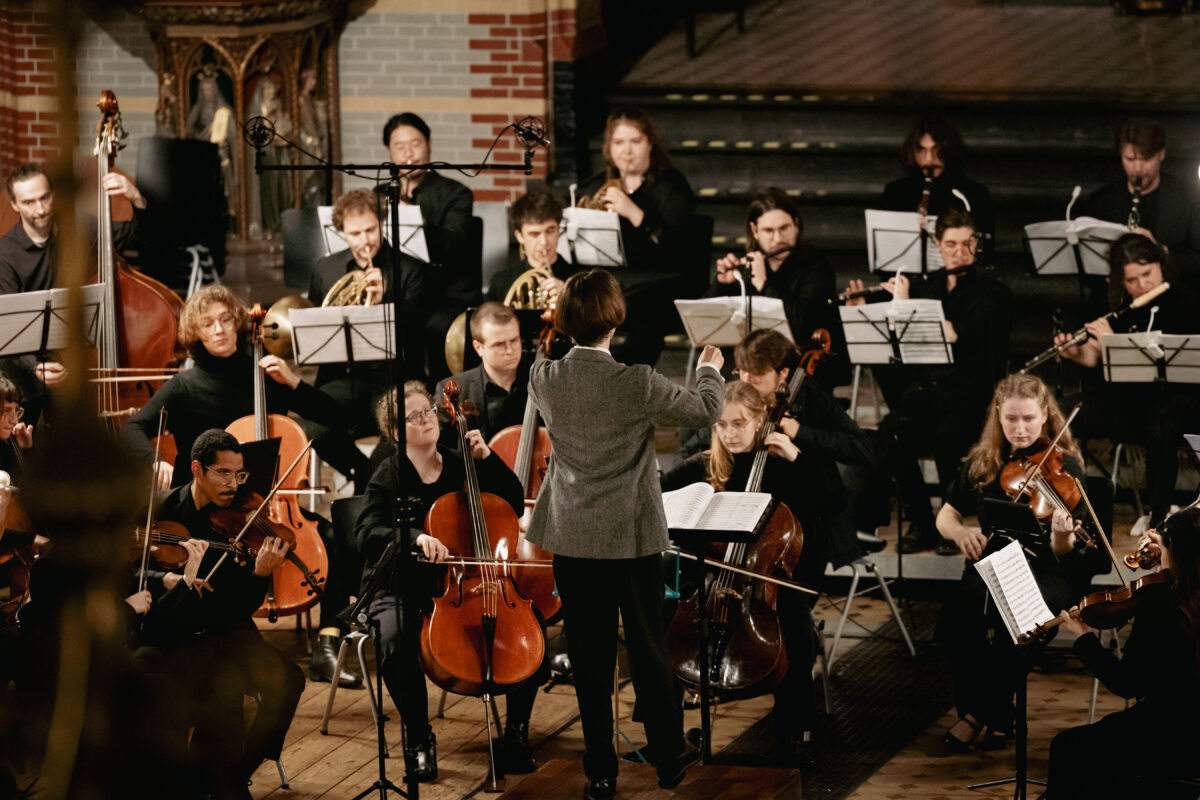
Historical Performance has been steadily looking toward the nineteenth-century as a source of inspiration, and Orchestra Lagrandt wants to lead the charge into Romantic orchestral performance practice. As an orchestra of ambitious musicians in their twenties from 25 different nations, we aspire to represent the voice of the new generation in Historical Performance.

Een Romantische Johannes Passion is an ongoing project to reimagine the Johannes Passion of J. S. Bach in a late nineteenth century style. The first Passion revivals in the Netherlands took place in Rotterdam in 1870, featuring large symphonic orchestrations, and a radically different musical language than that of the HP and modern classical worlds. In our initial performance with the Tangram Chamber Choir, we pushed the boundaries of what Romantic Bach might have sounded like: exploring changes in orchestration, stoic tempi, rubato, phrasing, nineteenth- century bowing practices, and even portamento. We plan to establish this project as an annual tradition every Easter season, reworking the arrangement each time in the spirit of Romantic spontaneity.


One of the wonderful things about the Historical Performance movement is that we are able to use forgotten practices, this time hailing from the nineteenth century, to present such a beloved and well known-work in a new light.

The world is familiar with stories of clever forgers whose life’s mission is to cunningly reproduce the light and shadows of historical masterworks, from Vermeer’s brushstrokes to Da Vinci’s proportional precision… but what if these crimes of craftsmanship were to extend beyond the visual arts? What if the pieces we know to be by Palestrina, Monteverdi or even Johann Sebastian Bach were in fact stylistic copies, artfully composed by a secret circle of music forgers and passed off as the work of the greats? What if those music forgers are at work as we speak? 

This premise inspires our original program The Music Forgery Workshop. Our early music comedy imagines the lives of such a circle of musical criminals, offering a fresh and lively presentation of historical compositions, not as museum artifacts but as living works in progress. The workshop itself is set up on the stage and its members carry forth the plot in music and words. A narrator in the role of a suspicious inspector lends the performance a theatrical flow. The listener is invited into a satire on high society’s art commerce, while the performers make fun of themselves for having devoted their lives to the niche subject of historical music performance. 

Violinist Elizabeth Sommers combines her skills and experience in traditional music with expertise in the performance and improvisation of medieval and Renaissance repertoires. Multi-instrumentalist Eliot X. Dios (keyboards, bagpipes and flutes) works wholeheartedly to employ storytelling techniques developed through the history of literature and cinema in his early music concerts. Composer Gunnar Haraldsson (violin, guitar) seeks to translate the forms and intentions of early composition for a modern audience. Halldór B. Arnarson (keyboards, voice) has devoted his career to bringing musical craftsmanship from the era of counterpoint to the attention of the public and comedy to the early music scene. Singer and storyteller Ásta S. Arnardóttir brings the storyline to the public with personal immediacy, and through her character work defines the different veins of the show, sometimes hilarious and sometimes serious. 

The story is narrated by the character of the Inspector, acted out by the members of the MFW, and told in rhyming Icelandic verse in one musical pillar of the show, a madrigal composed by our very own 

Halldór in the style of Monteverdi. The show has an entertaining educational dimension. The audience is exposed to a broad sweep of historical and musical information in a condensed form, necessary to understand the musical humour, while dramatic rhythm and scenographic effects prevent overwhelm. We also place particular emphasis on theatrical illusion and synchronisation. One example appears in the opening scene, in which the inspector is seen watching television. On stage, this becomes a complex exercise in coordination: each time the inspector presses a button on the remote control, the musicians instantly switch pieces, creating the impression of rapidly changing television channels. 

This opening scene establishes the tone of the entire show, comical and satirical in its storytelling and diverse in its musical language. It not only introduces the wide range of musical styles that appear throughout the performance, but also functions as the plot’s inciting incident, as the inspector hears a news report about the discovery of a previously unknown concerto by Vivaldi. 

Another important scene takes place when one forger is alone on stage in low light, perusing books on medieval music, while the musicians perform and sing offstage, sounding his audiation as he reads. This intimate moment evokes the sleepless nights spent studying facsimiles and learning historical compositional techniques, by which the forger acquires the inspiration and the expertise necessary to his art, and reveals a hidden side of musical performance: the immense amount of study and preparation that precedes the moment on stage. This setting also creates space for visual and musical comedy, as seen in the trailer video, where a 14th-century melody is played backwards because Halldór is unknowingly reading the facsimile upside-down, only realising the mistake when the music begins to sound absurd. 

Fun and friendship are at the heart of the whole project, though the link between music and crime is an important historical consideration. Classical music was often used as the demonstration of a monarch’s power, music teaching as a cover up for secret affairs, and pieces were published under another’s name for profit. Such examples of “inappropriate practices” carry an exciting and attractive element for the audience which the MFW seeks to exploit. Under this light-hearted surface lies a more serious layer of questions concerning our present-day existence, such as excessive materialism in high society and the threat posed on human craftsmanship and skill by the rise of artificial intelligence. 

Please Note:

The main applicant and creative/intellectual driver of the project must be 30 or under (on May 15th).

The average age of all musicians must not be older than 32, and the maximum age of supporting musicians must be no more than 35 (on May 15th.)