
Christ Church Cathedral | Map
Norbert Rodenkirchen (medieval flutes)
The transverse flute was a highly-treasured instrument in the Middle Ages. Of all medieval instruments the flute, a cylindrical wooden tube with six finger holes, is the most similar to the human voice. Through its intensive tone and sensitivity to slight modulations in breath pressure, it plays the role of mediator between man and nature, and in late antiquity it represents communication with the hereafter. Although the flute of the ancient Greeks, primarily associated with shepherds, was held in low esteem, the instrument, like the lyre, was prized by the Romans for the accompaniment of poetry. Pictures from Byzantium indicate that the transverse flute was a popular instrument at court, from whence it made its way to central Europe, where it remained essentially unaltered until the Renaissance. With the exception of early bone flutes, no transverse flutes from the Middle Ages have been preserved. They were similar in form to Renaissance flutes, but their design was less systematized (as iconographic sources tell us). Their finger holes must have been placed differently in order to accommodate Pythagorean temperament and the requirements of the medieval modes. Norbert Rodenkirchen plays on such a medieval transverse flute – reconstructed and built by Berlin-based flutemaker Neidhart Bousset and modified, optimized in close collaboration. Important iconographic documentation of the medieval forms of transverse flutes are found in the so called Codex Manesse and in the miniature illustrations to the Cantigas de St. Maria in the Codex El Sabio.
Supported by Ingrid Söchting and Elaine Adair

Click here for information about parking around / transiting to Christ Church Cathedral
Join Early Music Vancouver, Medieval flautist Norbert Rodenkirchen, and Beverly Ackhurst of Ocean Breath Yoga on Tuesday, November 15th for an afternoon of mindfulness and music at the Centre for Peace at Canadian Memorial United Church in Vancouver. More details and ticket information here.
Programme
Original melodic models – all of them used during the 13th ct., listed in chronological order:
“Felix qui humilium” super “L autrier estoie” / Ludus super Anticlaudianum
Adam de la Bassée / Henri III, duc de Brabant
Sequence: “Salve porta perpetuae lucis fulgida” / Pruem (11th ct.)
Anonymus
Planctus: “Planctus ante nescia” / Carmina Burana
Godefroy de St. Victor
“Olim in harmonia” super notula “De juer et de baler“ / Ludus super Anticlaudianum
Adam de la Bassée / Anonymus
Fragment of: “1er Estampie Roial” (Ductia / extended ) / Chansonnier du Roi
Anonymus
Stantipes super “Nitimur in vetitum” / “Quant li rosignol” / Egerton Chansonnier
Philippe le Chancelier / Anonymus
“Nobilitas” super rondellus “Qui grieve ma cointise” / Ludus super Anticlaudianum
Adam de la Bassée / Anonymus
“Modestos blandititiae” / Ludus super Anticlaudianum
Adam de la Bassée
“O felix custodia” / “L ́autrier matin el mois de mai” / Ludus super Anticlaudianum
Adam de la Bassée / Anonymus
Neupma 1 (extended) /Grocheo, De Musica
Anonymus
Conductus “In hoc ortus occidente” / Florence manuscript pluteo 29,1
Philippe le Chancelier
Conductus “Fontis in rivulum” / Florence manuscript pluteo 29,1
Philippe le Chancelier
Nota “La note Martinet” / Chansonnier Paris BN 845
Stantipes “Res Tassini” / Codex Montpellier (tenor)
Stantipes super “Ausi com unicorne sui / Ego te tuli“ / Chansonniers Cange & Egerton
Thibaut de Champagne / Anonymus
Neupma 8 (extended) /Grocheo, De Musica
Anonymus
Fragment of lost responsory “Te sanctum dominum” / Egerton Chansonnier
Anonymus (Thibaut palimpsest)
Programme Notes
There is nearly no written trace of instrumental music before the 13th century. The earliest notated instrumental pieces including the ductia and estampie, are surprising for their high level of melodic invention and formal organisation. It is assumed that they represent the first attempt to notate the late form of a highly developed improvisatory tradition that had only been transmitted orally for centuries. The music in this programme is an attempt to recapture the earlier forms of this tradition before the pieces were actually written down.
Johannes de Grocheo (13th century) described in his book, De musica, two differing kinds of instrumental forms: the ductia and stantipes (”stante pede“ means performed spontaneously and on the spot). According to new analysis of Grocheo ́s descriptions of his own music, his eight estampies royales, are, in fact, ductiae – dancelike, textless tunes in regular rhythm and in simple double versicle form. Grocheo describes the stantipes as a more contemplative and complex improvisational genre of which we unfortunately have no surviving manuscripts. According to Grocheo, the stantipes were performed non-rhythmically and were followed by Gregorian melismas called neupma to which he documented the basic notes for all 8 modes, explicitly to be extended ad libitum. This programme presents two attempts to reconstruct original stantipedes by including all of the information given by Grocheo.
Melodic invention was regarded differently in the Middle Ages than in other eras and most of the music preserved is anonymous. This anonymity is based partly on a medieval worldview in which the individual artist subordinated any proprietary claims to the higher religious ideal of cosmic unity. It is also rooted in the most important phenomenon of medieval music, the system of the modes. The modal system is a blueprint for melodic organization, which uses the church modes as a framework. In the Middle Ages, these church modes were far more than scales, they functioned as musical character types, each with its own melodic formulae and gestures. Modal music found itself in a perpetual state of flux in which melodic ideas could be borrowed, varied or completely changed without any worry of plagiarism. There was no perceived difference in the value of a new composition and one consisting of borrowed material. Rather, medieval musicians had to master a certain shared modal vocabulary that provided the material out of which their melodic forms would crystallize. They made no claims to their value as finished works. It is in this context that the contrafactum, the free exchange of melodic material between the sacred and secular realms, should be understood.
The procedure of creative borrowing and quoting could involve single phrases or even complete melodies. Most of these contrafacta were well-known tunes and suitable for a purely instrumental approach. This practice of instrumental performance of well-known vocal music is well documented in examples of medieval literature. In my new live version of “Tibia ex tempore / Medieval sketches” (2016), nearly all the original melodies were chosen as a coherent suite from the repertoire of the contrafacta (13th century in Northern France incl. Paris).
To what extent did a medieval musician also improvise his very own music, apart from quoting already existing music? What does this mean for a creative approach to historical improvisation today? How much of one’s own invention is convincingly suitable for an attempt to authentically reconstruct a lost art of playing ex tempore? Without definitive proof, there can only be individual artistic choices. Tonight’s programme follows the middle path. In some cases, vocal pieces from the middle ages are used as sources of melodic material. In others, I make a conscious effort to break free of such models and use melodic figures/compositional forms from the Middle Ages to create something wholly new. The music appears as a continuous stream of sound, which flows through various levels of orientation towards concrete melodic models and fills a spectrum between a literally exact “note to note” approach and free modal inventions. Without the own creative input of the modern performer, the attempt to trace back the ancient roots of improvisation would only lead into an empty ruin.
– Norbert Rodenkirchen
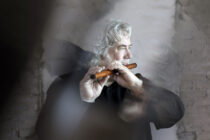
Norbert Rodenkirchen
Norbert Rodenkirchen studied flute at the Staatliche Musikhochschule Köln with Hans Martin Mueller and Günther Höller. He has been the regular flute player of the internationally renowned medieval ensemble Sequentia since 1996, and also works regularly with the French-Croatian ensemble Dialogos directed by Katarina Livljanic. With both ensembles he has been invited to numerous international festivals. Norbert Rodenkirchen additionally collaborates intensively in a medieval duo project with the acclaimed singer Sabine Lutzenberger.
He is also much in demand as a composer of music for theater and film, as well as a producer for CD projects. His main partner in modern music is the violinist and composer Albrecht Maurer. Norbert Rodenkirchen as served as artistic director of the concert series “Schnuetgen Konzerte – Musik des Mittelalters” in the medieval museum of Cologne. Additionally he has given workshops on medieval instrumental improvisation at renowned academies like Mozarteum Salzburg, Musikhochschule Koeln (Cologne), Schola Cantorum Basiliensis or Conservatory of Lyon, a.o.. In 2012 he released his third solo CD Hameln Anno 1284 / Medieval flute music / On the trail of the Pied Piper and was invited with that program to many outstanding festivals and early music series in Boston, Vancouver, Oslo, Paradyz, Copenhagen, Moscow, and elsewhere.
www.norbertrodenkirchen.org
Media
https://www.youtube.com/watch?v=upSb9GGz8UA