• My Account
  • Cart
  • About
    • Who is Early Music Vancouver
    • What is Early Music?
    • OUR INSTRUMENT COLLECTION
    • Employment Opportunities
    • Annual General Meeting 2025
    • 2024/25 Annual Report
  • Pacific Baroque Orchestra
    • August 7 | Vivaldi’s The Four Seasons
    • October 17 | A Little Night Music with Mozart 
    • December 20 | Festive Cantatas
    • March 25, 2027 | Handel’s La Resurrezione
  • EVENTS
    • Summer Festival 2026: The Power of Music
    • EMV’s 2026-2027 Main Season
    • Digital Concert Hall
    • Free Events
    • Past Events
  • Learn
    • PROGRAMMES
    • Artist Interviews
    • Instrument Videos
  • Support Us
    • Donate Now
    • Corporate Opportunities
    • Volunteer
    • Host an EMV Musician
  • Ticketing Info
    • BOX OFFICE
    • Gift Vouchers
    • Venues
  • Press Centre
    • Media Releases
    • EMV PRESS KIT
    • EMV in the News
Early Music Vancouver
  • My Account
  • Cart
  • Donate
  • Buy Tickets
  • Gift Vouchers
  • Get our newsletter
Toggle Menu
  • About
    • Who is Early Music Vancouver
    • What is Early Music?
    • OUR INSTRUMENT COLLECTION
    • Employment Opportunities
    • Annual General Meeting 2025
    • 2024/25 Annual Report
  • Pacific Baroque Orchestra
    • August 7 | Vivaldi’s The Four Seasons
    • October 17 | A Little Night Music with Mozart 
    • December 20 | Festive Cantatas
    • March 25, 2027 | Handel’s La Resurrezione
  • EVENTS
    • Summer Festival 2026: The Power of Music
    • EMV’s 2026-2027 Main Season
    • Digital Concert Hall
    • Free Events
    • Past Events
  • Learn
    • PROGRAMMES
    • Artist Interviews
    • Instrument Videos
  • Support Us
    • Donate Now
    • Corporate Opportunities
    • Volunteer
    • Host an EMV Musician
  • Ticketing Info
    • BOX OFFICE
    • Gift Vouchers
    • Venues
  • Press Centre
    • Media Releases
    • EMV PRESS KIT
    • EMV in the News
Home  >  Early Music Vancouver Past Events  >  Solo repertoire for Lute by Bach and Weiss with Paul Beier & Robert Barto

Solo repertoire for Lute by Bach and Weiss with Paul Beier & Robert Barto

Tuesday July 28, 2015 | 7:30pmRoy Barnett Recital Hall | Map

Paul Beier, lutenist; Robert Barto, lutenist


Pre-concert chat at 6:45 PM with Paul Beier, Lucas Harris, and Matthew White

Solo works for lute by Johann Sebastian Bach and Leopold Weiss, including two Bach Suites for harpsichord transcribed for lute by Paul Beier.

This event is generously sponsored by Vic and Joan Baker.

Programme

Robert Barto:

German Lute Music of the 17th and 18th Centuries

Suite in G minor               Esaias Reusner (1636-1679)

Allemande
Courante
Sarabande
Aria I
Aria II
Gigue

Chaconne                       Count Anton Logy (1645-1721)

Sonata in D minor (no.36)         Silvius Leopold Weiss (1687-1750)

Allemande
Courante
Bourree
Sarabande
Menuet
Allegro

Variations on a theme of Locatelli   Bernhard Joachim Hagen (1720-1787)

INTERVAL

Paul Beier:

Johann Sebastian Bach – Transformations for Baroque Lute

French Suite No. 1, BWV 812

Allemande
Courante
Sarabande
Menuet I – II
Gigue

French Suite No. 2, BWV 813

Allemande
Courante
Sarabande
Air
Menuet
Gigue

Programme notes

German Lute Music of the 17th and 18th Centuries

This program shows the the development of what we today call the “baroque lute” in Germany between the years of about 1650 until 1760. The four lutenist/composers on the program were all the leading players of their generations with Sylvius Leopold Weiss (1687-1750) standing out as one of the greatest lutenists of all time.

In the early 17th century, French lutenists began experimenting with different lute tunings in an attempt to increase the resonance of the instrument. Although many variants of the old “G” tuning were tried, a tuning based on a d minor chord was eventually adopted and became the basis for both the French and German lute schools. This tuning was used throughout northern Europe until the lute’s eventual demise around 1800.

Esaias Reusner (1636-1679) learned the lute from his father. A child prodigy, he performed for the queen (of Poland) at the age of ten. He was then given the opportunity to learn the new French style in d minor tuning with an unnamed French lutenist. All of his works were written in this tuning and serve as a basis for the German baroque lute tradition. One of the first composers to adopt the dance suite form, Reusner also arranged 100 sacred melodies to be played in the new lute tuning, just as his father had done in the old tuning,

Count Johann Anton Logy was a very wealthy aristocrat who dedicated his life to music and the lute in particular. He is credited with bringing a more melodic or Cantabile Italian style to the French lute style. Upon the news of Logy’s death in 1721, Sylvius Weiss composed one of his most beautiful, complex pieces in his honor, an indication of the esteem in which Logy was held. This Tombeau sur la mort de M. Comte de Losyis one of Weiss’s best known works today.

Sylvius Weiss is the outstanding figure in the German baroque lute. Mentioned by his contemporaries along with Telemann, Händel and Bach as one of the best German musicians, it was also said that he “was the first to show that one could do more on the lute than previously thought possible.”

When writing for solo lute, Weiss used almost exclusively the dance suite form ( although he called them sonatas or partitas). Although on a smaller scale than many of his late works (several last over 35 minutes), the Sonata no. 36 on this program shows Weiss’s expressive use of complex harmonies and almost playful handling of the dance forms. As often in his later works, he substitutes an allegro for the more usual gigue.

When Bernhard Joachim Hagen composed his works for lute at the court of Bayreuth in the 1760s, the lute had all but died out in the rest of Europe. The interest for the lute had so waned that Hagen himself, although a virtuoso lutenist and very inventive composer, had to work primarily as a violinist. The work presented here is Hagen’s arrangement for lute of Locatelli’s variations on a minuet-like theme

Robert Barto

Johann Sebastian Bach – Transformations for Baroque Lute

From an early age, ever since hearing Julian Bream play the first two Bach lute suites in the early 1960s, it has been my lifelong ambition to play the lute works of J. S. Bach. When I finally did acquire a real baroque lute my project was given further impetus, and by the late 1990s I had recorded the complete solo lute works on two CDs published by Stradivarius. Since then I have returned to these works often, and they still provide me great pleasure, but lately I have been on the lookout for some new material from the pen of the Cantor of St. Thomas. The obvious choice, of course, is to arrange the solo works for ‘cello or violin for the lute. This can work very well but it requires some adjustment, the baroque lute being a chordal instrument characterized by its set of deep bass notes, and the violin and ‘cello being mostly capable of playing single melodic lines. So the arranger has to fill out the texture by adding harmony and bass notes. The alternative is to look at Bach’s copious output for keyboard, but here the problem is the opposite, the musical texture is too thick – think of the harpsichordist’s ten fingers producing sound on a keyboard, as opposed to the lutenist’s mere four fingers of the right hand that produce the sound on a lute. Bach’s French Suites occupy a middle ground. They seem to have been first conceived as a wedding gift to his second wife, Anna Magdalena, who was a singer and amateur harpsichordist, so they were written in a much lighter and more easily approachable manner than the six “English” suites that preceded them or the Partitas that followed in the chronology of Bach’s composition. Indeed they were called “French” (but never by Bach himself) because of their brevity and charm, to distinguish them from the more severe and academic style of the English suites. Yet in trying to set them on the lute I still encountered some major difficulties. For one thing, the musical texture often occupies a span of over four octaves, whereas the lute is only really capable of three. For another, Bach’s use of the left hand: it is always active with scales and arpeggios, or sustaining a middle voice as well as the bass. The single right hand thumb of the lutenist, which alone is responsible for the entire bass tessitura of the lute, could not possibly compete with this. So in arranging these suites for the lute, I was obliged to follow the opposite approach from that needed when arranging from the ‘cello or violin: instead of expanding the music to fit the instrument, I had to contract it – retaining the essential musical material but distilling it to a form that is coherent with the style of lute music in Bach’s day. I will let tonight’s audience be the judge as to whether or not the fruits of my labors can be considered successful.

Paul Beier
Paul Beier, lutenist

Paul Beier graduated from the Royal College of Music, London under Diana Poulton. He has performed in Europe, North and South America and Australia as soloist, director of Galatea, member of various groups and as continuo player in orchestral and opera productions. His solo lute repertoire extends from the Italian Cinquecento to the music of Bach and Weiss. Founder and director of Galatea, he has also collaborated with Aglaia, Aurora, La Cetra, Ensemble Concerto, Nova Ars Cantandi, Pacific Baroque, La Risonanza, etc.

His 12 solo CDs and 5 as director of Galatea have been well received, earning recognition such as “Disque du Mois” of Répertoire, 5 Diapason, 5 stars of Goldberg, “La Scelta” of Amadeus, etc. Since 1981 Mr. Beier has taught lute, continuo and ensemble at the Scuole Civiche di Milano. He is a founding member of the Italian Lute Society, and is a consulting editor of the Lute Society of America Journal.

For more information, photos and audio clips and reviews, see: www.musico.it/lute
read more...

Robert Barto, lutenist

Robert Barto graduated from the University of California, San Diego, having specialized in historical lute performance. A Fulbright scholarship brought him to Europe, where he continued his studies with Michael Schaeffer in Cologne and Eugen Dombois in Basle. In 1984, he was awarded first prize at the International Lute Competition in Toronto, as well as top prize in a competition of all the instrumental soloists at the Musica Antiqua Competition in Bruges, Belgium.

Robert Barto has performed throughout Europe and North America, including solo recitals in the Festival of Flanders, London’s Purcell Room, the Utrecht Festival and the “Music Before 1800” event in New York City. In 2000, he gave solo performances at the Lufthansa Baroque Festival in London, Bavarian Radio’s Bach Night in Munich and presented a special tribute to Silvius Leopold Weiss for the city of Dresden. Robert Barto’s five volumes of baroque lute sonatas by Silvius Leopold Weiss and 2 CDs of the complete solo works of Joachim Bernhard Hagen have met with great enthusiasm from critics and the public alike.

read more...


Media

1254 W 7TH AVE
VANCOUVER, BC, V6H 1B6

(604) 732-1610
staff@earlymusic.bc.ca

  • About EMV
    • What is Early Music?
    • Staff
    • Partners
    • Board of Directors
    • Venues
  • Education & Community
    • BC Scholarship Programme – 2026/2027
    • OUR INSTRUMENT COLLECTION
  • Press Centre
  • Join Our Mailing List
Facebook URLTwitter URLYoutube URLInstagram URL

Copyright © 2026 EARLY MUSIC VANCOUVER | EMV | PHOTOS BY JESS MACALEESE, MARK MUSHET AND JAN GATES.
CONTACT EMV FOR INDIVIDUAL CREDITS. | site by DFS Digital Fusion Studios web designAND MEDIUM RARE Medium Rare Interactive

Een Romantische Johannes Passion

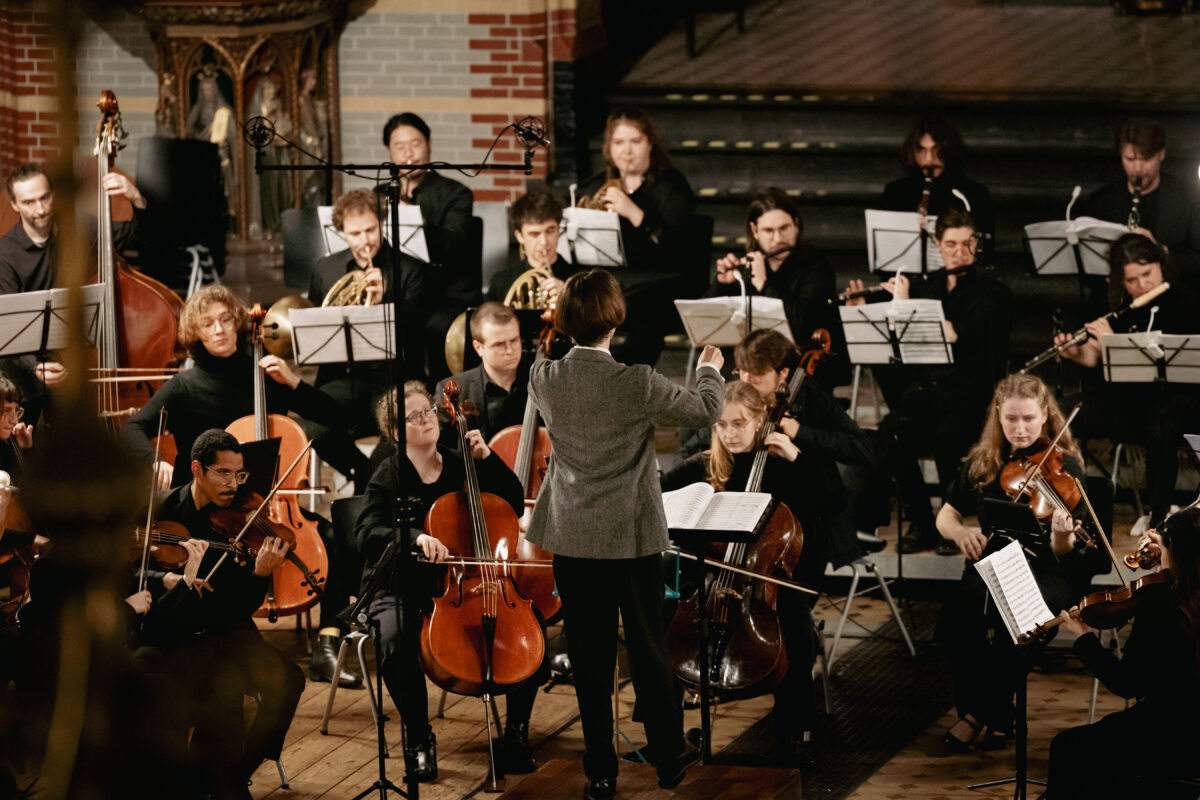
Historical Performance has been steadily looking toward the nineteenth-century as a source of inspiration, and Orchestra Lagrandt wants to lead the charge into Romantic orchestral performance practice. As an orchestra of ambitious musicians in their twenties from 25 different nations, we aspire to represent the voice of the new generation in Historical Performance.

Een Romantische Johannes Passion is an ongoing project to reimagine the Johannes Passion of J. S. Bach in a late nineteenth century style. The first Passion revivals in the Netherlands took place in Rotterdam in 1870, featuring large symphonic orchestrations, and a radically different musical language than that of the HP and modern classical worlds. In our initial performance with the Tangram Chamber Choir, we pushed the boundaries of what Romantic Bach might have sounded like: exploring changes in orchestration, stoic tempi, rubato, phrasing, nineteenth- century bowing practices, and even portamento. We plan to establish this project as an annual tradition every Easter season, reworking the arrangement each time in the spirit of Romantic spontaneity.


One of the wonderful things about the Historical Performance movement is that we are able to use forgotten practices, this time hailing from the nineteenth century, to present such a beloved and well known-work in a new light.

The world is familiar with stories of clever forgers whose life’s mission is to cunningly reproduce the light and shadows of historical masterworks, from Vermeer’s brushstrokes to Da Vinci’s proportional precision… but what if these crimes of craftsmanship were to extend beyond the visual arts? What if the pieces we know to be by Palestrina, Monteverdi or even Johann Sebastian Bach were in fact stylistic copies, artfully composed by a secret circle of music forgers and passed off as the work of the greats? What if those music forgers are at work as we speak? 

This premise inspires our original program The Music Forgery Workshop. Our early music comedy imagines the lives of such a circle of musical criminals, offering a fresh and lively presentation of historical compositions, not as museum artifacts but as living works in progress. The workshop itself is set up on the stage and its members carry forth the plot in music and words. A narrator in the role of a suspicious inspector lends the performance a theatrical flow. The listener is invited into a satire on high society’s art commerce, while the performers make fun of themselves for having devoted their lives to the niche subject of historical music performance. 

Violinist Elizabeth Sommers combines her skills and experience in traditional music with expertise in the performance and improvisation of medieval and Renaissance repertoires. Multi-instrumentalist Eliot X. Dios (keyboards, bagpipes and flutes) works wholeheartedly to employ storytelling techniques developed through the history of literature and cinema in his early music concerts. Composer Gunnar Haraldsson (violin, guitar) seeks to translate the forms and intentions of early composition for a modern audience. Halldór B. Arnarson (keyboards, voice) has devoted his career to bringing musical craftsmanship from the era of counterpoint to the attention of the public and comedy to the early music scene. Singer and storyteller Ásta S. Arnardóttir brings the storyline to the public with personal immediacy, and through her character work defines the different veins of the show, sometimes hilarious and sometimes serious. 

The story is narrated by the character of the Inspector, acted out by the members of the MFW, and told in rhyming Icelandic verse in one musical pillar of the show, a madrigal composed by our very own 

Halldór in the style of Monteverdi. The show has an entertaining educational dimension. The audience is exposed to a broad sweep of historical and musical information in a condensed form, necessary to understand the musical humour, while dramatic rhythm and scenographic effects prevent overwhelm. We also place particular emphasis on theatrical illusion and synchronisation. One example appears in the opening scene, in which the inspector is seen watching television. On stage, this becomes a complex exercise in coordination: each time the inspector presses a button on the remote control, the musicians instantly switch pieces, creating the impression of rapidly changing television channels. 

This opening scene establishes the tone of the entire show, comical and satirical in its storytelling and diverse in its musical language. It not only introduces the wide range of musical styles that appear throughout the performance, but also functions as the plot’s inciting incident, as the inspector hears a news report about the discovery of a previously unknown concerto by Vivaldi. 

Another important scene takes place when one forger is alone on stage in low light, perusing books on medieval music, while the musicians perform and sing offstage, sounding his audiation as he reads. This intimate moment evokes the sleepless nights spent studying facsimiles and learning historical compositional techniques, by which the forger acquires the inspiration and the expertise necessary to his art, and reveals a hidden side of musical performance: the immense amount of study and preparation that precedes the moment on stage. This setting also creates space for visual and musical comedy, as seen in the trailer video, where a 14th-century melody is played backwards because Halldór is unknowingly reading the facsimile upside-down, only realising the mistake when the music begins to sound absurd. 

Fun and friendship are at the heart of the whole project, though the link between music and crime is an important historical consideration. Classical music was often used as the demonstration of a monarch’s power, music teaching as a cover up for secret affairs, and pieces were published under another’s name for profit. Such examples of “inappropriate practices” carry an exciting and attractive element for the audience which the MFW seeks to exploit. Under this light-hearted surface lies a more serious layer of questions concerning our present-day existence, such as excessive materialism in high society and the threat posed on human craftsmanship and skill by the rise of artificial intelligence. 

Please Note:

The main applicant and creative/intellectual driver of the project must be 30 or under (on May 15th).

The average age of all musicians must not be older than 32, and the maximum age of supporting musicians must be no more than 35 (on May 15th.)