Christ Church Cathedral | Map
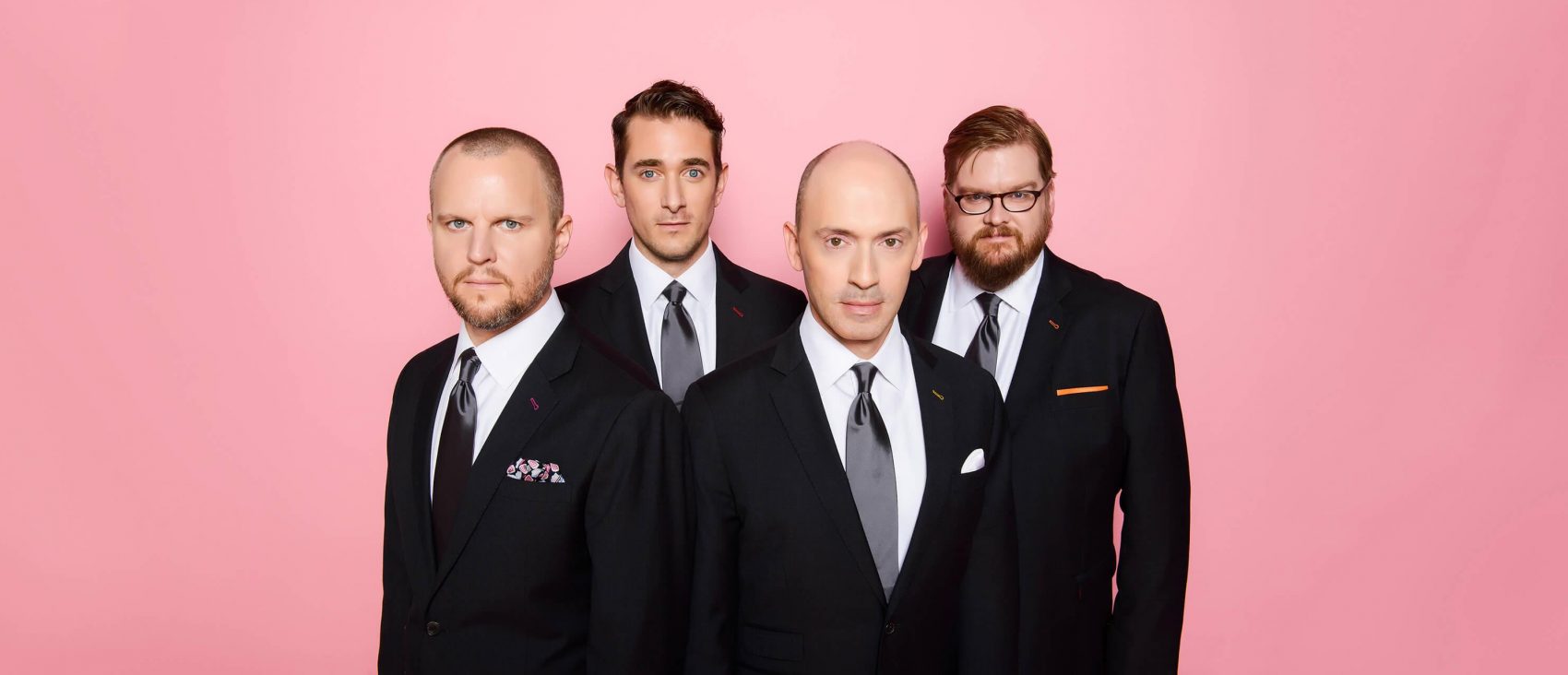
Praised for a “rich, natural sound that’s larger and more complex than the sum of its parts,” (National Public Radio) New York Polyphony is one of the foremost vocal chamber ensembles active today. The four men, “singers of superb musicianship and vocal allure,” (The New Yorker) give vibrant, modern voice to repertoire ranging from Gregorian chant to cutting-edge compositions. Their dedication to innovative programming, as well as a focus on rare and rediscovered Renaissance and medieval works, has not only earned New York Polyphony two GRAMMY nominations and wide acclaim, but also helped to move early music into the classical mainstream.
There will be a pre-concert discussion at 6:45pm with composer Gregory Brown and Professor Christopher Douglas from UVic’s Centre for Studies in Religion and Society moderated by Ian Alexander.
To view/download the programme for this event, please click here.
This concert is part of the VSO’s New Music Festival
This concert is generously supported by George Laverock and Jane Coop

Click here for information about parking around / transiting to Christ Church Cathedral
Programme
Kyrie Cunctipotens Genitor Deus – Andrew Smith (b. 1970) *
Mass for Four Voices – Thomas Tallis (1505-1585)
Gloria in excelsis Deo
Credo in unum Deum
Sanctus
Benedictus
Agnus Dei
Ite Missa est – Gabriel Jackson (b. 1962) *
INTERMISSION
Missa Charles Darwin *- Gregory Brown (b. 1974)
Introitus; Tropus Ad Kyrie
Gloria: “There is grandeur in this view of life”
Alleluia: “It is those who know little and not those who know much”
Credo: “All that we can do”
Sanctus: “As buds give rise…”
Agnus Dei/Ite missa est: “Natural selection…”
Three American Folk Hymn – arranged by Gregory Brown
Morning Trumpet
The Dying Californian
Sweet hour of prayer
*Composed for New York Polyphony
Programme Notes
Missa is simply the Latin form of the word Mass and refers to the texts and music of the Roman Catholic liturgy. This liturgy has an established structure and in general terms is associated with a public celebration of faith. Naturalist Charles Darwin’s name forms the latter part of the title due to the fact that the bulk of the texts used in this mass are taken from his writings of Charles Darwin, particularly the seminal Origin of Species. The musical and liturgical form of the Mass is distinct and canonic, with intrinsic proportions, structure, and drama. Casting Darwin’s texts into that form is a way of drawing parallels, and exploring contrasts between the two, as in the Kyrie. The central message of the Kyrie is one of supplication and mercy, while Darwin’s natural selection is inherently lacking in mercy. This format is also a way to venerate Darwin and his legacy in a form that is associated with the public celebration of belief.
The practice of substituting a different set of texts into the Mass is not a new one, and has been practiced in various forms throughout the centuries, though generally with other sacred texts substituting for the typical Mass texts. Perhaps the most notable example of something like this—again sacred—is Ein deutches Requiem by Johannes Brahms, which uses the name “Requiem,” (a particular type of mass for the dead) but uses Brahms’s own selections from scripture in place of the liturgy.
The premise and texts for the Missa Charles Darwin come from New York Polyphony’s bass, Craig Phillips, who approached the composer with a draft of the libretto and a proposal that it be set to music. There was a brief flurry of collaboration over the disposition and tone of the various texts, and the composer set to work on the music shortly thereafter.
In order to bind the work together, the composer devised an opening idea which was linked to Darwin, evolution, and genetics. Using a portion of the genetic sequence of Platyspiza crassirostris (a bird from the group commonly known as Darwin’s Finches), he translated the amino acids into notes, thereby deriving a melody. This melody serves as a motto of sorts for the Mass, showing up here and there as generative (musical) material. Other ideas taken from genetics appear in the Credo, where mutation, insertion, and deletion are applied to the motto melody (along with standard musical procedures of inversion and retrograde) to create an evolving musical texture.
Other underlying ideas in the work include symmetry, which is common to both science and music. A notable example of symmetry comes in the Gloria, where the four voices sing the passage “Different, yet dependent upon each other” in phrases that are point-reflections of one another. The symmetry here serves to underline the interdependence of the voices, at the same time creating something of intricate beauty, and also taking advantage of the double meaning of the word “reflect.”
Similarly, the Sanctus is a slowly evolving canon with one basic melodic idea (“As buds give rise by birth to fresh buds…”) presented in four closely related forms in the four voices. These ideas eventually grow together, intertwining to form an interlocking texture grown from the self-same idea.
The genetic sequence that has (in various guises) served as a motto for the piece returns in the final movement in a slightly altered, yet recognizable, form as a bookend for the piece. The final “Amen” includes a fleeting and oblique quotation of the Ite Missa est in the midst of a reprise of the “Alleluia” that closes the second movement.
The Missa Charles Darwin venerates a celebrated work of human ingenuity through the application of an accepted musical form that is uniquely suited to enhance the expressive potential of language. Through music, it seeks to celebrate not only Darwin’s genius, but also his inestimable contribution to the human spirit. – Gregory Brown
During the Renaissance, settings of the Latin Mass settings keenly demonstrated a composers’ sensitivity to the temporal forces of the day. On the most basic level, each work is an expression of Roman Catholicism suited to and affected by the religious and political challenges of its time. In the face of movable and at times arbitrary rules and restrictions however, Tallis transcended the basic requirements to craft powerful, poignant and deeply personal musical statements.
The ascension of the House of Tudor, would irreversibly alter religious traditions in England. By the time Thomas Tallis was active in the mid-sixteenth century, the religious climate had changed drastically. Tallis witnessed firsthand the separation of England from the Roman Catholic Church and with it the destruction of religious institutions and cherished musical traditions. It is unclear during whose reign Tallis wrote his Mass for Four Voices. Regardless, the piece exhibits masterful pragmatism. Its simple lyricism and economic use of polyphony—likely driven by liturgical necessity—result in an understated and demure masterpiece.
When considering the entire output of Thomas Tallis and the fact that over the course of his professional life he served four different monarchs, it is hard not to marvel at how skilfully he adapted artistically to changes in style, liturgy, and language. His genius lies not only in his shrewd pragmatism, but also in his careful attention to the setting of text. Tallis applies polyphony only in controlled bursts, relying instead on a steady syllabic structure throughout. The effect is efficient, but never pedantic. Texts are set in a beautifully crafted hierarchy of harmony and discord. In terms of liturgical tradition his Mass for Four Voices is an odd hybrid: Catholic in intent and Anglican in execution. It is not known whether Tallis remained a devout Roman Catholic throughout his life. In the Sanctus however, he displays a love for the liturgy he knew as a young musician. As a possible nod to the elaborate mass settings of the older Sarum rite, Tallis creates a remarkably lengthy statement. When combined with the Benedictus, it is nearly twice the duration of his concisely syllabic Gloria and Credo.
Tallis’ Mass for Four Voices does not include a Kyrie. Perhaps its absence is due to fluctuating liturgical practices of the Chapel Royal. More likely, a remnant of older traditions such as a troped plainsong Kyrie appropriate for the feast day was inserted. Regardless, we offer a modern setting of the troped Kyrie: Cunctipotens genitor Deus, composed for New York Polyphony by Andrew Smith (b. 1970). As further proof that times go by turns, this program concludes with Gabriel Jackson’s (b. 1962) playfully intricate Ite missa est, composed for New York Polyphony in 2012.
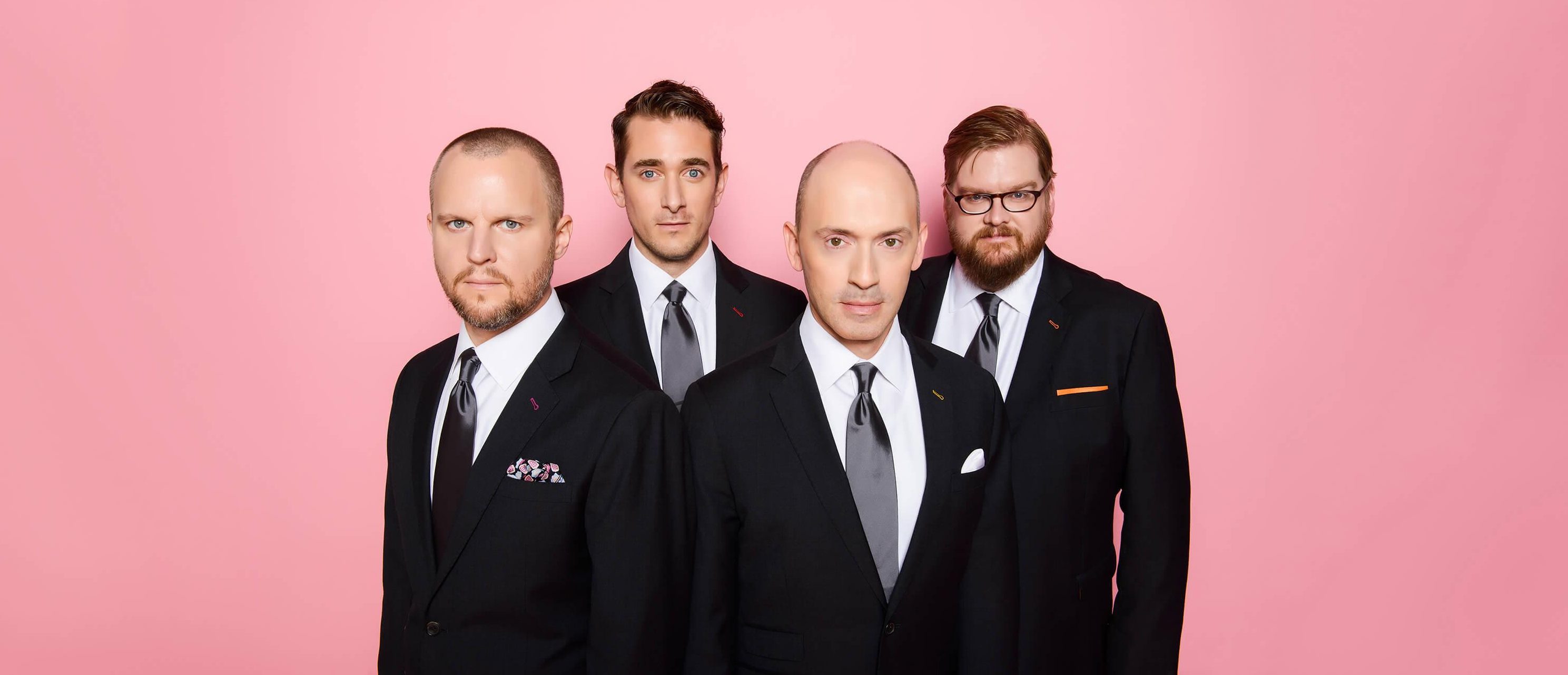
New York Polyphony
Praised for a “rich, natural sound that’s larger and more complex than the sum of its parts,” (National Public Radio) New York Polyphony is one of the foremost vocal chamber ensembles active today. The four men, “singers of superb musicianship and vocal allure,” (The New Yorker) give vibrant, modern voice to repertoire ranging from Gregorian chant to cutting-edge compositions. Their dedication to innovative programming, as well as a focus on rare and rediscovered Renaissance and medieval works, has not only earned New York Polyphony two GRAMMY nominations and wide acclaim, but also helped to move early music into the classical mainstream.
Commissioning new works has been central to the mission of New York Polyphony since their founding in 2006. Both in performance and on recording, the ensemble has demonstrated a commitment to presenting contemporary compositions that explore the boundaries between ancient and modern music. They have forged relationships with numerous composers, including established artists such as Richard Rodney Bennett, Jonathan Berger and Jackson Hill, emerging talents Bora Yoon and Gregory Brown, and prominent figures such as Gabriel Jackson and Andrew Smith. In January 2017, as part of Miller Theatre at Columbia University’s Early Music Series, New York Polyphony premiered The Vespers Sequence, a multi-movement setting of the Byzantine evening prayer service composed for the ensemble by Ivan Moody. Future projects include The Bitter Good by American composer Gregory Spears, for which the quartet was awarded a 2016 Commissioning Grant from Chamber Music America.
The ensemble’s growing discography includes two GRAMMY-nominated releases and albums that have topped the “best of” lists of The New Yorker, Gramophone, and BBC Music Magazine. In August 2016, New York Polyphony released Roma aeterna, a program highlighted by two masses of the High Renaissance by Giovanni Pierluigi da Palestrina and Tomás Luis de Victoria. The album, their seventh overall and fourth on BIS Records, debuted at #4 on Billboard magazine’s Traditional Classical Album chart. It has been hailed as “blissfully confident and beautiful” (BBC Radio 3 – Record Review), “resplendent and elegant” (San Francisco Chronicle), and “nothing short of revelatory” (AllMusic).
Called a “spacious, radiant retreat” by The New York Times and selected as a “must have” in its Holiday Gift Guide, 2014’s release Sing thee Nowell scored New York Polyphony its second GRAMMY nomination in the Best Chamber Music/ Small Ensemble Performance category. With the 2013 release of Times go by Turns, the ensemble’s fourth album, New York Polyphony continued “to claim a spot as one of the finest small vocal groups performing today” (Audiophile Audition). Commended as “a complex, clear-eyed yet still painfully beautiful tapestry,” (Gramophone) Times go by Turns amassed substantial critical acclaim. In addition to being named one of iTunes 10 Best Classical Releases of 2013, the album garnered a GRAMMY nomination.
New York Polyphony released endBeginning in early 2012. Featuring rare and never-before recorded works from the Franco-Flemish Renaissance, the album was hailed as a “gorgeous, reflective program” by National Public Radio and selected as one of the ‘Top Ten Notable Classical Music Recordings of 2012′ by The New Yorker. “A stunning tour through chant, polyphony and renaissance harmonies,” (Minnesota Public Radio) New York Polyphony’s 2010 effort Tudor City spent three weeks in the Top 10 of the Billboard classical album chart. It was featured on Danish Public Radio, American Public Radio and NPR’s All Things Considered. New York Polyphony’s debut album I sing the birth was released in 2007. An intimate meditation on the Christmas season, the disc garnered unanimous praise. Gramophone named it “one of the season’s best,” BBC Music Magazine selected it as ‘Editor’s Christmas Choice’, and Classic FM Magazine (UK) deemed it “a disc for all seasons.”
New York Polyphony tours extensively, participating in major concert series and festivals around the world. Noteworthy engagements include debut performances at London’s Wigmore Hall and The Royal Concertgebouw in Amsterdam, residencies at Dartmouth College and Stanford University, concerts under the aegis of the Festival Oude Muziek Utrecht (Netherlands), and the European premiere of the Missa Charles Darwin—a newly commissioned secular Mass setting based on texts of Charles Darwin by composer Gregory Brown—at the Museum für Naturkunde in Berlin. Elsewhere New York Polyphony has performed as part of the Tage Alter Musik Regensburg; Rheingau Musik Festival, Thüringer Bachwochen (Germany); Abvlensis International Music Festival (Spain); Stiftskonzerte Oberösterreich (Austria); Festival de Música de Morelia (Mexico); and the Elora Festival (Canada), among others. They have been featured on Performance Today for American Public Media, Footprints to Paradise: A Medieval Christmas for Public Radio International, and BBC Radio 3’s In Tune. In December 2011, New York Polyphony made its national television debut on The Martha Stewart Show.