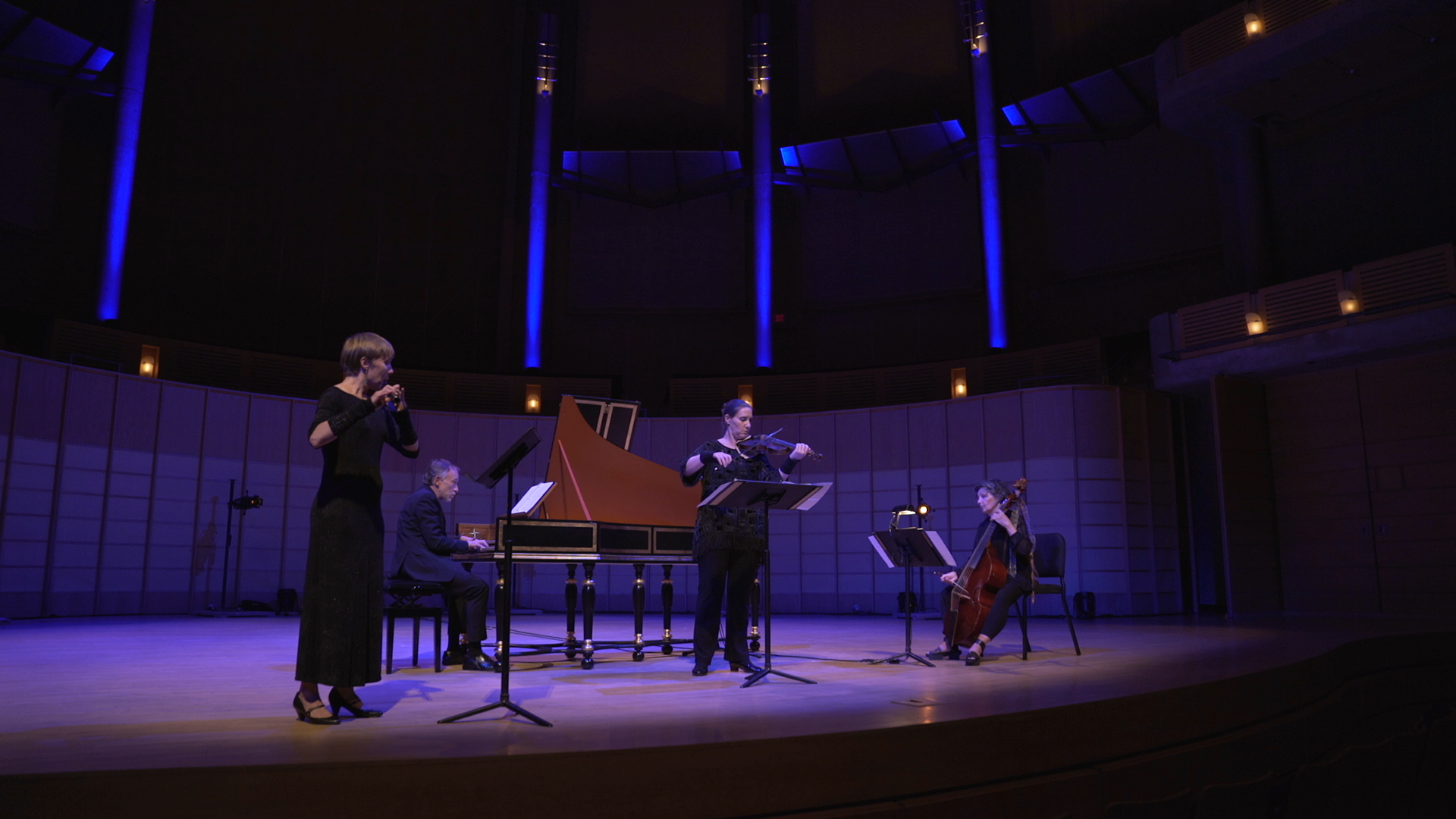
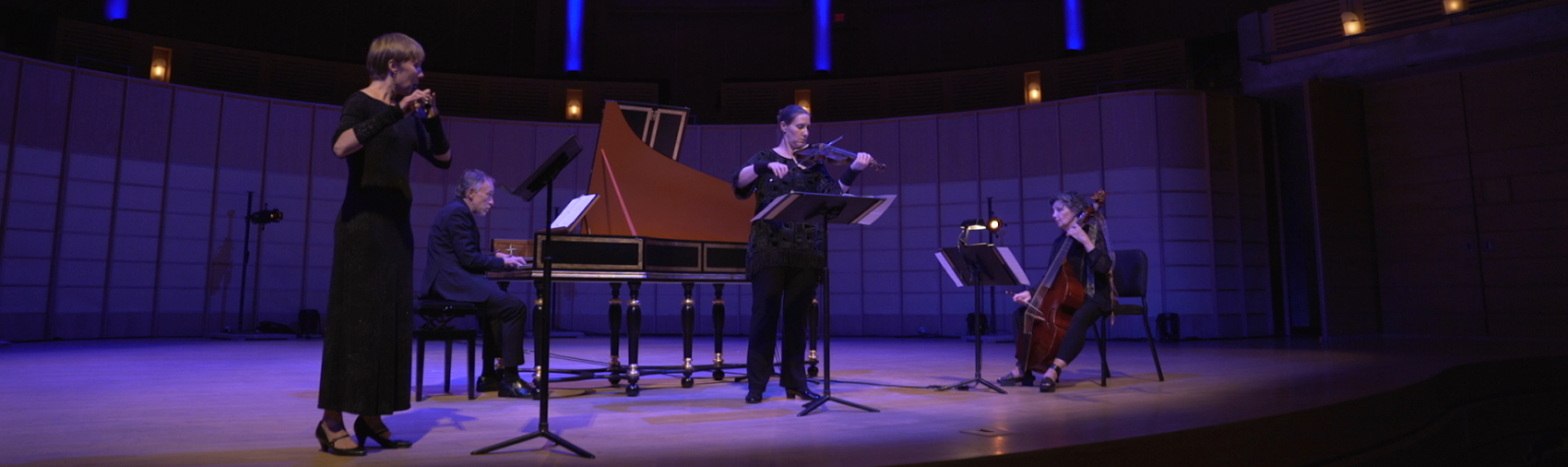
Alexander Weimann | Sponsored by Bruce Munro Wright, O.B.C., Harpsichord; Chloe Meyers | Sponsored by Jill Bodkin, Violin; Natalie Mackie, Gamba; Musical Offering: Transcending Time | EMV DCH, Flute
Bach’s Musical Offering was initiated in 1747 when Frederik the Great invited 62-year-old J.S. Bach to his court with a challenge: to improvise a three-part fugue on a complicated musical theme chosen by Frederik himself. To the amazement of all present, “Old Bach” met the challenge with unprecedented creativity and innovation. Bach sent the King The Musical Offering, a brilliant collection of canons and fugues, and a trio sonata that is without parallel in 18th century chamber music, all dedicated to exploring and exhausting the contrapuntal possibilities of the same musical theme. Composed in 2002, Vancouver composer Jocelyn Morlock’s “Revenant” is based on reversing the same royal theme.
Access to the concert is free, but donations are greatly appreciated. Concert will remain online one year from premiere date.
This concert is generously supported by Delma Hemming


How to watch:
ONLINE: Watch the concert online by clicking here.
This concert is available to watch for free thanks to the generosity of donors. To support our programming by making a tax-deductible donation, click here.
Concert will remain online one year from premiere date.
Programme
Johann Sebastian Bach (1685-1750)
“The Musical Offering” BWV 1079:
Exordium
Thema Regium (Royal Theme)
Ricercar à 3
Narratio
Canon perpetuus super Thema Regium
Canones diversi super Thema Regium:
Canon à 2
Canon à 2 in unisono
Canon à 2 per Motum contrarium
Canon à 2 per Augmentationem, contrario Motu ‘Notulis crescentibus crescat Fortuna Regis’
Canon à 2 per tonos ‘Ascendente Molulatione ascendat Gloria Regis’
Fuga Canonica in Epidiapente
Propositio
Ricercar à 6
Argumentatio
Canon à 2 Quaerando Invenietis
Canon à 4
Sonata sopr’il Soggeto Reale: Largo, Allegro, Andante, Allegro
Conclusio
Canon perpetuus
Jocelyn Morlock (b.1969)
“Revenant”
Programme Notes
Loaded with mystery, enigmas, and hidden meanings, the Musical Offering has intrigued musicologists and musicians through generations. Bach wrote this masterpiece two months after his legendary visit to the Prussian court of Frederick the Great in Potsdam where his second son, Carl Philipp Emanuel, was a musician. Frederick, an avid flute player and composer of some talent himself, had been curious to meet the famed ‘old Bach’ and had urged Carl Philipp to invite him to the court. In 1747 at the age of 62, Johann Sebastian undertook the long trip from Leipzig. As he arrived, the King was about to begin his nightly chamber music concert with his court musicians, and Bach wasn’t given the time to even change out of his travel clothes, as Frederick invited Bach to join the party and try the King’s collection of brand-new fortepianos.
Intrigued by Bach’s fame as an improviser, Frederick gave Johann Sebastian a theme to improvise upon. He first asked for a regular three-part fugue, which Bach mastered to the great astonishment of his listeners. The King then asked for a six-part fugue on the same tune: as the theme lent itself poorly to counterpoint, Bach chose to use a theme of his own for the latter improvisation.
Unable to respond to the King’s challenge on the spot, Bach set himself to perfect the task in print, and two months after his visit Frederick was sent the completed Musical Offering, a collection of pieces dedicated to the King, based on Frederick’s “Thema Regium” (Royal Theme). This collection exhausted the contrapuntal possibilities of the theme, entailing two fugues titled Ricercars, one in three and one in six parts; 10 canons in different forms; and a grand trio sonata, scored for flute, violin, and basso continuo, honoring the King’s chosen instrument. The Musical Offering is considered one of the pinnacles of contrapuntal writing, and the six-part Ricercar to be Bach’s greatest fugue.
It is speculated that the theme is too complex to be by the King himself, but was rather by Carl Philipp, who might have hoped to challenge or embarrass his father in the presence of some of the finest musicians of the time. The school of strict counterpoint that Johann Sebastian had devoted his life to perfecting was by now considered stale and old-fashioned, and the Prussian court favoured the new, lighter gallant style that celebrated human expression and emotion. For Bach’s son’s generation, music was seen more as recreational entertainment, rather than a divine art form designed for the glory of God.
The Musical Offering is full of musical enigmas and riddles, and Bach’s motivations behind each detail have been the subject of great speculation. Dedicated to the glory of the King, some of the writing may actually be considered questionable commentary on the monarch. Canon a 2 per tonos is a transposing canon where each statement ends a whole tone higher: the inscription states “And as the modulation rises, so may the Glory of the King”, yet the journey through evermore uncomfortable keys hardly seems celebratory, and played six times, one returns to the original key, as if nothing had changed since the beginning. The flute part of the Trio Sonata, undoubtedly written with the King in mind, presents many highly unidiomatic and close-to-impossible passages for the instrument, which was unlikely by accident. And in the Trio Sonata’s third movement, with its sighing figures and abrupt dynamic changes, Bach appears to be imitating – or perhaps ridiculing– the gallant style of his son.
The performance order is not indicated in Bach’s publication. In this performance, the pieces are grouped together following Quintilian’s order of speech, derived from the rhetoric ideals of Ancient Greece, with which Bach would have been intimately familiar. Like many other of Bach’s late works, such as the Mass in B minor and the Art of Fugue, the Musical Offering may have been more of an abstract exercise in the quest for perfection in music, rather than intended for a performance.
Second on this programme, Vancouver-based Jocelyn Morlock’s Revenant (2002) is also an exploration of King Frederick’s theme. As stated in Morlock’s notes, the word Revenant is derived from French word revenir and means “one that returns after death or a long absence”. Written for the same instrumentation as the Trio Sonata of Bach’s Musical Offering, Revenant opens with the theme introduced by the harpsichord, notes played in reverse “as if the theme were moving backwards in time.” The theme is always near-present, alternating between freer fantasia-like and stricter sections, both nods to the past and the old idioms–most notable in the second, canonic section– and exploring new exquisite textures using the old instruments. The otherworldly final section with its stillness and mesmerising colours indeed appears to transcend time.
Notes by Soile Stratkauskas

Alexander Weimann | Sponsored by Bruce Munro Wright, O.B.C., Harpsichord
The internationally renowned keyboard artist Alexander Weimann has spent his life enveloped by the therapeutic power and beauty of making music. Alex grew up in Munich. At age three he became fascinated by the intense magic of the church organ. He started piano at six, formal organ lessons at 12 and harpsichord at university (along with theatre theory, medieval Latin and jazz piano.) He is in huge demand as a director, soloist and chamber player, traveling the world with leading North American and European ensembles. He is Artistic Director of the Pacific Baroque Orchestra in Vancouver and teaches at the University of British Columbia where he directs the Baroque Orchestra Mentorship Programme.
Alex has appeared on more than 100 recordings, including the Juno-award-winning album “Prima Donna” with Karina Gauvin and Arion Baroque orchestra. His latest album series “The Art of Improvisation” (Volume 1: A Prayer for Peace; Volume 2: Ad libitum; and Volume 3: Canavian Variations, released on Redshift, 2024) unites his passions for both baroque music and improvisation on organ, harpsichord, and piano.
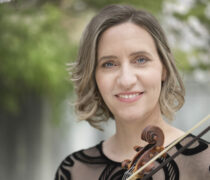
Chloe Meyers | Sponsored by Jill Bodkin, Violin
Violinist Chloe Meyers performs with early music ensembles across North America as leader, orchestra member, and chamber musician. She is the concertmaster of the Pacific Baroque Orchestra in Vancouver and co-concertmaster of Arion Baroque Orchestra in Montreal. She has led or appeared as soloist with groups including the Victoria Baroque Players, Pacific MusicWorks, Ensemble Les Boréades, the Theatre of Early Music, Ensemble Masques, and Les Voix Baroques, of which she was a founding member. She has had the pleasure of sharing the stage with international violin stars, performing double concerti with Stefano Montanari, Enrico Onofri, Amandine Beyer, and Cecilia Bernardini. Chloe’s playing may be heard on many award-winning disks, including the 2022 Juno award winning recording “Solfeggio”… in which she leads the orchestra L’Harmonie des Saisons as concertmaster. In 2023 she was nominated as Best Musical Director for her work in Pergolesi’s Stabat Mater with the Edmonton Opera.
Alongside Chloe’s passion for performance and directing, is her love of teaching. As adjunct professor at the University of British Columbia, she trains young artists in the Baroque Orchestra Mentorship Program, chamber music and solo lessons. She has years of teaching children, university and students of all ages and levels! She is an active teacher in the summer Victoria Conservatory teaching programs, as well the UVic Collegium orchestral program.
Chloe lives in Ladner, BC, with her ever growing family and dog.
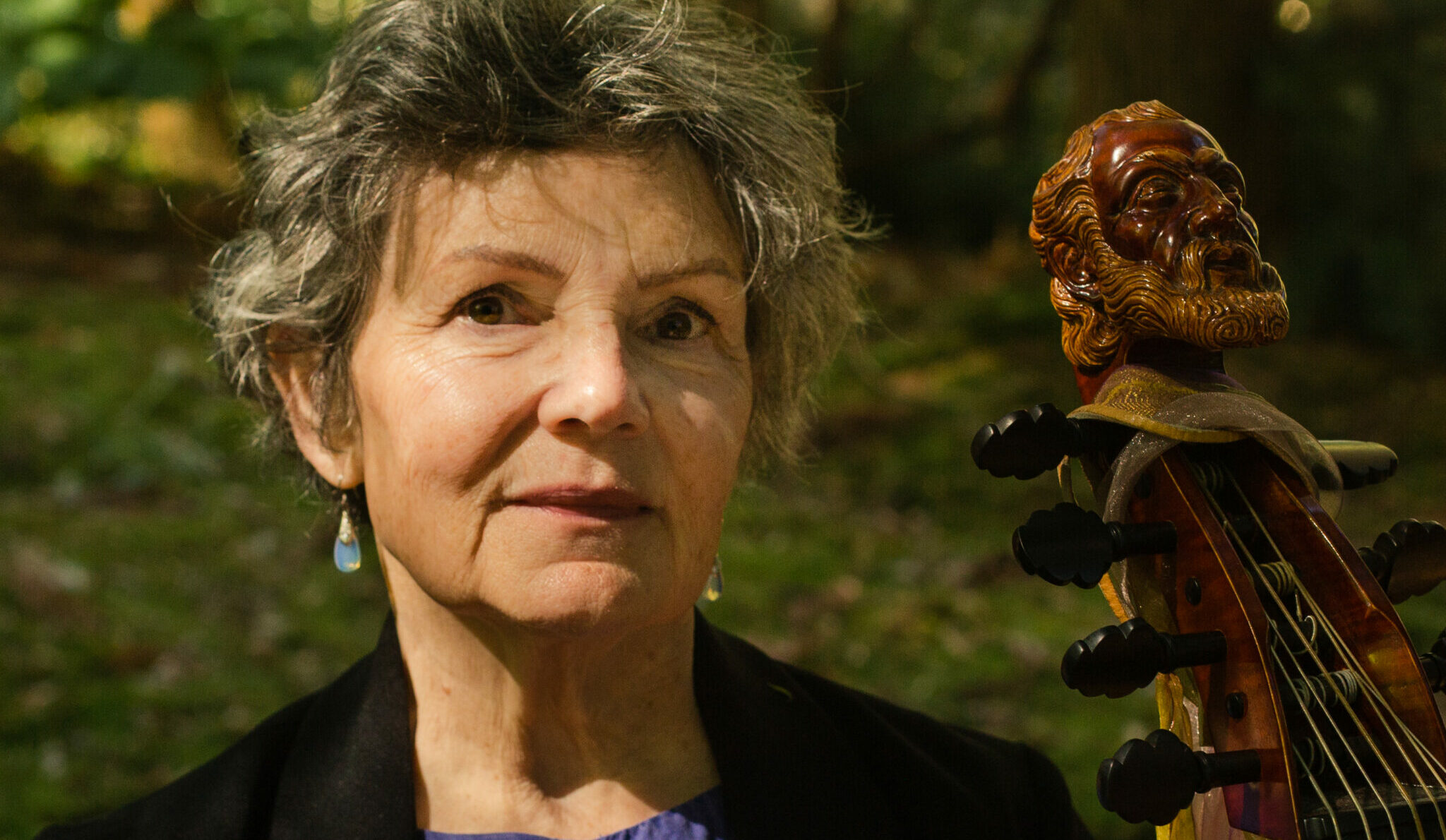
Natalie Mackie, Gamba
Natalie Mackie studied cello at the Conservatoire de Musique (Québec), followed by a degree from the School of Music, University of British Columbia. While at UBC she was introduced to the viola da gamba, and following graduation, she pursued further studies at the Koninklijk Conservatorium in The Hague. Natalie has played with many ensembles in Canada and the US, including New World Consort, Les Coucous Bénévoles, Tafelmusik, Portland, and Seattle Baroque Orchestras, Les Voix Humaines, Tempo Rubato, Les Voix Baroque, Oregon Bach Festival Orchestra, Victoria Baroque, and Vancouver Intercultural Orchestra among others. Natalie is a member of Pacific Baroque Orchestra and the chamber ensemble “La Modestine”- both Vancouver-based ensembles. She has toured throughout Canada, Europe, and the US and recorded for Radio France, German Radio, BBC, CBC, and NPR, as well as the Canadian label Atma Classique. Natalie is a regular performer in the Pacific Baroque Festival, held annually in Victoria, BC, and teaches in the Baroque Orchestra Mentorship Program at the University of British Columbia.