• My Account
  • Cart
  • About
    • Who is Early Music Vancouver
    • What is Early Music?
    • OUR INSTRUMENT COLLECTION
    • Employment Opportunities
    • Annual General Meeting 2025
    • 2024/25 Annual Report
  • Pacific Baroque Orchestra
    • About
    • August 7 | Vivaldi’s The Four Seasons
    • December 20 | Festive Cantatas
    • October 17 | A Little Night Music with Mozart 
    • March 25, 2027 | Handel’s La Resurrezione
  • EVENTS
    • Summer Festival 2026: The Power of Music
    • EMV’s 2026-2027 Main Season
    • Digital Concert Hall
    • Free Events
    • Past Events
  • Learn
    • PROGRAMMES
    • Artist Interviews
    • Instrument Videos
  • Support Us
    • Donate Now
    • Corporate Opportunities
    • Volunteer
    • Host an EMV Musician
  • Ticketing Info
    • BOX OFFICE
    • Gift Vouchers
    • Venues
  • Press Centre
    • Media Releases
    • EMV PRESS KIT
    • EMV in the News
Early Music Vancouver
  • My Account
  • Cart
  • Donate
  • Buy Tickets
  • Gift Vouchers
  • Get our newsletter
Toggle Menu
  • About
    • Who is Early Music Vancouver
    • What is Early Music?
    • OUR INSTRUMENT COLLECTION
    • Employment Opportunities
    • Annual General Meeting 2025
    • 2024/25 Annual Report
  • Pacific Baroque Orchestra
    • About
    • August 7 | Vivaldi’s The Four Seasons
    • December 20 | Festive Cantatas
    • October 17 | A Little Night Music with Mozart 
    • March 25, 2027 | Handel’s La Resurrezione
  • EVENTS
    • Summer Festival 2026: The Power of Music
    • EMV’s 2026-2027 Main Season
    • Digital Concert Hall
    • Free Events
    • Past Events
  • Learn
    • PROGRAMMES
    • Artist Interviews
    • Instrument Videos
  • Support Us
    • Donate Now
    • Corporate Opportunities
    • Volunteer
    • Host an EMV Musician
  • Ticketing Info
    • BOX OFFICE
    • Gift Vouchers
    • Venues
  • Press Centre
    • Media Releases
    • EMV PRESS KIT
    • EMV in the News
Home  >  Early Music Vancouver Past Events  >  Locura & Tormenti: Spanish and Italian Music from Around the Time of Cervantes

Locura & Tormenti: Spanish and Italian Music from Around the Time of Cervantes

Friday January 20, 2017 | 7:30pm (Pre-concert talk 6:45pm)Christ Church Cathedral | Map

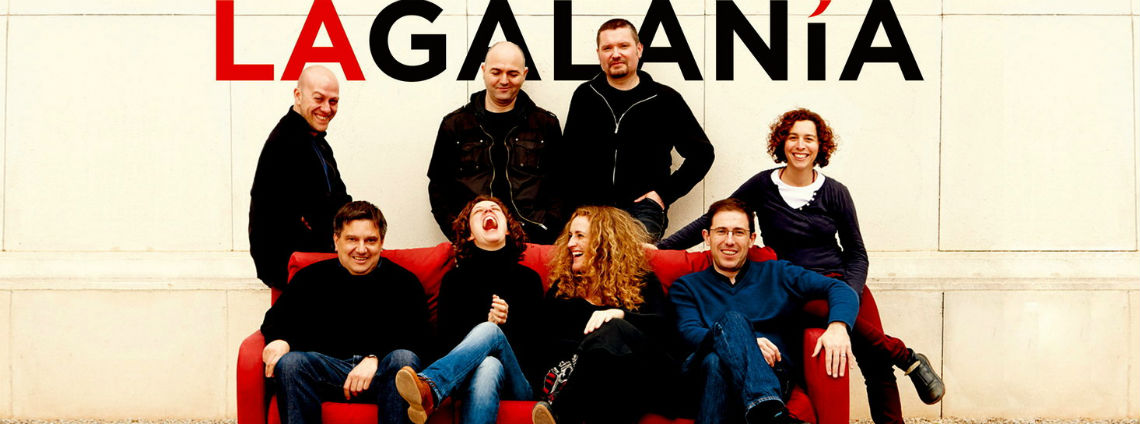
Ensemble La Galanía; Raquel Andueza


Locura & Tormenti (madness and torments) features intimate 17th century Spanish and Italian songs about love and heartbreak by composers including Monteverdi, Quevedo, Strozzi and Sanz.

Spanish soprano Raquel Andueza is one of Spain’s most respected early music vocalists, and works regularly with L’Arpeggiata, Al Ayre Español, Gli Incogniti, Orquesta Barroca de Sevilla. She is also a regular guest of conductors including William Christie, Fabio Biondi, Monica Huggett, Eduardo López-Banzo, Christina Pluhar, Richard Egarr, Ottavio Dantone and Sir Colin Davis.

Supported by Stephen and Betty Drance and Jose Verstappen

Click here for information about parking around / transiting to Christ Church Cathedral

Programme

(download texts and translations)

I
Yo soy la locura – Henry du Bailly (¿? – 1637)
Marizápalos
 – Anonymous (s. XVII)
Zarabanda del Catálogo – Text: Anónimo
 / Arrangement: Álvaro Torrente (n. 1963)
Folias – G. Sanz/improv (ca. 1640 – 1710)
Sé que me muero
 – Jean Baptiste Lully (1632-1687)
La Ausençia
 – Anonymous (s. XVII)
Vuestros ojos tienen d’amor – Anonymous (s. XVII)
Canarios
 – Francisco Gerau (1649 – 1722)
Jácara de la Trena – Text: Francisco Quevedo (1580 – 1645) / Arrangement: Álvaro Torrente (1963)

II
Folle è ben che si crede – Tarquinio Merula (1595 – 1665)
Eraclito amoroso – Barbara Strozzi (1619 – 1664)
Bella mia
 – Anonymous (siglo XVII)
Toccata arpeggiata – Giovanni G. Kapsberger (1580 – 1651)
Oblivion soave
 – Claudio Monteverdi (1567 – 1643)
Caprice de Chacone – Francesco Corbetta (1615 – 1681)
Sdegno campione audace – Virgilio Mazzocchi (1597 – 1646)
Chi vuol ch’il cor gioisca – Pietro P. Capellini (fl. 1641 – 1660)


Programme Notes

“Locura & Tormenti”, madness and torments: they usually go together when concerning love. We wanted to bring together these two visceral feelings in a program, which consist of two very different sections.

In the first part, we will perform Spanish music, but also scores with text in Castilian that have been found in 17th century French, English, and Italian collections: songs about love and disaffection, hope and abandonment.

Likewise, we bring some new music to light, created upon the harmonic and rhetorical parameters of two very famous dances of the Spanish baroque: the Zarabande and the Jácara. The Zarabande was already forbidden in 1583 because it was considered an obscene and disgraceful dance, but composers and the greatest men of letters (Cervantes, Góngora, Lope de Vega, etc) continued making use of it and the Zarabanda was hugely popular until the end of the 17th century. All the written music was lost (or destroyed), but not its texts. The Spanish musicologist Álvaro Torrente, one of the greatest specialists of the Spanish 17th century, and also expert in literature and rhetoric of that period, has reconstructed for La Galanía one zarabanda, of anonymous text, and one jácara with a text by Francisco de Quevedo. In both cases, it can be considered as a reliable and traditional sample of how these dances used to be. In this zarabanda we present a rascal who describes, without a hint of shyness, why he loves all kinds, types, and social position of women; and in the case of the jácara, our protagonist, another rogue of the period, writes a letter to his lover from a Sevillian prison, and he narrates all of his adventures and misfortunes being locked there.

In the second half of the concert, we will move to 17th century Italy, guided by the main composers of the period: Monteverdi, Strozzi, Merula. We show different styles of compositions of the Seicento: strophic songs, like “Folle è ben” and “Bella mia”, melodical constructions upon ground basses, bassi ostinati, that is to say, upon the repetition of the same harmonic pattern, as in the passacaglia “L’Eraclito amoroso” or the ciaccona in “Sdegno campione audace”. We will also bring danses of Neapolitan origin, as the tarantella, in “Chi vuol ch’il cuor gioisca”.

All these love songs alternate with Spanish and Italian traditional dances (folía, canarios and ciaccona), as well as with a wonderful toccata arpeggiata from the theorbo player and composer Giovanni Girolamo Kapsberger.

In conclusion, it is a program from that wonderful century called degli affetti, or “of affections”, to love, dream, cry, and, above all, feel. We really hope you will enjoy it as much as we do performing it on stage. Please, make yourself comfortable. Thank you very much for coming.

-Raquel Andueza
Ensemble La Galanía

Formed by Raquel Andueza and Jesús Fernández Baena in 2010, La Galanía quickly established itself as one of the most important groups of the Spanish music scene.

The ensemble is specialised in Baroque music from the 17th and 18th century. Their performances are always based on meticulous historical research and are realised together with the best Spanish and foreign musicians, busy in this sort of repertoire.

All the members of the group are also taking part in diverse other globally recognised orchestras and prestigious groups, such as Hespèrion XXI, Al Ayre Español, L’Arpeggiata, Orquesta Barroca de Sevilla, Private Musicke, and the Orchestra of the Age of the Enlightenment amongst others. The core of the group is soprano Raquel Andueza, who regularly is invited to the world’s most important auditoriums and festivals.

La Galanía made its very successful debut at Pamplona Cathedral with Pergolesi’s Stabat Mater. Henceforward the group quickly began to appear at the most prestigious auditoriums and festivals all over the world, including the National Auditorium of Music of Madrid, RheinVokal Festival in Germany, Kultur-Casino Bern, Konzerthaus Berlin, WDR Symphony Orchestra Cologne, Saint- Michel-en-Thiérache Abbey, MA Festival Bruges, Royal Palace of La Almudaina in Palma de Mallorca, Aranjuez Festival, Panama City Early Music Festival, Donostia-San Sebastián Musical Fortnight, Festival Van Mechelen, Moscow International Christmas Festival, Bogotá Sacred Music Festival, and Innsbruck Festival amongst others.

In January 2011 their first recording Yo soy la locura was published on the record label Anima e Corpo. Since its release, the album has been enjoying great success in terms of sales and reviews and it was unanimously conferred the Festclásica award by the Spanish Association of Classical Music Festivals in 2011. In July 2013 the group released Alma Mia, a compilation of the most beautiful opera arias and cantatas by Antonio Cesti, which is also receiving enthusiastic reviews and accolades from the press. In 2014 their youngest recording, Pegaso was released on Anima e Corpo. The next CD, Yo soy la locura 2, will be appear in 2015.

Further info: www.lagalania.com
read more...

Raquel Andueza

Born in Pamplona, Raquel Andueza began her music training at the age of six. Subsequently, a scholarship from the government of Navarre and the Town Hall of London enabled her to go on to train at the Guildhall School of Music and Drama in London, where she was awarded a Bachelor of Music degree with Honours and the School Singing Prize. Afterwards, she met the singing teacher, Richard Levitt, who has been her referent to date.

Raquel Andueza works regularly with a number of ensembles: L’Arpeggiata, Gli Incogniti, B’Rock, La Tempestad, Al Ayre Español, Orquesta Barroca de Sevilla, El Concierto Español, Private Musicke, Conductus Ensemble, La Real Cámara, Hippocampus, Orphénica Lyra, etc. In 2003 she became a member of the vocal quartet La Colombina. Together with the theorbo player Jesús Fernández Baena she began a duet specialised on the Italian music of the XVII century, and in 2010 she founded her own ensemble, La Galanía.

She currently sings as a soloist at the main festivals and halls in Europe (Paris, Madrid, Barcelona, Brussels, Frankfurt, Utrecht, Prague, Bucarest, Viena, Mexico, Naples, Granada, Minneapolis, Bern, London, Hong Kong, etc). In 2012 she made her New Yorker debut at Carnegie Hall and also at the Londoners Proms.

Raquel Andueza has performed with such conductors as William Christie, Fabio Biondi, Emilio Moreno, Jacques Ogg, Monica Huggett, Eduardo López-Banzo, Christina Pluhar, Richard Egarr, Ottavio Dantone, Christian Curnyn, Pablo Heras, Sir Colin Davis, José Ramón Encinar, etc.

Raquel is regularly invited to teach singing courses at the Teatro Real in Madrid and at the universities of Burgos and Alcalá de Henares.

Raquel has made recordings for the labels Virgin Classics, Glossa, K617, NB Musika, Accentus and Zig-Zag Territoires. In 2010 she created her own label, Anima e Corpo, and she released the disc ‘Yo soy la locura’ in January 2011, which obtained the award “Festclásica 2011”, given by the Spanish Association of Classical Music Festivals.

www.english.raquelandueza.com

read more...


Media

1254 W 7TH AVE
VANCOUVER, BC, V6H 1B6

(604) 732-1610
staff@earlymusic.bc.ca

  • About EMV
    • What is Early Music?
    • Staff
    • Partners
    • Board of Directors
    • Venues
  • Education & Community
    • BC Scholarship Programme – 2026/2027
    • OUR INSTRUMENT COLLECTION
  • Press Centre
  • Join Our Mailing List
Facebook URLTwitter URLYoutube URLInstagram URL

Copyright © 2026 EARLY MUSIC VANCOUVER | EMV | PHOTOS BY JESS MACALEESE, MARK MUSHET AND JAN GATES.
CONTACT EMV FOR INDIVIDUAL CREDITS. | site by DFS Digital Fusion Studios web designAND MEDIUM RARE Medium Rare Interactive

Een Romantische Johannes Passion

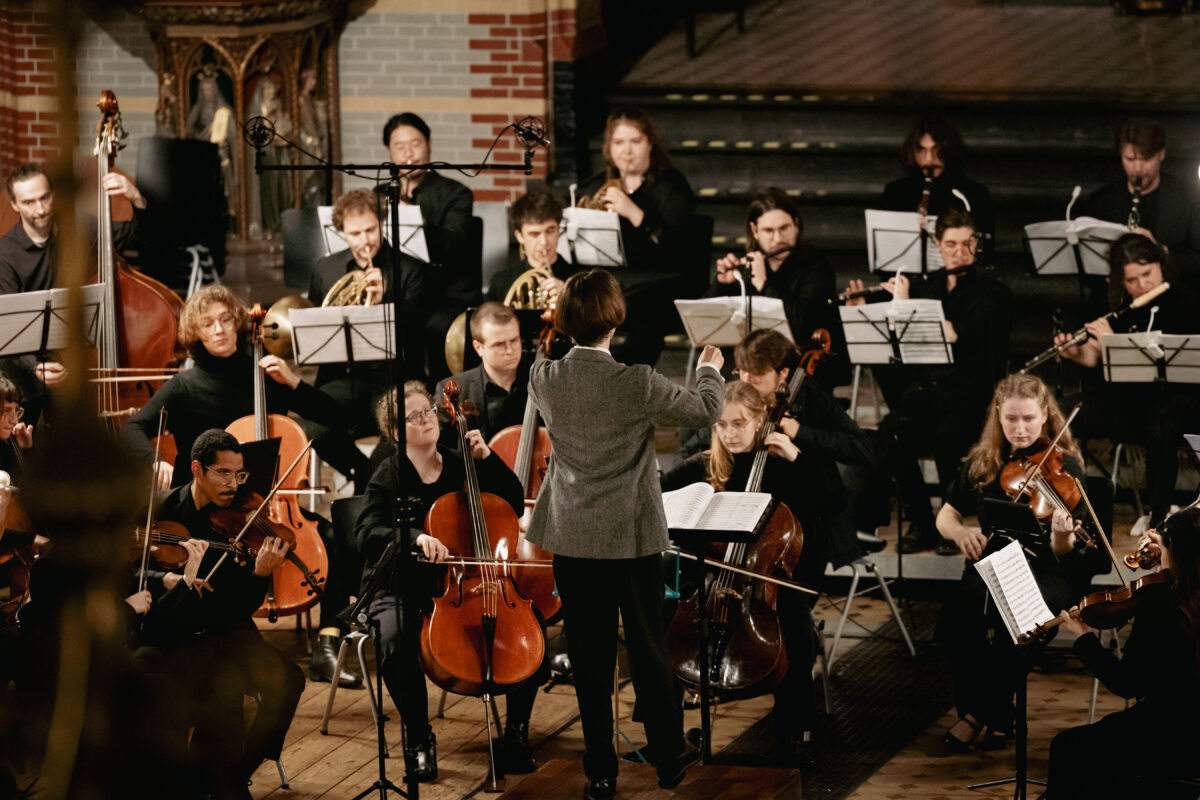
Historical Performance has been steadily looking toward the nineteenth-century as a source of inspiration, and Orchestra Lagrandt wants to lead the charge into Romantic orchestral performance practice. As an orchestra of ambitious musicians in their twenties from 25 different nations, we aspire to represent the voice of the new generation in Historical Performance.

Een Romantische Johannes Passion is an ongoing project to reimagine the Johannes Passion of J. S. Bach in a late nineteenth century style. The first Passion revivals in the Netherlands took place in Rotterdam in 1870, featuring large symphonic orchestrations, and a radically different musical language than that of the HP and modern classical worlds. In our initial performance with the Tangram Chamber Choir, we pushed the boundaries of what Romantic Bach might have sounded like: exploring changes in orchestration, stoic tempi, rubato, phrasing, nineteenth- century bowing practices, and even portamento. We plan to establish this project as an annual tradition every Easter season, reworking the arrangement each time in the spirit of Romantic spontaneity.


One of the wonderful things about the Historical Performance movement is that we are able to use forgotten practices, this time hailing from the nineteenth century, to present such a beloved and well known-work in a new light.

The world is familiar with stories of clever forgers whose life’s mission is to cunningly reproduce the light and shadows of historical masterworks, from Vermeer’s brushstrokes to Da Vinci’s proportional precision… but what if these crimes of craftsmanship were to extend beyond the visual arts? What if the pieces we know to be by Palestrina, Monteverdi or even Johann Sebastian Bach were in fact stylistic copies, artfully composed by a secret circle of music forgers and passed off as the work of the greats? What if those music forgers are at work as we speak? 

This premise inspires our original program The Music Forgery Workshop. Our early music comedy imagines the lives of such a circle of musical criminals, offering a fresh and lively presentation of historical compositions, not as museum artifacts but as living works in progress. The workshop itself is set up on the stage and its members carry forth the plot in music and words. A narrator in the role of a suspicious inspector lends the performance a theatrical flow. The listener is invited into a satire on high society’s art commerce, while the performers make fun of themselves for having devoted their lives to the niche subject of historical music performance. 

Violinist Elizabeth Sommers combines her skills and experience in traditional music with expertise in the performance and improvisation of medieval and Renaissance repertoires. Multi-instrumentalist Eliot X. Dios (keyboards, bagpipes and flutes) works wholeheartedly to employ storytelling techniques developed through the history of literature and cinema in his early music concerts. Composer Gunnar Haraldsson (violin, guitar) seeks to translate the forms and intentions of early composition for a modern audience. Halldór B. Arnarson (keyboards, voice) has devoted his career to bringing musical craftsmanship from the era of counterpoint to the attention of the public and comedy to the early music scene. Singer and storyteller Ásta S. Arnardóttir brings the storyline to the public with personal immediacy, and through her character work defines the different veins of the show, sometimes hilarious and sometimes serious. 

The story is narrated by the character of the Inspector, acted out by the members of the MFW, and told in rhyming Icelandic verse in one musical pillar of the show, a madrigal composed by our very own 

Halldór in the style of Monteverdi. The show has an entertaining educational dimension. The audience is exposed to a broad sweep of historical and musical information in a condensed form, necessary to understand the musical humour, while dramatic rhythm and scenographic effects prevent overwhelm. We also place particular emphasis on theatrical illusion and synchronisation. One example appears in the opening scene, in which the inspector is seen watching television. On stage, this becomes a complex exercise in coordination: each time the inspector presses a button on the remote control, the musicians instantly switch pieces, creating the impression of rapidly changing television channels. 

This opening scene establishes the tone of the entire show, comical and satirical in its storytelling and diverse in its musical language. It not only introduces the wide range of musical styles that appear throughout the performance, but also functions as the plot’s inciting incident, as the inspector hears a news report about the discovery of a previously unknown concerto by Vivaldi. 

Another important scene takes place when one forger is alone on stage in low light, perusing books on medieval music, while the musicians perform and sing offstage, sounding his audiation as he reads. This intimate moment evokes the sleepless nights spent studying facsimiles and learning historical compositional techniques, by which the forger acquires the inspiration and the expertise necessary to his art, and reveals a hidden side of musical performance: the immense amount of study and preparation that precedes the moment on stage. This setting also creates space for visual and musical comedy, as seen in the trailer video, where a 14th-century melody is played backwards because Halldór is unknowingly reading the facsimile upside-down, only realising the mistake when the music begins to sound absurd. 

Fun and friendship are at the heart of the whole project, though the link between music and crime is an important historical consideration. Classical music was often used as the demonstration of a monarch’s power, music teaching as a cover up for secret affairs, and pieces were published under another’s name for profit. Such examples of “inappropriate practices” carry an exciting and attractive element for the audience which the MFW seeks to exploit. Under this light-hearted surface lies a more serious layer of questions concerning our present-day existence, such as excessive materialism in high society and the threat posed on human craftsmanship and skill by the rise of artificial intelligence. 

Please Note:

The main applicant and creative/intellectual driver of the project must be 30 or under (on May 15th).

The average age of all musicians must not be older than 32, and the maximum age of supporting musicians must be no more than 35 (on May 15th.)