
Christ Church Cathedral | Map
The keyboard music of the early Romantics such as Chopin and Schumann – and even of still later composers – was written for pianos substantially different from the ubiquitous modern Steinway. This two-concert collaboration with Vancouver’s Chopin Society is an exploration of how the use of period instruments can have a dramatic effect on an artist’s interpretive choices. Award-winning Polish pianist, Janusz Olejniczak, will play two recitals with different programmes. In each concert, he will play the first half on a 19th-century fortepiano and the second half on a modern Steinway.
Olejniczak has recorded best-selling soundtracks for two famous movies: Roman Polański’s The Pianist and Andrej Żuławski’s La Note Bleue, even acting in the latter as Frederic Chopin. He is also an avid chamber musician as well as concerto soloist, and has collaborated with, among others, the Orchestra of the 18th Century under the late Frans Brüggen. Chopin’s music fascinates Janusz Olejniczak with what he describes as its ethereal, elusive character: “It’s like a bird of paradise, which keeps slipping through your hands. Only occasionally do you succeed in grasping its essence, in getting close to it. It offers limitless possibilities for interpretation, …So I continually have to try again.”
Supported by Chris Guzy & Mari Csemi


Click here for information about parking around / transiting to Christ Church Cathedral
Programme
Friday:
Nocturne in C-sharp minor, Op. Posth
(performed on both the Broadwood and the Steinway)
BROADWOOD:
Four Mazurkas Two Waltzes
Polonaise in A major, Op.40
STEINWAY:
Nocturne in C minor, Op. 48 Ballade No. 1 in G minor, Op. 23 Mazurka
Scherzo No. 2 in B-flat minor, Op. 31 Mazurka
Polonaise in A-flat major Op. 53
Saturday:
Nocturne in C-sharp minor, Op. Posth
(performed on both the Broadwood and the Steinway)
BROADWOOD:
Six Mazurkas Waltz
Two Preludes Polonaise in A major, Op.40
STEINWAY:
Nocturne No. 19 in E minor, Op. 72 Scherzo No. 2 in B-flat minor, Op. 31 Mazurka
Ballade No. 1 in G minor, Op. 23 Polonaise in A-flat major Op. 53
Programme Notes
On 16 February 1848, Chopin gave what was to be his last concert in the Salle Pleyel where he had made his Paris debut sixteen years earlier. The audience of 300 heard a programme that began with a Mozart piano trio followed by a nocturne, the Barcarolle, etudes and the Berceuse in the first half; the second half began with his new cello sonata and ended with preludes, mazurkas, and waltzes. The instrument was a Pleyel grand, Chopin’s favourite make since his arrival in the city in 1831 at the age of twenty-one.
Camille Pleyel was Chopin’s loyal friend and supporter as well as a provider of instruments. In the summer of 1837 the pair made a visit to London with Chopin incognito. At James Shudi Broadwood’s house, the composer was introduced as “Mr. Fritz”, but his playing after dinner gave his identity away. (The association between Broadwood in London and Pleyel in Paris was occasioned by the threat of Érard who had factories in both cities.)
Chopin had grown up with Viennese pianos in Warsaw. For his 1829 debut in Vienna, he selected an instrument by Graf. In Paris, there was a clear division between the concert instrument and the salon instrument. The word was: “Érard – Liszt, Pleyel – Chopin”.
Chopin was oft-quoted as saying: “When I feel out of sorts, I play on an Érard piano, where I easily find a ready-made tone. But when I feel in good form and strong enough to find my own individual sound, then I need a Pleyel piano.” Liszt himself acknowledged that Chopin cherished Pleyels for their “silvery and slightly veiled sonority and their lightness of touch.” Érard provided Liszt with the power he needed in a city of virtuosos.
Aside from the 1837 London visit, Broadwood pianos do not figure in Chopin’s life until 1848 when he spent seven months in England and Scotland from 20 April to 23 November. Chopin’s decision to go to London was occasioned by the Paris Uprising on 22 February, only one of the revolutions that were to engulf Europe in that year. The Polish Springtime of Nations and its aftermath were also to be a constant preoccupation. The political situation affected his economic situation. Giving lessons in Paris was his main source of income and this was to dry up in the climate of fear that engulfed the city.
Chopin went to London with the intention of giving concerts in public and private settings, as well as teaching. From Paris, Pleyel sent the grand piano that Chopin had used for his February concert. Érard likewise provided a grand for Chopin’s drawing room. From the Broadwood factory, Chopin selected a grand piano for his public concerts and another for his lodgings.
John Fowler Broadwood, grandson of the company founder, provided such generous and constant support to Chopin that the composer called him “a real Pleyel”. The majority of Chopin’s London concerts and one in Manchester on 29 August featured a Broadwood concert grand, now on permanent loan to the Cobbe Collection in England. Broadwood put Chopin in touch with music publishers, and even secretly provided the composer with a new spring mattress when he complained of not sleeping well.
When the London season was over and Chopin made the twelve- hour train journey to Edinburgh on 5 August, Broadwood paid for two tickets for the composer (the second being for his legs) as well as another for his new Irish manservant, Daniel, who would stay with Chopin until his death. At Calder House, near Edinburgh, Chopin’s loyal and over-helpful Scottish friend and Paris pupil, Jane Stirling, along with her married sister, Catherine Erskine, kept the composer socially occupied. Stirling made her Pleyel grand available to Chopin in her drawing room, and he found a Broadwood in his own rooms. When he returned to Edinburgh after his Manchester concert on 29 August, he stayed with the Polish- born doctor, Lyszczynski, whose wife recalled Chopin playing on an old Broadwood square piano of her childhood “with evident pleasure”. For his Glasgow concert on 4 October, Broadwood again sent a grand from London.
In the end, neither the English nor Scottish climate proved beneficial to the composer’s health or his spirit. On 31 October Chopin returned to London and played in public only once more— in a side room at a Grand Polish Ball and Concert on 16 November. When he wrote to his close friend Grzymala to set up a Paris apartment again, he requested a Pleyel. Ultimately it was only on a Pleyel that Chopin could realize his unique pianist gift.
In 1849, John Fowler Broadwood was working on a piano to send to Chopin—the first of his full iron frame grands. But its arrival was precluded by the thirty-nine-year-old composer’s death on 17 October—less than a year after his return from England.
The period instrument being used in tonight’s performance is no. 989 in a series of Boudoir Grand Pianos manufactured by Broadwood in London between 1835 and 1890. It is a rare find. The piano shows remarkably little wear and is as close to its original condition as one might hope for after one hundred and sixty-six years.
This Broadwood was a family instrument, brought by its English owners to British Columbia in the 1950s, and seemingly unplayed during its history. Marinus van Prattenburg of Abbotsford restored the piano in the spring of 2017. All of the parts are original except for the strings which have been replaced by Röslau steel wire, using the original gauges.
The oak case is 7’1” in length, and 4’2” in width. The veneer is of Bookmatch Brazilian Rosewood. The bottom of case is open, but covered with loose-woven burlap. As is characteristic of this model of Broadwood, the lid has only a short stick. An iron composite frame with two tension bars stabilizes the case.
The keyboard has a range of six and three-quarter octaves, from CC to a4. The 82 keys are made of ebony and ivory. The soundboard grain runs across the strings (parallel to keyboard). The instrument is straight strung, with single stringing in the bass from CC to FF, double stringing in the next octave up to F, and triple stringing for the remainder of the instrument up to a4. The original tuning pins are oblong (not square as on the modern piano), and required the making of a special-fitting tuning hammer of the period. The tuning sits at A 430 Hz, slightly under modern pitch.
The Broadwood action is simple (without Érard’s double escapement), but still allows for unusually good key repetition. The original hammers, felts, and dampers were restored to playing condition and did not need to be replaced. There are two wooden pedals, damper and una corda. (In contrast to Viennese and other makes, these two pedals were standard on English grands throughout their history.) The fact that the wood on the sustaining pedal is hardly worn is a good indication that the 1852 instrument was hardly played.
Because the hammer strikes a partial, and the damper is on a node, in pianos up until the later nineteenth century, there is always a shimmer of overtone (in contrast to the dry cut-out of sound on modern instruments where larger dampers cover both the partial and the node). The soundboard is flat, not crowned as on modern piano.
The result of the restoration is an instrument with a true Broadwood harmonic sound spectrum. Later Broadwood
pianos, such as Early Music Vancouver’s recently-restored 1870 Broadwood Drawing Room Grand, are more powerful, with bigger hammers and dampers, higher string tension, heavier string gauges, and heavier frames.
+ + +
NOTE: The above description is based on information provided by Marinus van Prattenburg who regards Broadwood piano makers as not just craftsmen but as artists (using comparatively primitive tools). In a career spanning more than fifty years, Marinus has restored numerous Broadwoods, both squares and grands, the earliest a 1784 square piano. Square pianos, both British and American, have been a special passion of his. Aside from Broadwoods, he has restored several Érard grands, and occasionally Pleyel and Gaveau instruments.
When asked to choose among period pianos he has restored, Marinus says he treasures Érard for its clarity and sweetness of sound. (“I never came across a bad-sounding Érard.”) For construction technology, he cites Broadwood. (“Their joinery of wood framing, etc., is unbelievably fine. This is why so many survived so well.”) For the modern piano his choices are Steinway and Bechstein.
When asked for a comparison of the treble on instruments associated with Chopin, Marinus commented on the Pleyel with its beautiful clarity in the upper strings, “sweet, like silver bells”. For him, Érard has similar clarity. The Broadwood treble is “less sustaining, drier, but still pretty”.
The 1852 Broadwood was his final restoration. Now that he has retired, his final project is for himself—a new Viennese fortepiano, ca. 1800, of his own design, which he plans to finish by late spring of 2018.
Marinus is also a published author whose books include Mr. Sebastian: the life story of a mid-nineteenth century grand piano.
Notes by John Glofcheskie (2018)
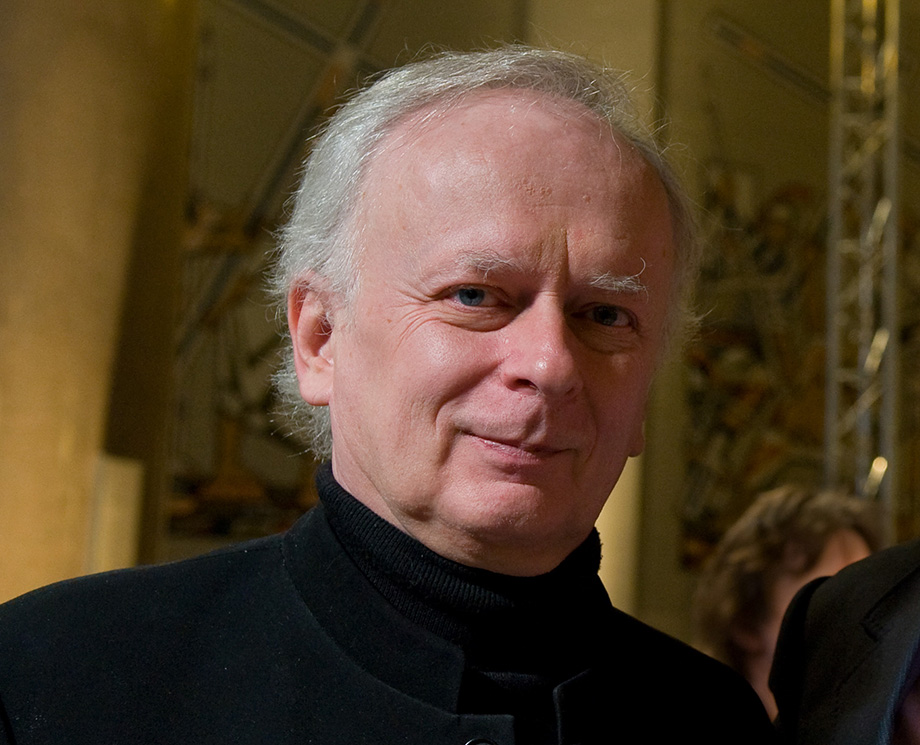
Janusz Olejniczak
Born in Wrocław, he studied in Warsaw and Łódź with Luiza Walewska, Ryszard Bakst and Zbigniew Drzewiecki, as well as in Paris and Switzerland with Witold Małcużyński. He graduated from the High School of Music in Warsaw in 1974 in the class of Barbara Hesse-Bukowska, and continued his studies with Victor Merzhanov in Warsaw and Paul Badura-Skoda in Essen (1977-78). He was the youngest award winner at the 8th International Fryderyk Chopin Piano Competition in 1970, and award winner at the International Alfredo Casella Competition in Naples.
Janusz Olejniczak performs in the leading concerts halls in Europe, the Americas, Asia and Australia, including the Berlin Philharmonic, Teatro Colón in Buenos Aires, Salle Pleyel in Paris, Tokyo’s Suntory Hall, Washington’s Lincoln Center, Tonhalle in Düsseldorf, Concertgebouw in Amsterdam. For four years he has taught at the Music Academy in Cracow. He has also sat on numerous piano competitions juries and given masterclasses in Canada, Japan, Colombia, and at the Mozart Academy in Salzburg.
His repertoire centers on the works of Chopin, Bach, Schubert, Schumann and Liszt. His interpretations of twentieth-century works have also been acclaimed, including Debussy, Ravel (Concerto in G), Prokofiev, Messiaen, Henryk Mikołaj Górecki, Wojciech Kilar, and Witold Lutosławski. He is an avid chamber musician, and has appeared with orchestras conducted by Witold Rowicki, Andrzej Markowski, Kazimierz Kord, Antoni Wit, Jerzy Maksymiuk, Tadeusz Strugała, Charles Dutoit, Andrzej Borejko, Grzegorz Nowak, Jacek Kaspszyk, Marek Pijarowski, Marek Moś and others. In recent years he has also given concerts and recorded on historical instruments (Érard and Pleyel), often collaborating with the Orchestra of the 18th Century of Frans Brüggen. At the Chopin and His Europe Festival in Warsaw, he appeared with the Orchestre des Champs-Élysées under the direction of Philippe Herreweghe.
Apart from an extensive Chopin repertoire (for Polskie Nagrania, Tonpress, Muza, Wifon, Opus 111, Camerata, Sony Classical, Selene, CD Accord, Bearton), Janusz Olejniczak has also recorded works by Rameau, Mozart, Schubert, Prokofiev, Kilar, Górecki and Lutosławski. In recognition of his outstanding musical achievements he has received eight Fryderyk Awards of the Polish recording industry, as well as the Officer’s Cross of the Polonia Restituta (2000) and the Gloria Artis Gold Medal (2005).
Janusz Olejniczak has also recorded best-selling soundtracks for two famous movies: Roman Polański’s The Pianist and Andrzej Żuławski’s La note bleue, additionally appearing in the latter as an actor playing role of Frederick Chopin.