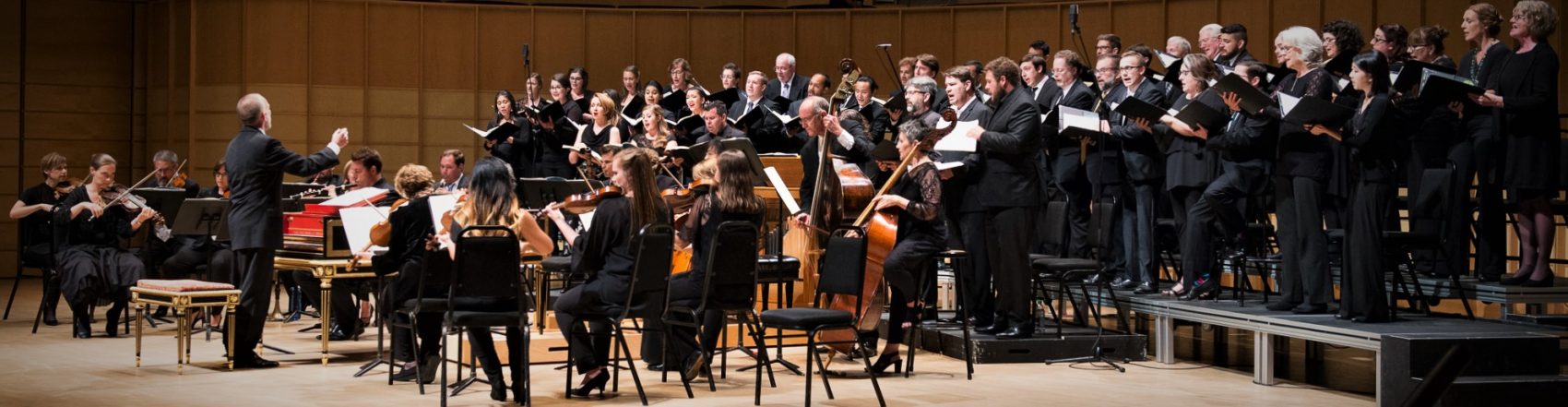
Chan Shun Concert Hall at the Chan Centre for the Performing Arts | Map
Pacific Baroque Orchestra; Alexander Weimann | Sponsored by Bruce Munro Wright, O.B.C., music director; Vancouver Cantata Singers; Paula Kremer, VCS artistic director; Danielle Reutter-Harrah, soprano; Vicki St. Pierre, mezzo soprano; Sumner Thompson, bass-baritone; Ross Hauck, tenor
Handel’s monumental Coronation Anthems, composed in 1727 for the coronation of King George II and Queen Caroline of England, bring an exciting, regal note to end the Pacific Baroque Orchestra’s season with a performance at the Chan Centre. The programme will be complemented by Handel’s festive Ode for the Birthday of Queen Anne (upon which she granted Handel a “pension” of two hundred pounds a year for life).
To view/download this programme, click here.
This concert is generously supported by Helen & Frank Elfert and the Mary & Gordon Christopher Foundation
Programme
G.F. Handel – Coronation Anthems
Zadok the Priest
Let thy hand be strengthened
The King shall rejoice
My heart is inditing
G.F. Handel – Ode for the Birthday of Queen Anne
Programme Notes
- Evan Kreider[1]
During his successful three-year tour through Italy’s musical capitals, the gifted young Georg Friederick Händel (1685-1759) carefully studied their leading opera houses, conductors, instrumentalists, singers, libretti, and orchestral and vocal writing. He was intent on learning everything he could about the art and business of opera. Since he received acclaim for his own compositions and performances, travelling virtuosi and well-placed individuals began suggesting that someday he should also try his luck in England. Although most Italians tended to disdain London as a cultural backwater, some people noted its growing affluence and opportunities. While seriously pondering an extended visit to England, the young entrepreneur wisely found a way to hedge his bets in case London was not as hospitable as desired. On June 6, 1710, Händel accepted the position of Kapellmeister in Hanover at the court of George, Elector of Hanover (who would later become King George I of England). However, Händel (the inveterate free-lancer) insisted upon the unusual stipulation that he be allowed to visit London first. We think that he must have arrived in London by November of 1710. Thanks to the wealth flowing into the Kingdom’s capital from its far-flung colonies, the metropolis had been largely rebuilt after the Great Fire of 1666.
Händel arrived in England during the reign of the beloved Queen Anne (1702-1714), known for her patronage of the arts and her love of the theatre. Her growing kingdom was rapidly becoming an even greater world power thanks to its colonies, navy, and commerce. Händel discovered that the stories he had heard were indeed true, that people were eager to experience music in the Italian style, and that money was available to satisfy that craving. For the next five decades, the composer would be trying to please the capricious tastes and whims of stodgy aristocrats (so wonderfully described in retrospect by Dickens) and the energized merchant class which thrived on competition and taking risks. Händel’s entrée into the London scene was his opera Rinaldo (first performed on February 24, 1711, the day after his 26th birthday). Its success surprised everyone, including the composer. He then added an opera a year, all the while ignoring orders to return to his new position at the court of George, Elector of Hanover.
Upon the death of Queen Anne in 1714, preparations were made for Händel’s disgruntled employer in Hanover to become King George I of England. Relations between the two men were to remain cool for the next three years. A reconciliation between the King and his court’s favourite composer was finally achieved when Händel wrote his Water Music, which delighted George I so thoroughly that he insisted it be repeated two more evenings, complete with torch-lit boats filled with instrumentalists. Finally, in 1726, George I decreed that Georg Friedrich Händel be granted English citizenship and be appointed “Composer of Musick for the Chapel Royal”. Thereafter, the composer anglicized his name, calling himself George Frideric Handel.
The Coronation Anthems (October 11, 1727)
While travelling in Germany during yet another return visit, King George I had a massive heart attack on June 9, 1727 and died two days later. When his son, the Prince of Wales, who was to become George II, refused to go to Germany to attend his estranged father’s funeral, many in England were pleased, thinking that this confirmed his preference for England over Germany. Handel was commissioned to provide a set of four anthems for George II’s lavish coronation at Westminster Abbey. One wonders whether eye witnesses possibly exaggerated when reporting that the choir of more than 40 singers was accompanied by an orchestra of 160. Whatever the forces, the music’s effect was electrifying. Five years later, advertisements for Esther assured readers that “The Musick to be disposed after the Manner of the Coronation Service.” The music of these anthems was in tune with the nation’s political-patriotic-religious fervour, for their new King was God’s appointed ruler of the United Kingdom and Ireland, and the protector of the Church of England.
I. Zadok the Priest (HWV 258)
The first anthem was performed immediately after the Anointing of George II. The text describes the anointing of Solomon as King David’s successor and has been included in every English coronation ceremony since that designed by St. Dunstan for King Edgar (Ēadgār) the Peaceful at Bath in about 973. Handel’s setting of this text has likewise been included for every coronation since that for King George II in 1727. Soccer fans will recognize this as the source for the UEFA Champions League anthem.
Zadok the Priest, and Nathan the Prophet anointed Solomon King.
And all the people rejoiced, and said:
God save the King! Long live the King!
May the King live for ever,
Amen, Alleluia.
Based on a translation of the Antiphon for the 7th Sunday after Pentecost,
Unxerunt Salomonem Sadoc sacerdos, which is built on 1 Kings 1:38-40
II. Let Thy Hand Be Strengthened (HWV 259)
The second anthem was performed during the ceremony at the Recognition of George II. The use of this text in English coronations can also be traced back to the service designed by St. Dunstan for King Edgar (c. 973).
Let thy hand be strengthen’d,
Let thy right hand be exalted.
Let justice and judgment be the preparation of thy seat!
Let mercy and truth go before thy face!
Alleluia!
Based on Psalm 89:13-14
III. The King Shall Rejoice (HWV 260)
This anthem was performed at the Crowning of George II, though traditionally it would have been at the Recognition. Hearing the choir’s occasional loud bursts of brief phrases followed by rests, Charles Burney wrote of the anthem as being in the composer’s “big bow-wow” ceremonial style.
The King shall rejoice in Thy strength, O Lord!
Exceeding glad shall he be of Thy salvation.
Glory and great worship hast Thou laid upon him.
Thou hast prevented him with the blessings of goodness,
And hast set a crown of pure gold upon his head.
Alleluia.
Psalm 21:1, 5b, 3
IV. My Heart is Inditing (HWV 261)
The compilation of texts in the final anthem was first used by Henry Purcell for the coronation of King James II in 1685 (the year of Handel’s birth). Handel’s musicians performed this anthem after the Coronation of Queen Caroline, Princess of Wales and wife of George II. Orphaned when still young, she was raised at the Prussian court, where her education was as Protestant as it was thorough. Her intellect clearly overshadowed that of her husband, who repeatedly turned to her for political advice. He adored her to the end, declaring at her deathbed that he would never remarry—only have mistresses. Her reply? “Ah, mon Dieu, cela n’empêche pas!” (“My God, that doesn’t prevent it!”)
My heart in inditing of a good matter:
I speak of the things which I have made unto the King.
Kings’ daughters were among thy honourable women.
Upon thy right hand did stand the Queen in vesture of gold.
And the King shall have pleasure in thy beauty.
Kings shall be thy nursing fathers
And queens thy nursing mothers.
Psalm 45:1, 10, 12a and Isaiah 49:23a
Eternal Source of Light Divine (HWV 74)
Birthday Ode for Queen Anne (February 6, 1713)
And now, dear Reader, we go back in time by about 14 years. We remember that Händel had moved to England in 1710 and conducted his opera Rinaldo in 1711. Less than two years later, he started receiving commissions to provide ceremonial music for Queen Anne’s court. The crucial series of treaties being conducted by Anne’s Tory ministers (1712-14) became known collectively as The Peace of Utrecht. Among other things, these treaties ended the War of the Spanish Succession and assured that Louis XIV of France would not interfere with the eventual Hanoverian succession to England’s throne. Handel was commissioned to write his glorious Utrecht Te Deum (January 14, 1713) to celebrate this peace. Three weeks later, he provided a delightful ode celebrating Queen Anne’s birthday (Monday, February 6, 1713). With the new peace treaty on everyone’s mind, the libretto by Ambrose Philips (1674-1749) repeatedly hails Queen Anne as the one “who fix’d a lasting peace on earth.” The Queen was so pleased with these celebratory compositions that she granted Handel—technically still on leave from the Court at Hanover—an annual pension of £200, an income which placed him in the upper 3% of England’s families.[2] Six months later, the Queen’s death and lack of an heir (in spite of 17 pregnancies) meant that George, Elector of Hanover and Handel’s employer, became King George I, thanks to the Peace of Utrecht.
Eternal Source of Light Divine is a secular cantata which features the composer’s Italianate orchestral sonorities and operatic displays so enjoyed by London’s audiences. We still admire the way the soloist draws out the cantata’s very first word, “Eternal”, and how it is so wonderfully answered by the trumpet. But Handel had also been studying works by Purcell and contemporaries, so there are many musical allusions to the ode’s pastoral motives (e.g., the soft fluttering of “the winged race”, “rolling streams”). . The fifth stanza refers to “Kind health” descending, a covert prayer on behalf of the Queen, who was no longer able to walk. Though not literally ‘conducted by angels’, she was either carried or wheeled by servants wherever she went. The sixth stanza asks that political differences be set aside for just one day—the persistent bickering between the Whigs and Tories was the bane of the monarch’s life. Birthday songs for monarchs are seldom admired for their literary value, but they are designed to be innocently enjoyed by all (somewhat in contrast to the fawning now required by the White House). There is not a sad word or darkened brow in sight. Instead, there is a charming sense of the Queen somehow being connected to a peaceful pastoral past. Each of the ode’s seven stanzas concludes with the ensemble’s brief jubilant refrain acclaiming the monarch by name and citing her most recent diplomatic achievement—true international peace.
I.
Eternal Source of light divine!
With double warmth thy beams display,
And with distinguish’d glory shine,
To add a lustre to this day.
The day that gave great Anna birth
Who fix’d a lasting peace on earth.
II.
Let all the winged race with joy
Their wonted homage sweetly pay,
Whilst tow’ring in the azure sky,
They celebrate this happy day.
The day that gave great Anna birth,
Who fix’d a lasting peace on earth.
III.
Let flocks and herds their fear forget,
Lions and wolves refuse their prey,
And all in friendly consort meet,
Made glad by this propitious day.
The day that gave great Anna birth,
Who fix’d a lasting peace on earth.
IV.
Let rolling streams their gladness show,
With gentle murmurs whilst they play,
And in their wild meanders flow,
Rejoicing in this blessed day.
The day that gave great Anna birth,
Who fix’d a lasting peace on earth.
V.
Kind health descends on downy wings,
Angels conduct her on the way.
To’our glorious Queen new life she brings,
And swells our joys upon this day.
The day that gave great Anna birth,
Who fix’d a lasting peace on earth.
VI.
Let envy then conceal her head,
And blasted faction glide away.
No more her hissing tongues we’ll dread,
Secure in this auspicious day.
The day that gave great Anna birth,
Who fix’d a lasting peace on earth.
VII.
United nations hall combine,
To distant climes the sound convey
That Anna’s actions are divine,
And this the most important day!
The day that gave great Anna birth,
Who fix’d a lasting peace on earth.
Ambrose Philips (1674-1749)
[1] Professor Emeritus, Musicology, UBC and member of the Vancouver Cantata Singers.
[2] Robert D. Hume, “The Value of Money in Eighteenth-Century England: Incomes, Prices, Buying Power—and Some Problems in Cultural Economics,” in: Huntington Library Quarterly, Vol. 77, No. 4 (2015), pp. 373ff.

Pacific Baroque Orchestra
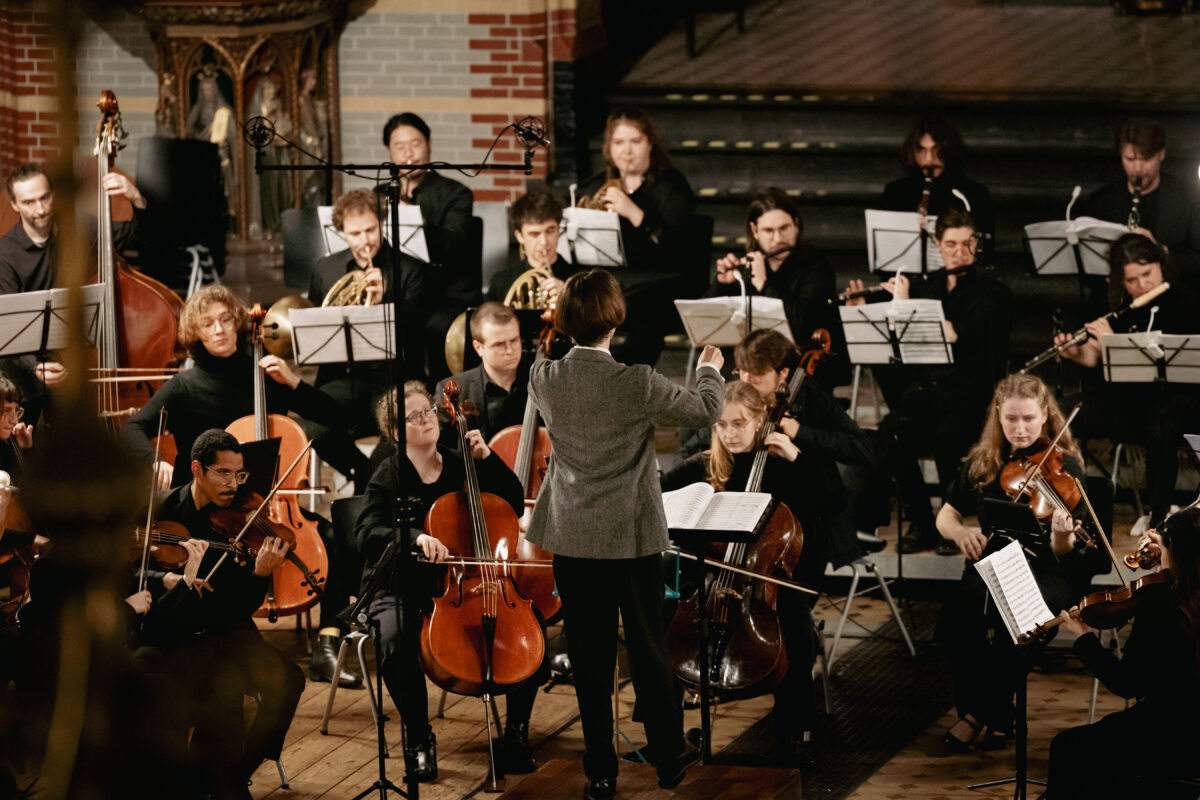
The ‘house band’ of Early Music Vancouver, The Pacific Baroque Orchestra (PBO) is recognized as one of Canada’s most exciting and innovative ensembles performing “early music for modern ears.” Formed in 1990, the orchestra quickly established itself as a force in Vancouver’s burgeoning music scene with the ongoing support of Early Music Vancouver. In 2009, PBO welcomed Alexander Weimann as Director. His imaginative programming, creativity and engaging musicianship have carved out a unique and vital place in the cultural landscape of Vancouver.
PBO regularly joins forces with internationally-celebrated Canadian guest artists, providing performance opportunities for Canadian musicians while exposing West Coast audiences to a spectacular variety of talent. The Orchestra has also toured throughout BC, the northern United States, and across Canada. Their 2019 East Coast Canadian tour with Canadian soprano Karina Gauvin culminated in a critically acclaimed album, Nuit Blanches, released by Atma Classique.

Alexander Weimann | Sponsored by Bruce Munro Wright, O.B.C., music director
The internationally renowned keyboard artist Alexander Weimann has spent his life enveloped by the therapeutic power and beauty of making music. Alex grew up in Munich. At age three he became fascinated by the intense magic of the church organ. He started piano at six, formal organ lessons at 12 and harpsichord at university (along with theatre theory, medieval Latin and jazz piano.) He is in huge demand as a director, soloist and chamber player, traveling the world with leading North American and European ensembles. He is Artistic Director of the Pacific Baroque Orchestra in Vancouver and teaches at the University of British Columbia where he directs the Baroque Orchestra Mentorship Programme.
Alex has appeared on more than 100 recordings, including the Juno-award-winning album “Prima Donna” with Karina Gauvin and Arion Baroque orchestra. His latest album series “The Art of Improvisation” (Volume 1: A Prayer for Peace; Volume 2: Ad libitum; and Volume 3: Canavian Variations, released on Redshift, 2024) unites his passions for both baroque music and improvisation on organ, harpsichord, and piano.
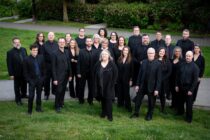
Vancouver Cantata Singers
The Vancouver Cantata Singers (VCS) is one of Canada’s preeminent, award-winning choral ensembles. Known for its exceptional artistry, technical virtuosity and exquisite tonal blend, the choir maintains the highest standards of performance in repertoire encompassing 500 years. VCS have been awarded the Canada Council’s top prize in choral singing, the Healey Willan Grand Prize, more than any other choir in the country. Led by Paula Kremer since 2013, VCS also commissions new works from critically acclaimed composers which have led to extremely successful and innovative collaborations with regional and international artists and ensembles.
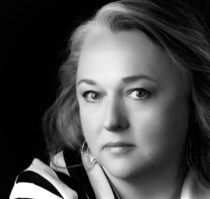
Paula Kremer, VCS artistic director
Born in Vancouver and educated at the University of British Columbia and the Vancouver Academy of Music, Paula Kremer has studied choral conducting at Eton College, Westminster Choir College, the Eastman School of Music and the University of Michigan. An accomplished vocalist and pianist, Paula studied voice with Phyllis Mailing, Bruce Pullan, Marisa Gaetanne and Laura Pudwell and piano with Margot Ehling. As permanent faculty member of the School of Music at Vancouver Community College, Paula teaches choral techniques, voice and solfege. She was previously the Director of Vancouver Bach Choir ensembles for young adults, the Vancouver Bach Youth Choir and Sarabande Chamber Choir. Paula joined the alto section of our choir in 1994 and has been the Artistic Director of the Vancouver Cantata Singers since 2013.
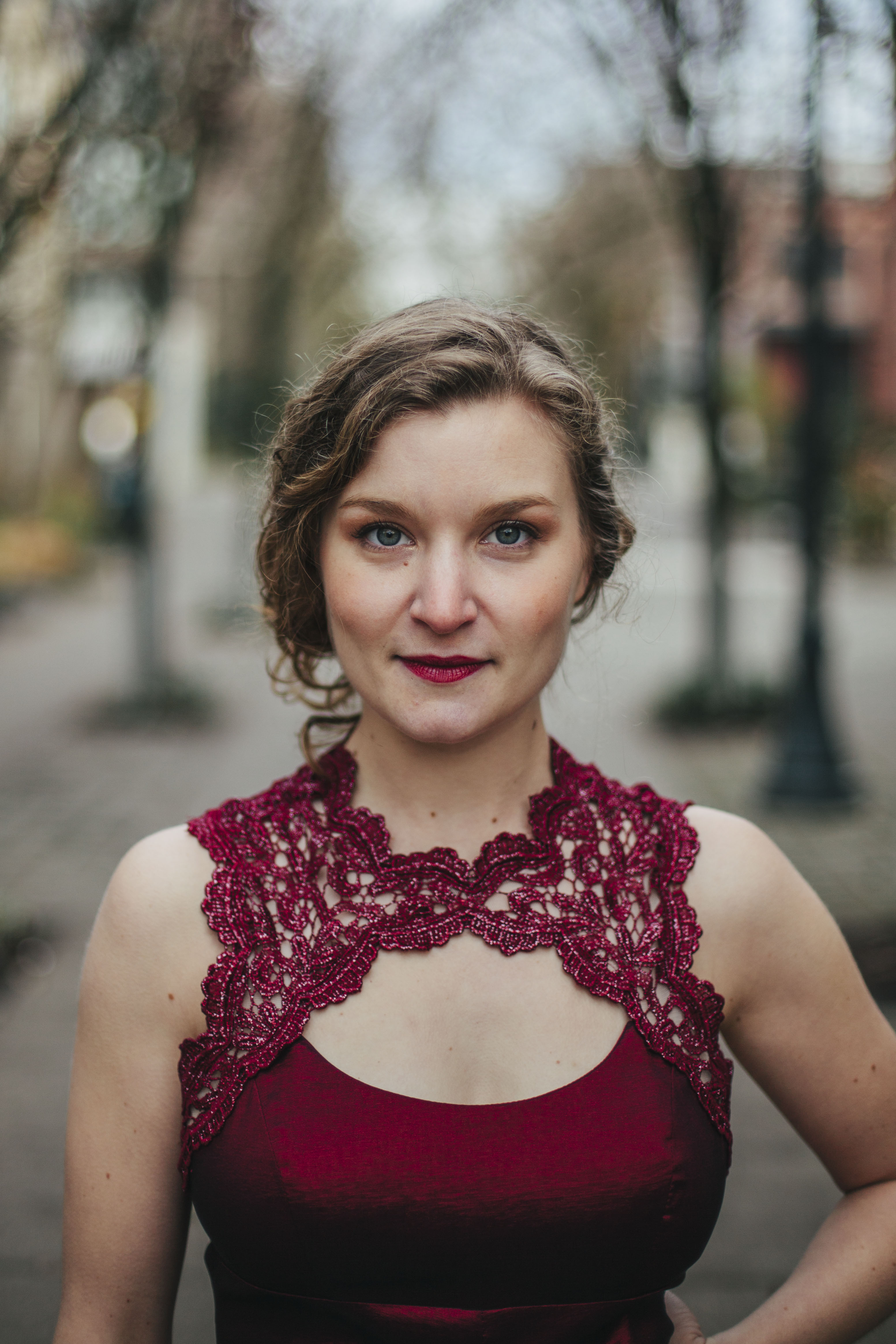
Danielle Reutter-Harrah, soprano
Danielle Reutter-Harrah has performed at the Boston Early Music Festival, with Seattle Symphony Orchestra, Seattle Opera, California Bach Society, American Bach Soloists, Baroque Chamber Orchestra of Colorado, Alabama Symphony, and Early Music Vancouver, among others. She most recently sang the role of Belinda in Baroque Chamber Orchestra of Colorado’s semi-staged rendition of Purcell’s Dido and Aeneas. In fall 2019 she performed with Pacific MusicWorks, the Byrd Ensemble and Early Music Vancouver. The 2018/19 season involved concerts of music by Brahms, Bach, Monteverdi, Handel, Clara Schumann and Fanny Mendelssohn, and others. Reutter-Harrah is a founding member of the voice and plucked strings duo Jarring Sounds, with Adam Cockerham on guitar, theorbo, Baroque guitar and lute. She sings frequently with Seattle’s Byrd Ensemble and Pacific MusicWorks. Danielle received her Bachelor’s of Music degree from the University of Denver’s Lamont School of Music and her Master of Music degree from the San Francisco Conservatory of Music. She lives in Seattle with her husband and son.
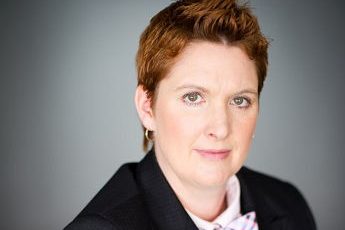
Vicki St. Pierre, mezzo soprano
Contralto Vicki St. Pierre’s voice “invitingly combines clarity of expression and beauty of tone,” and is described as “rich with both a darkness and brightness.” As a specialist in early music, she has performed internationally with such groups as the Academy of Ancient Music, Tafelmusik, Les Violons du Roy, Portland Baroque Orchestra, Sacabuche, and the Pacific Baroque Orchestra. She has also performed with Symphony Nova Scotia, the Edmonton Symphony Orchestra, the Calgary Philharmonic Orchestra, and the Victoria Symphony Orchestra. She has appeared on the operatic stage with Opera Atelier, Ensemble Masques de Montreal, Toronto Masque Theatre, and Early Music Vancouver, among others. She has directed choirs across Canada and in the UK, and has been an assistant conductor with Opera Atelier. Vicki has a doctorate in vocal performance from the University of Toronto, and has been a faculty member at Mount Allison University in Sackville, NB since
2015. In 2020, Dr. St. Pierre was appointed Interim Dean of Arts, and in early 2021, she was offered the position of Dean of Arts for a 5-year term.
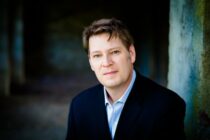
Sumner Thompson, bass-baritone
Praised for his “elegant style” (The Boston Globe), Sumner Thompson is one of today’s most sought-after baritones. He has performed across North America and Europe as a soloist with renowned ensembles such as Concerto Palatino, Tafelmusik, Apollo’s Fire, Les Boréades de Montréal, Les Voix Baroques, the King’s Noyse, Mercury Baroque, and the symphony orchestras of Charlotte, Memphis, and Phoenix. Recent highlights include Monteverdi’s Vespers of 1610 and the new Vespers of 1640 with the Green Mountain Project; Buxtehude’s Membra Jesu Nostri with Les Voix Baroques and Houston’s Mercury Baroque; Mozart’s Requiem at St. Thomas Church in New York City; a tour of Japan with Joshua Rifkin and the Cambridge Concentus; and Britten’s War Requiem with the New England Philharmonic. He most recently appeared with EMV last year in From War to Peace: Heinrich Schurz and His Time (November) and Festive Cantatas: JS Bach Magnificat (December).
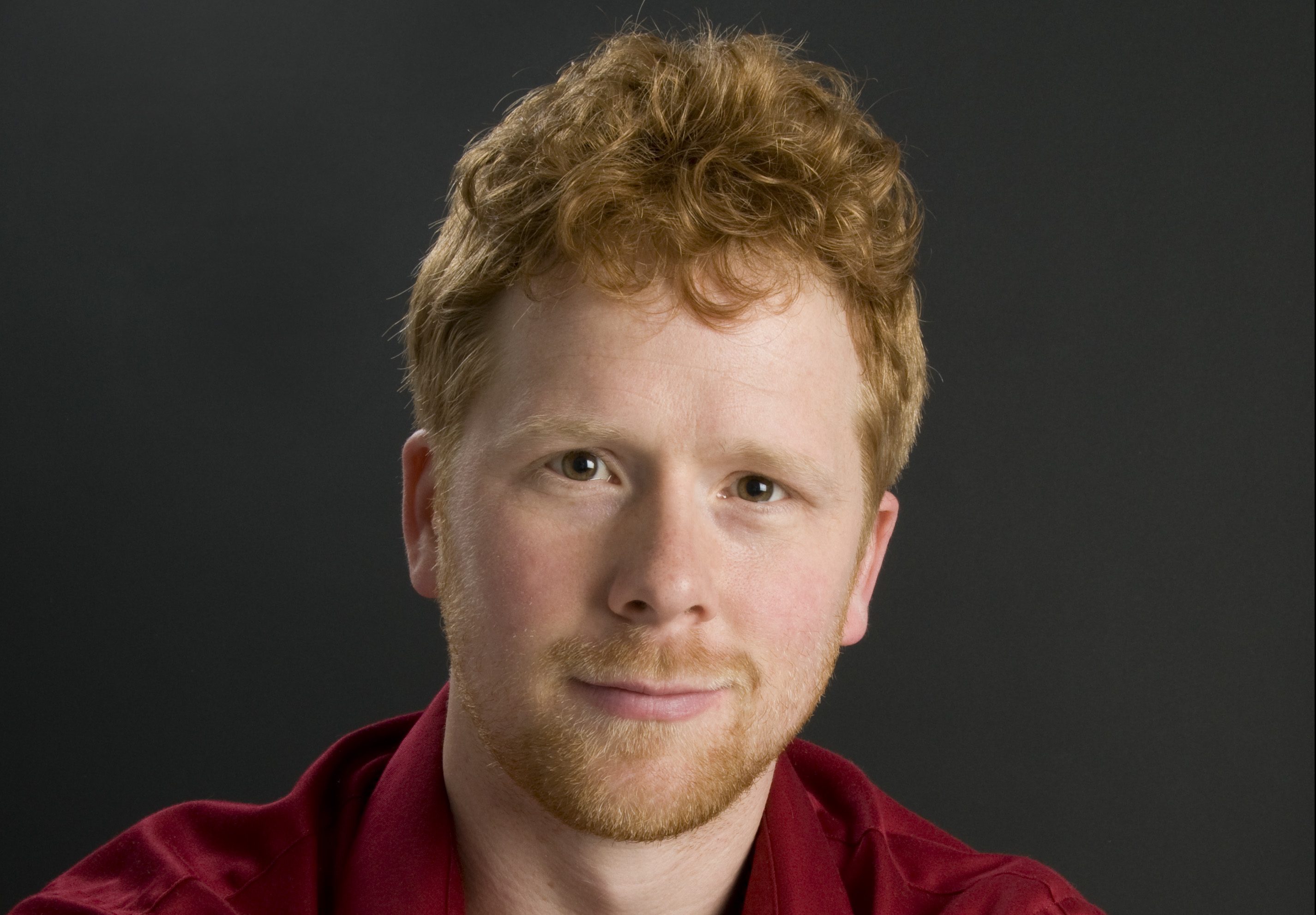
Ross Hauck, tenor
Tenor Ross Hauck is a specialist in sacred oratorio work, but is well-known for his versatility. His work in early music is often with Apollo’s Fire and Pacific MusicWorks. Recent concert credits include the symphonies of Baltimore, Phoenix, Dallas, Chicago, Grand Rapids, Kansas City, Portland, and the National Symphony. This season includes Carmina Burana with both the Seattle Symphony and the Hawaii Symphony, Messiah in both Cleveland and Seattle, Celtic Journey with the symphonies of Omaha and Edmonton (CA), and a UK tour of “Sugarloaf” mountain with Apollo’s Fire. Opera credits include lead roles with companies in Tacoma, Sacramento, Indianapolis, and Cincinnati, among others. An active recitalist, he has been heard live on PBS. Mr. Hauck is a distinguished alum of the Cincinnati-College Conservatory of Music, with further training at Tanglewood, Ravinia, Aspen and 2 seasons at the prestigious Filene Center at Wolf Trap. He is a former cellist, a professor of voice at Seattle University, and the music director at his home church in Washington state, where he lives with his wife and 4 children.