Christ Church Cathedral | Map
Nigel North, lute; Les Voix Humaines; Stacey Brown, composer
Star British lutenist Nigel North joins Canada’s now-legendary viol consort, Les Voix Humaines, for a performance of John Dowland’s 1604 Lachrimae. This iconic collection of passionate pavans, galiards, and almands is replete with musical effects, dissonances and suspensions that powerfully evoke the melancholic subjects that re-appear throughout Dowland’s compositions: the agonies of the soul, night, and darkness. This performance will also include the premiere of a new work by Quebec composer Stacey Brown commissioned for Les Voix Humaines by Early Music Vancouver.
“The group’s blend is soft-woven and wonderfully fibrous, full of textural interest. Extensive ornamentation throughout the disc and a rhetorical approach to line give the music a pleasing, madrigal-like freedom.” – Gramophone Magazine
Presented in collaboration with Music on Main’s Modulus Festival
This concert is generously supported by Johanna Shapira & John Geddes and Marianne Gibson
To view/download this programme, please click here.




Programme
Lachrimae
John Dowland (1563-1626)
Lachrimæ, or seaven Teares figured in seaven passionate Pavans […]
set forth for the Lute, Viols, or Violons, in five parts (1604)
Sir John Souch his Galiard
Lachrimæ Antiquae (Old tears)
Mr George Whitehead’s Almayn
Lachrimae Pavan – lute solo
Captaine Digorie Piper his Galiard
M. Henry Noel his Galiard
Lachrimæ Antiquae Novæ (Old tears renewed)
Sir John Langtons Pavan
Semper Dowland, semper dolens – lute solo
Lachrimæ Gementes (Sighing tears)
Lachrimæ Tristes (Sad tears)
INTERVAL
Premiere of a new work commissioned by EMV:
Stacey Brown (1976 – )
Lachrimae Viventium
(living tears, the tears of living, les larmes de la vie)
Lorasirme Ryny their Galliard
Lachrimae Coactae (Forced tears)
Lachrimæ Amantis (A Lover’s tears)
The Earl of Essex Galiard
In Nomine Farewell – lute solo
King of Denmarks Galliard
Lachrimæ Veræ (True tears)
Programme Notes
John Dowland
Little is known about John Dowland’s beginnings. Born in 1562 or 1563, there are arguments for both London and Dublin as his place of birth. His enviable international career started in 1580 when he became lutenist in the service of Sir Henry Cobham, Queen Elizabeth’s ambassador to the French court in Paris. Here he converted to Roman Catholicism, a move that would have lifelong consequences.
He attributed his unsuccessful bid to serve at Elizabeth’s court to his attachment to his Catholic faith. Elizabeth, a great admirer of Dowland’s musicianship, described him as “a man to serve any Prince in the world but an obstinate Papist”! He was obliged to pursue a very successful career in Europe while his family remained on the “precious stone set in a silver sea”.
Highly sought after as the foremost lutenist of his time, the poet, Richard Barnfield wrote that Dowland’s “heavenly touch upon the lute doth ravish human sense.” In 1598 Dowland became one of the highest paid servants to Christian IV of Denmark, whose musical court was the envy of Europe. Dowland’s huge salary allowed him to travel regularly to England to publish his latest volumes and to see his family, to the ire of the King of Denmark!
During his European adventure, Dowland, like other seemingly innocent musicians, was also involved in espionage. On top of his musical duties, he acted as a spy for Sir Robert Cecil, Queen Elizabeth’s Secretary of State, and was even offered a handsome sum by the Pope to spy on some heinous, Roman intrigue. He turned down that attractive proposition through a sense of loyalty to his Queen.
In 1606 Dowland was released from his duties at the Danish court and returned to England to serve as a member of James I’s musical entourage until his death in London in 1626.
Lachrimæ
Dowland’s Lachrimæ, or Seaven Teares, Figured in Seaven Passionate Pavans, featuring the saddest, descending tetrachord heard throughout the pavans, is an iconic work that defies the 21st-century concept of sound bites or tweets! Slow and rich in harmony with time for contemplation, the pavans unfold with increasingly exquisite and dissonant harmonies.
The sonnet:
Flow my tears, fall from your springs,
Exil’d for ever let me mourn;
Where night’s black bird her sad infamy sings,
There let me live forlorn…
The sonnet, Flow my tears, possibly penned by Dowland himself, appears first in his Second Booke of Songs or Ayres dated 1600. Based on the dance form of the pavan, Dowland composed several versions of the piece for solo lute, the first, Lachrimæ Pavan, appearing in 1596. Other composers borrowed the theme; John Bennet in his madrigal Weep oh mine eyes and Dowland’s Scottish colleague in Denmark, celebrated viol player, composer and mercenary soldier Tobias Hume, in his What greater grief, to name but a few.
Published in London in 1604, during Dowland’s years in Denmark, Lachrimæ or Seaven Teares is dedicated to Anne, Queen of Denmark. The title page includes the epigram “Aut Furet, aut Lachrimat, quem non Fortuna beavit,” or, “He whom Fortune has not blessed either rages or weeps.” In the preface Dowland writes, “Though the title doth promise teares, unfit guests in these joyfull times, yet no doubt pleasant are the teares which Musicke weepes, neither are teares shed always in sorrow, but some time in joy and gladnesse.” The collection also includes “divers other pavans, galliards and allemands,” which, in our concert, alternate with the Lachrimæ pavans and exquisite lute solos on which Dowland’s reputation was built.
Dowland’s Lachrimæ has become canon in the annals of consort music. “Unfit guests in these joyful times,” these seven tears of extreme intensity are lamentations beautifully expressing the deepest melancholy of the soul!
The programme includes a new 21st-century take on Lachrimæ by Montreal-based composer Stacey Brown, commissioned by Early Music Vancouver.
This performance is significantly different from most in that the music is ornamented in a style appropriate to the period and in defiance of a certain modern Puritanism that demands total adherence to the written page. The embellishments add expressive elegance and musical freedom to the performance that we hope enhances the audience’s “joy and gladnesse”!
Susie Napper, 2019
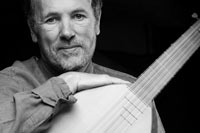
Nigel North, lute
Born in London, England, Nigel North has been Professor of Lute at the Early Music Institute, Indiana University, Bloomington (USA) since 1999. Previous positions included The Guildhall School of Music and Drama, London (1976-1996), Hochschule der Künste, Berlin (1993-1999) and the Royal Conservatory, Den Haag, (2006-2009).
Initially inspired at the age of seven by the early 60’s instrumental pop group “The Shadows”, Nigel studied classical music through the violin and guitar, eventually discovering his real path in life, the lute, when he was 15. Basically self-taught on the lute, he has been playing and teaching for nearly 50 years.
After hearing one of Nigel’s Bach recitals in London, Julian Bream recalled in 2002 “I remember going to a remarkable recital, one which I wish I had the ability to give: it was one of Nigel North’s Bach recitals, and I was bowled over by how masterful and how musical it was. A real musical experience, something you don’t always get from guitar and lute players and which, in general, is pretty rare.” Recordings include a four CD boxed set “Bach on the Lute” (Linn Records), four CDs of the lute music of John Dowland (Naxos), and a new ongoing series of music by Sylvius Weiss (BGS) and Francesco da Milano (BGS).
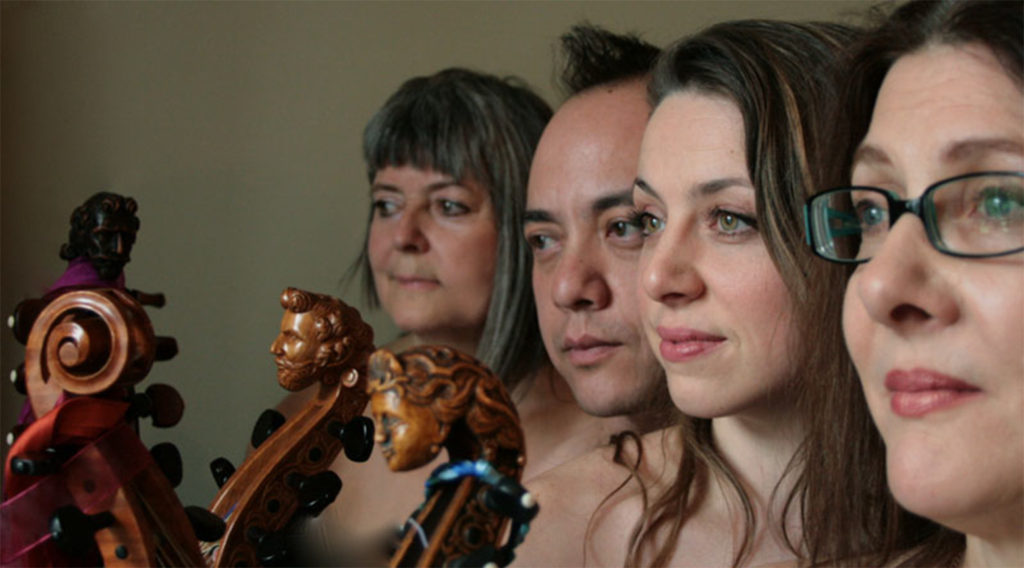
Les Voix Humaines
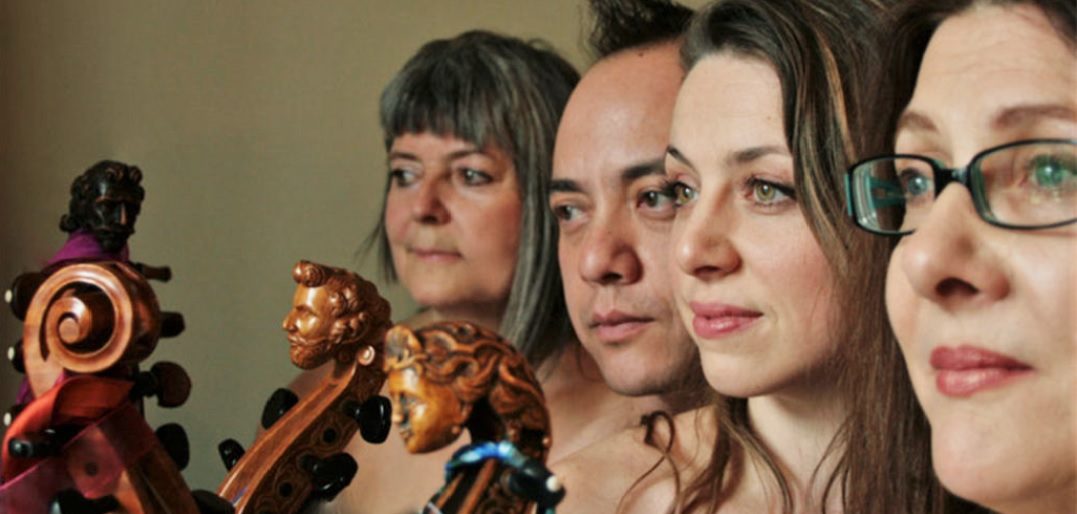
Recipients of numerous prizes, Susie Napper and Margaret Little, have thrilled audiences worldwide with dashing performances of early and contemporary music for viols since 1985. Their musical complicity has been compared to the skill of two trapeze artists or the telepathic communion of a pair of jazz saxophonists! They are renowned for their spectacular arrangements of a wide variety of music for two viols and have become a world reference for the music of Sainte-Colombe. Les Voix humaines has toured Canada, USA and Mexico, Europe, Australia, New Zealand, Israel, China and Japan, has recorded most of the repertoire for two equal viols and has worked with renowned musicians such as Bart and Wieland Kuijken, Charles Daniels, Eric Milnes, Skip Sempe, David Greenberg and Nigel North.
With colleagues Mélisande Corriveau and Felix Deak, Les Voix humaines Consort has been touring Europe and North America for the past several years. In 2017 the VH Consort toured in Mexico and its next venture is a Scandinavian and Eastern European tour in November.
Les Voix humaines has recorded over forty CDs to critical acclaim and has won prestigious awards (Diapason d’Or, Choc du Monde de la Musique, Repertoire-Classica 10, Goldberg 5, Classics Today 10/10, Prix Opus, etc). LVH Consort recordings include Purcell’s complete Fantasias, Bach’s Art of Fugue, Les Voix humaines’ own arrangement of Vivaldi’s Quatro Staggione, “4 Seasons, 4 Viols”, and Dowland’s Lachrimae.
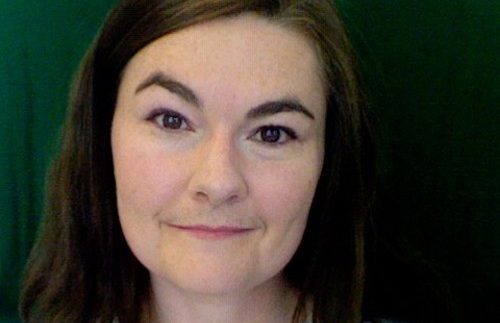
Stacey Brown, composer
Montreal-based Canadian composer Stacey Brown has been called “a composer to watch” (Broad Street Review) whose “considerable promise is apparent” (Philadelphia Inquirer). Her varied and versatile musical output – described as organic and deftly interwoven (Le Devoir), and “showing a gift for skillful orchestration” (Bachtrack) – includes opera and concert works, from solo to orchestra, as well as music for projects involving theatre, dance, and film. Winner of Symphony Nova Scotia’s Maria Anna Mozart Award (2019), the National Composition Prize of the Canadian University Music Society (2010), and the 1st and 3rd prizes of the Prix collégien de musique contemporaine (2016, 2018), Brown has had her works performed across Canada and in the United States by ensembles including the Philadelphia Orchestra (Yannick Nézet-Séguin), the Kamloops Symphony Orchestra (Dina Gilbert), l’Orchestre Métropolitain (Yannick Néset-Séguin), l’Orchestre de la Francophonie (Jean-Phillipe Tremblay), Bicycle Opera Project, VivaVoce (Peter Schubert), Fiolûtröniq, Ensemble Kô (Tiphaine Legrand), Pianos Galore Clyde Mitchell), and Erreur de type 27 (Katia Makdissi-Warren), as well as by performers including Daniel Cabena, Claudine Ledoux, Philippe Prud'homme, and Katelyn Clark. Brown’s premieres in 2019 include the trumpet concerto En soi, in and of itself (2019) with trumpeter Stéphane Beaulac and the Orchestre Métropolitain conducted by Nicolas Ellis; Lachrimae Viventium and Lorasirme Ryny Their Galliard for viol consort (2019) with Les Voix humaines; and Urgent Solitudes for voice, cello, and piano with mezzo-soprano Stéphanie Pothier, cellist Amanda Keesmaat, and pianist Rosalie Asselin. An adjunct professor of music and experienced French-English translator, Brown has also authored several music analysis articles published by L’Éducation musicale (France). Stacey Brown is a Professional Member of the Canadian League of Composers and an Associate Composer of the Canadian Music Centre, and holds composition degrees from the University of Victoria (BMUS) and the Université de Montréal (MMUS; DMUS).