Christ Church Cathedral | Map
Alexander Weimann | Sponsored by Bruce Munro Wright, O.B.C., harpsichord; Stephan MacLeod, bass-baritone
This recital offers two of Bach’s most iconic works for keyboard, the “French Overture” and the “Italian Concerto,” played by internationally acclaimed harpsichordist Alexander Weimann. Swiss baritone Stephan MacLeod joins Mr. Weimann for two virtuosic cantatas in the Italian style, one on each half, featuring the harpsichord as an equal partner – “Dalla Guerra Amorosa” by Handel and “Amore Traditore” by Bach.

Click here for information about parking around / transiting to Christ Church Cathedral
Programme
Johann Sebastian Bach (1685-1750): Overture in the French style bwv 831
Overture
Courante
Gavotte I / II
Passepied I / II
Sarabande
Bourrée I / II
Gigue
Echo
George Frideric Handel (1685-1759): Cantata “Dalla guerra amorosa” hwv 102a
Recitativo: Dalla guerra amorosa
Aria: Non v’alletti un occhio nero
Recitativo: Fuggite, sì fuggite
Aria: La bellezza è com’ un fiore
Recitativo / Finale: Fuggite, sì fuggite
INTERVAL
Johann Sebastian Bach: Italian Concerto bwv 971
Allegro
Andante
Presto
Johann Sebastian Bach: Cantata “Amore Traditore” bwv 203
Aria: Amore traditore
Recitativo: Voglio provar
Aria: Chi in amore ha nemica la sorte
Programme Notes
Johann Sebastian Bach published his Clavier-Übung II in 1735 consisting of two solo works for two-manual harpsichord – the Italian Concerto (Concerto nach Italienischen Gusto/Concerto after the Italian taste) and the French Overture (Ouverture nach franzosicher Art/Overture in the French style). Clavier-Übung can be translated as “keyboard practice”. Bach published four volumes:
I: Six partitas published separately (sold in one volume in 1731)
II: Italian Concerto and French Overture (1735)
III: Sometimes called the German Organ Mass (1739)
IV: Aria with diverse variations – Goldberg Variations (1741)
Far from purely pedagogical exercises, the works in these four collections are, like the Art of the Fugue and the Musical Offering, demonstrations of Bach’s total mastery and knowledge of the technical and stylistic musical conventions present in Europe in the first half of the 18th century.
French Overture: The title of the suite comes from the convention of starting French orchestral dance suites with an Overture. This movement replaces the Allemande that begins Bach’s other keyboard suites. With eleven movements, it is the longest keyboard suite Bach ever composed, wherein he includes optional dance movements both before and after the Sarabande. The inclusion of an extra movement after the Gigue as well, entitled “the echo”, is meant to exploit the loud and soft dynamics possible on a two-manual harpsichord. The dynamic indications (piano and forte) found throughout the work indicate where to switch manuals, providing child-like fun to harpsichordists in responding to the technical challenges of switching manuals at high speed. The similarity between this final movement to the beginning of the Italian Concerto connect the two compositions of Clavierübung II.
Bach had originally conceived Clavierübung I of consisting of seven partitas, the 7th being an early version of the French Ouverture with fewer ornaments and in C minor. When it came to the publication of Clavierübung I, however, he chose only 6 of the partitas and decided to release the missing 7th suite transposed and elaborated upon as one of the two major pieces in Clavierübung II. Here it is featured alongside another significant example of an orchestral piece transformed by Bach into a solo keyboard work – The Italian Concerto.
Cantata Dalla guerra amorosa HWV 102a:
The manuscript for this cantata dates from 1709 and was a copy made for the musical establishment of Marchese Francesco Ruspoli, one of several important patrons who supported Handel while he was living and working in Italy. Likely written for Ruspoli’s weekly musical gatherings, this secular cantata is reminiscent in theme to Handel’s Trionfo del Tempo (1707) and his Apolle e Dafne (1709), which also include exquisitely realized musings on the fading nature of physical beauty and the dangers inherent in love. Handel was beloved by the Italians and was referred to as “Il Caro Sassone” (The Dear Saxon) by his patron and the Italian public alike. His total immersion and love for Italian musical culture, and opera in particular, remained at the heart of his personal style for the rest of his life.
The Italian Concerto:
Throughout his life Bach took an interest in the concerto form, developed in Italy. The Italian Concerto demonstrates his masterful assimilation of the latest musical fashions into a language uniquely his own. One of Bach’s sternest critics, the composer and writer Johann Adolph Scheibe, was forced to admit: “This keyboard concerto is to be regarded as a perfect model of a well-designed solo concerto.” In composing a solo concerto in Italian style for the two-manual keyboard, Bach brilliantly manages to recreate in miniature the Italian “Concerto Grosso” or “contest effect” between a full instrumental ensemble and a soloist. The two manuals allow him to delineate clearly the solo line on one manual and the orchestral textures on the other.
Cantata Amore Traditore BWV 203:
Unlike Handel, who spent several years in Italy fully embracing its rich musical culture, J.S. Bach never made an Italian pilgrimage. He was nonetheless heavily influenced and impressed by the Italian musical style of the period. Through studying scores, he knew and adapted the music of, among others, Arcangelo Corelli, Tomaso Albinoni, Claudio Monteverdi, Antonio Vivaldi and Benedetto Marcello.
This secular cantata, also on the theme of treacherous love, dates from Bach’s time in Weimar (1718-1723). It is modeled on the Italian solo cantata tradition for voice and continuo, and its first performance and librettist are both unknown. That he only wrote two works using Italian text and no opera at all, demonstrates that though he was perfectly capable of writing convincingly in this style and in the Italian language as well, his heart and mind were somewhere else. The complex keyboard part in the final aria suggests it might have been written as an opportunity for the master to demonstrate his own extravagant keyboard skills.
Notes by Matthew White
Texts and Translations
Click here to view or download the texts and translations for this concert

Alexander Weimann | Sponsored by Bruce Munro Wright, O.B.C., harpsichord
The internationally renowned keyboard artist Alexander Weimann has spent his life enveloped by the therapeutic power and beauty of making music. Alex grew up in Munich. At age three he became fascinated by the intense magic of the church organ. He started piano at six, formal organ lessons at 12 and harpsichord at university (along with theatre theory, medieval Latin and jazz piano.) He is in huge demand as a director, soloist and chamber player, traveling the world with leading North American and European ensembles. He is Artistic Director of the Pacific Baroque Orchestra in Vancouver and teaches at the University of British Columbia where he directs the Baroque Orchestra Mentorship Programme.
Alex has appeared on more than 100 recordings, including the Juno-award-winning album “Prima Donna” with Karina Gauvin and Arion Baroque orchestra. His latest album series “The Art of Improvisation” (Volume 1: A Prayer for Peace; Volume 2: Ad libitum; and Volume 3: Canavian Variations, released on Redshift, 2024) unites his passions for both baroque music and improvisation on organ, harpsichord, and piano.
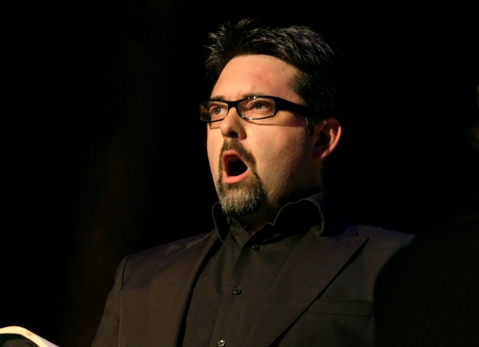
Stephan MacLeod, bass-baritone
Born in Geneva, Stephan MacLeod first played the violin and the piano and then studied singing with Kurt Moll in Cologne and with Gary Magby in Lausanne. Active all over the world as a renowned concert singer since his early twenties, his desire to conduct led him to establish his own ensemble, Gli Angeli Genève, in 2005. The ensemble has since become one of the most respected European ensembles specializing in period performance. In recent years, he has been invited to conduct a production of Cavalli’s La Calisto in Geneva, Mozart concerts at the Lausanne Opera, a production of Sondheim’s Sweeney Todd in Geneva, Bach Motets with the Netherlands Bach Society, Bach’s Matthew Passion in Switzerland, Germany, and the Netherlands, and orchestral works by Bach and Rameau with the Orchestre de la Suisse Romande.
As a soloist, Stephan is particularly active in the oratorio repertoire, particularly under Philippe Herreweghe, Gustav Leonhardt(†), Franz Brüggen(†), Masaaki Suzuki (Bach Collegium Japan), Jordi Savall, Philippe Pierlot (Ricercar Consort), Michel Corboz, Daniel Harding, Václav Luks, Sigiswald Kuijken, Konrad Junghänel (Cantus Cölln), Christophe Coin, Helmut Rilling, Frieder Bernius, Jos Van Immerseel, Jésus López Cobos, Hervé Niquet, Paul Van Nevel (Huelgas Ensemble), and with such ensembles as the Akademie für Alte Musik Berlin, Musica Antiqua Köln, the Freiburger Barockorchester, Tafelmusik, and the RIAS-Kammerchor. In the opera world, he has sung in several productions in Brussels (La Monnaie), Venice (La Fenice), Cologne, Bilbao, Edinburgh, and Geneva.
Stephan currently holds a professorship in singing at the Haute Ecole de Musique of Lausanne and is about to embark on a new concert series with Gli Angeli featuring performances of the complete Haydn Symphonies.