
Early Music Vancouver Summer Courses Contact Us Facebook Musick Blog Press Section Calendar of Events More About Us Calendar of Events Home page Your Support Site Map & Navigation  
 
   
Johannes Vermeer: “The Concert” (c.1664) - detail
 
in cooperation with
UBC Music
UBCMUSIC

Vancouver Early Music Programme 2012

“The Compleat Singer”:
Course Information & Repertoire Suggestions

An Outline - by Course Director Ray Nurse

A wide variety of music will be suitable for classes. In general, the course focuses on seventeenth century repertoire which set the foundations of baroque style and gesture. It is recommended that each participant have a variety of repertoire prepared, of contrasting styles, languages and forms. In general, any solo vocal repertoire from circa 1600 to 1750 is relevant.

Below is a list intended as a reminder of repertoire that is suitable.

In choosing repertoire to bring to the course, remember that sessions will be accompanied by a harpsichord or lute, so music with continuo accompaniment is more suitable than the editions with piano/orchestral reductions found in vocal albums. Always find the best edition possible – a good place to start is in standard editions of collected works of major composers, and editions prepared by responsible editors. It is important that one can differentiate between what the composer wrote and what the editor has added, and a facsimile of the original print or manuscript can be of great help in solving textual problems if one is available. (Locating/ preparing good performing editions is an important attribute of successful baroque performers and will be discussed in the course).

Both modern pitch A=440 and low pitch A=415 will be used at the course.

The Music Library of the UBC School of Music is located on the top floor of the Music building where the course is held, and will be open 9-5, Monday-Friday, but will be closed for British Columbia Day (the first day of the course, Monday, August 4). The Library has an excellent collection, and participants may expect to find much source material both in good modern editions and facsimiles. Photocopying facilities are easily available.

The following lists some types of music that are suitable for the course:

    • English Lute songs (Dowland, Campion, Rosseter, Danyel, etc.)
    • Songs from English Masques and continuo songs (Johnson, Lawes, Wilson, Lanier etc.)
    • Restoration continuo songs and theatre songs (Purcell, Blow, Eccles etc.)
    • English Operas and semi-operas (Dido and Aeneas, Venus and Adonis, The Fairy Queen, etc.)
    • Oratorios (Handel)

    • Italian monody and solo song (Caccini, Monteverdi, d’India, Peri, Frescobaldi, etc.)
    • Italian Opera (Monteverdi, Landi, Cavalli, Cesti, A. Scarlatti, Vivaldi, Handel, etc.)
    • Italian Cantatas (Rossi, Carissimi, Strozzi, Stradella, A.Scarlatti, etc.)
    • Oratorios and Sacred Music (Monteverdi, Carissimi, Legrenzi, Vivaldi, etc.)

    • French Airs de cour (Battaille, Guedron, Moulinie, Lambert, Le Camus, etc.)
    • French Cantatas ( Monteclair, Clerambault, Boismortier, etc.)
    • French Opera (Lully, Charpentier, Marais, Rameau, etc.)

    • German continuo song (Schütz, Hammerschmidt, Krieger, Albert, etc.)
    • German Opera (Kusser, Franck, Kaiser, Telemann, etc.)
    • German sacred music (Schütz, Rosenmüller, Buxtehude, Bach, Telemann, etc.)

    • Spanish Tonos & music from Operas and Zarzuelas

And, of course, so much more....

Don’t hesitate to be in touch with me directly if you have any questions, or need help locating suitable repertoire.

Ray Nurse, course director
(Telephone number & e-mail address available on request from workshops@earlymusic.bc.ca)

Description of principal classes and necessary preparation

Masterclass sessions with Ellen Hargis

Each participant will sing three times in masterclass (masterclass lessons will be approx. 30 minutes), with repertoire chosen by the student. Pieces presented are considered works-in-progress but should be well prepared. Memorisation is not recommended for masterclass repertoire as we prefer pieces which are still in a flexible learning stage. In order to have adequate time, chosen pieces should not be too long, and single movements are preferred. Participants generally run their pieces with the designated accompanist in a coaching session prior to the masterclass, so that the accompanist is also prepared and the music is in order.

Accompanists prefer clearly edited scores with vocal part and figured bass, rather than piano realisations and transcriptions. Make sure you have translations of all foreign language texts, and that you have a clear copy of the music available – copies will be needed for the accompanist and Ms. Hargis, and we also make copies for the entire class.

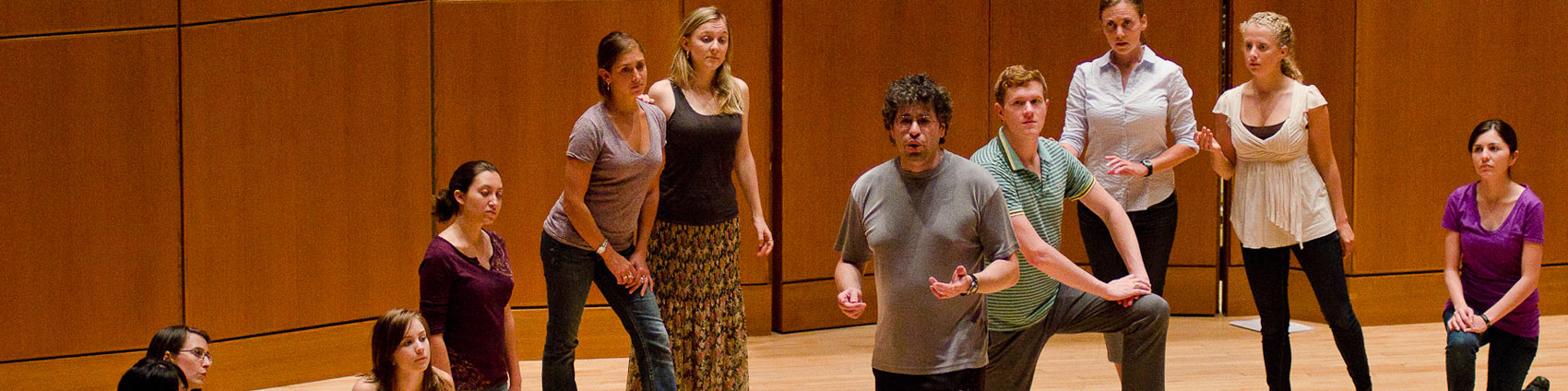
Gesture and Stage Movement with Steven Adby

For this class, please bring soft, flexible shoes (not training/running shoes), and also shoes with a heel of about 1-2" max: men may bring shoes with a normal size heel. If available, it would also be helpful if the ladies could bring a full length (ankle length) ‘full’ skirt (i.e. one not tight). Classes will begin with ensemble work in the basics of baroque gesture before applying it in staged scenes and excerpts .

Mr. Adby uses selections from notable baroque works as the focus of the class: especially selected scenes from Henry Purcell’s Dido and Aeneas, along with other works TBA. The goal will not be to reach a finished performance, but to explore gesture and staging techniques using the excerpts as material. When enrolment is finalised and the voice types of participants have been confirmed, further details of specific scenes with role assignments will be sent out along with music. Some music memorisation will be necessary in preparation, and more will be assigned from class to class. As general preparation it is suggested that students familiarise themselves with the entire score of Dido and Aeneas (listen to a good recording with music in hand), and particularly notice the roles that suit their voice type.

The first day’s class will introduce basic elements of baroque gesture using the beginning of the Grove Scene (Act II scene 2, “Thanks to these lonesome vales”) from Dido and Aeneas: all students should memorize the words and melody of this section (including the chorus – choose which part suits you best) before coming to the course (music will be sent out).

Coaching sessions

Each participant will receive two 30 minute coaching sessions each week with Michael Jarvis, Chris Bagan (harpsichords) or Ray Nurse (lute). Choice of the repertoire or questions to be considered are up to the participant, but music to be sung in masterclass should be looked at in these sessions.

Private Lessons with Ellen Hargis and Steven Adby

During the course, each full participant will receive two lessons (45 min and 30 min.) with Ellen Hargis. Material to be studied in these lessons (whether repertoire or technical study) should be decided in consultation with Ms. Hargis after the participant sings in masterclass. Each participant will also have a private session (45 min.) with Steven Adby, for which no preparation is necessary.

“The Modern Baroque Performer” – with Ray Nurse and faculty

A daily class/discussion will touch on a number of topics relevant to singers performing baroque music: aesthetics, performance context, rhetoric, ornamentation, historical vocal technique, choosing editions & reading facsimiles of early music, career issues, audition procedures, or other topics TBA. No preparation is necessary for this class.


On-Line Course & Accommodation Registration via our secure connection

Click here for on-line Course and Accommodation Registration.
Remember to also submit the required materials as outlined in our Application Checklist.


Brochure Download

Click here to download a printable PDF file of the brochure